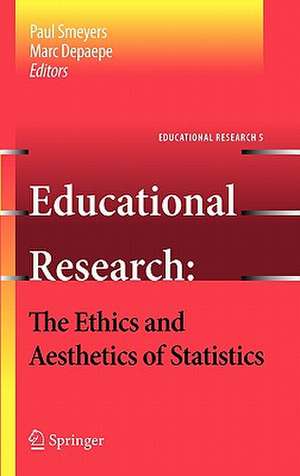
Educational Research
Autor Paul Smeyers Editat de Marc Depaepeen Limba Engleză Hardback – 30 dec 2010
Preț: 636.45 lei
Preț vechi: 748.76 lei
-15%
Puncte Express: 955
Carte tipărită la comandă
Livrare economică 06-20 noiembrie
Livrare prin curier în România Termenul estimat este afișat lângă disponibilitate.
Transport gratuit pentru acest produs Plată online sau ramburs, în funcție de opțiunile comenzii.
Retur gratuit în 14 zile Comandă securizată și suport în română.
Specificații
ISBN-13: 9789048198726
ISBN-10: 9048198720
Pagini: 224
Ilustrații: VIII, 224 p.
Dimensiuni: 162 x 242 x 23 mm
Greutate: 0.51 kg
Ediția:2010
Editura: Springer
Locul publicării:Dordrecht, Netherlands
ISBN-10: 9048198720
Pagini: 224
Ilustrații: VIII, 224 p.
Dimensiuni: 162 x 242 x 23 mm
Greutate: 0.51 kg
Ediția:2010
Editura: Springer
Locul publicării:Dordrecht, Netherlands
V-ar putea interesa
-
 The Demands of Liberal EducationMeira Levinson-28%Preț: 385.28 lei537.96 lei
 -
 Understanding History TeachingChris Husbands-29%Preț: 169.57 lei239.27 lei
 -
 Education, Philosophy and the Ethical EnvironmentGraham HaydonPreț: 462.25 lei
 -
 Preț: 341.29 lei
 -
 Knowmad SocietyJohn W. MoravecPreț: 141.30 lei
 -
 Blackwell Guide to the PhilosoAlison SmithPreț: 321.76 lei
 -
 The Passionate Mind of Maxine Greene: 'I am ... not yet'William F. Pinar-15%Preț: 458.95 lei539.94 lei
 -
 Global Trends in Educational PolicyDavid P. Baker-9%Preț: 738.63 lei811.68 lei
 -
 Leadership for a Better WorldNclp (National Clearinghouse for Leadership Programs)Preț: 328.63 lei
 -
 Educating the Reflective PractitionerDonald A. SchonPreț: 301.44 lei
 -
 Pedagogy of IndignationPaulo FreirePreț: 385.78 lei
 -
 Beyond Learning: Democratic Education for a Human FutureGert J. J. BiestaPreț: 403.72 lei
 -
 Preț: 191.24 lei
 -
 The Magic of MetaphorNick OwenPreț: 131.80 lei
Public țintă
ResearchCuprins
Representation or Hard Evidence? The Use of Statistics in Education and Educational Research.- The Lure of Statistics for Educational Researchers.- Dazzling Statistics? On the University Expansion in Flanders and the Need for Research into the History of Education that Transcends Quantifying Sociology.- Child Maltreatment in the Last 50 Years: The Use of Statistics.- Constructing Social Unity and Presenting Clear Predictions: The Promise of Public Opinion Pollsters to Measure and Educate Society.- n = 1: The Science and Art of the Single Case in Educational Research.- To Frame the Unframable: Quantifying Irregular Migrants’ Presence.- European Citizenship and Evidence-Based Happiness.- The Persuasive Power of Figures and the Aesthetics of the Dirty Backyards of Statistics in Educational Research.- The Good, the Beautiful and the Literate: Making Statistics Accessible for Action.- Statistics and the Inference to the Best Explanation: Living Without Complexity?.- Performativity, Statistics and Bloody Words.- A Bubble for the Spirit Level: Metricophilia, Rhetoric and Philosophy.- Calling to Account.
Textul de pe ultima copertă
Statistics are everywhere. Their power and their undoubted efficacy in many areas have given rise to faith in measurement and metrics. More of them will tell us all that we need to know. Their use carries with it a number of presuppositions: that reality can be satisfactorily represented and that it can be controlled or the risks managed. The papers in this book interpret the ethics and aesthetics of statistics in terms of representation, visualisation and accessibility, focus on the appeal of ‘simplicity’, of technical languages, numbers, diagrams and pictures, and pay attention to their connection with action plans. The book explores what has made educational researchers dependent on statistics, and deals with their use in areas such as the prevalence of maltreatment of children, European citizenship, well-being and happiness, illegal migrants, and university expansion. There is discussion of how the quest for more and better statistics finds its voice in policy initiatives that become slogans, and how public opinion polls are used to rationalise political decision-making. Can a more limited and modest use be made of statistics which does not deflect attention away from education’s core business and which does not destroy the local practical knowledge that on which good education is based?‘Smeyers and Depaepe continue to bring together a significant international group of educational philosophers and historians on topics of importance to researchers. This fifth volume in their series takes up the ‘gold standard’ use of statistics in case studies not contributed elsewhere. I highly recommend this text to counter a current over-emphasis on technique in research methodology. Use of statistics remains but herein under new, insightful conceptualizations.’Lynda Stone, Philosophy of Education, University of North Carolina at Chapel Hill, USA‘Once again, Depaepe and Smeyers succeeded in bringing together distinguished international andcross-disciplinary scholars exploring very timely and critical issues in current educational research. This is a groundbreaking book on a theme that can’t be ignored by educational researchers and those interested in a better understanding of the culture of science and science as culture. Moreover, the present book instigates to study history of educationalresearch, a limited but developing field, and invites reflection to those who are sometimes too reliant on number crunching as a mode of interpretation and rather credulous in the acceptance of institutional records.Frank Simon, Faculty of Psychology and Educational Sciences, Ghent University, Belgium This publication, as well as the ones that are mentioned on the preliminary pages of this work, were realized by the Research Community (FWO-Vlaanderen/Research Foundation Flanders, Belgium) Philosophy and History of the Discipline of Education: Faces and Spaces of Educational Research.
Caracteristici
This book is provocative and original as it challenges prevailing ideas about the ‘application’ of philosophy and history of education Demonstrates in a unique way how philosophical and historical approaches are relevant for the practice and theory of education Takes the debate of the historical and philosophical complexities and constraints of the discourse of educational research and the use of statistics
Recenzii
For some years both governments and Educational research associations such as AERA have subscribed to a view of the relationship between educational research and educational practices as needing to be linear and causal. The emphasis on RCTs and research informed decision-making and practice was going to shape educational rationally hence making it more effective. Central to this drive has been the psychology of education with its emphasis on transforming our understanding of brains and minds into sets of technologies. Increasingly it witnesses the superimposition of the neurological on the psychological. Such moves pay little attention to an inescapable and conditioning feature of education – that it is always a normative practice shaped everywhere by the kinds of things a society thinks or determines that it wants. While psychological and other forms of quantitative research are likely to offer important insight into the practices of education they will successfully do so only to the extent that they take seriously the contextual and related normative conditions of educational practices. In this edited volume Smeyers and Depaepe and their colleagues offer a timely intervention subjecting to serious interrogation the current passion to see particular, often aetiolated, impulses to reduce educational scholarship to a series of causal regularities immune to the complexities of actual lived educational encounters and practices. They argue carefully for the reinstatement of the central actor in education- the student as a complex, subtle, context located being whose education depends on more than statistical generalisations. Lest this volume be considered, in its turn, a collection of rhetorically freighted abstractions the essays here give considerable concrete expression to the concerns about the emergence of particular kinds of psychology and its attractiveness to the ‘modern’ mind. From Depaepe’s paper on thehistorical attractiveness of psychology, and its need for its grand theories to be modified by an attentiveness to everyday life, to Kraft’s challenge to educational theory, which has allowed the language of neuroscience to dominate it rather easily, the essays in this volume offer careful and consider attention to one of the most important issues in contemporary education. Anyone who wants to think seriously about some of the most pressing issues in educational research and practice will welcome this important and insightful collection. Smeyers and Depaepe are to be thanked for brining together this timely contribution.
James C Conroy, University of Glasgow, United Kingdom
The attraction of psychology surpasses both in scope and in time the short and limited history of the science of education. Already during the 17th century – long before Pädagogik became an academic ‘scientific’ discipline – the approach of the child bears the mark of religious expectations cherishing ‘the treasures of her soul’. What covertly preceded or could precede, i.e., the turning of the soul towards the grace of God, shall impose itself in a normative sense on education. Modern educational discourses expect from psychology infallible absolute directions for and justifications of education and childrearing. In as far as contemporary educational science embraces the architecture of such a concept of education it sides with a theological cultural legacy and speaks the theological language of education. It is this language and its architecture that is critically discussed in this interesting collection.
Fritz Osterwalder, Universität Bern,Switzerland
James C Conroy, University of Glasgow, United Kingdom
The attraction of psychology surpasses both in scope and in time the short and limited history of the science of education. Already during the 17th century – long before Pädagogik became an academic ‘scientific’ discipline – the approach of the child bears the mark of religious expectations cherishing ‘the treasures of her soul’. What covertly preceded or could precede, i.e., the turning of the soul towards the grace of God, shall impose itself in a normative sense on education. Modern educational discourses expect from psychology infallible absolute directions for and justifications of education and childrearing. In as far as contemporary educational science embraces the architecture of such a concept of education it sides with a theological cultural legacy and speaks the theological language of education. It is this language and its architecture that is critically discussed in this interesting collection.
Fritz Osterwalder, Universität Bern,Switzerland