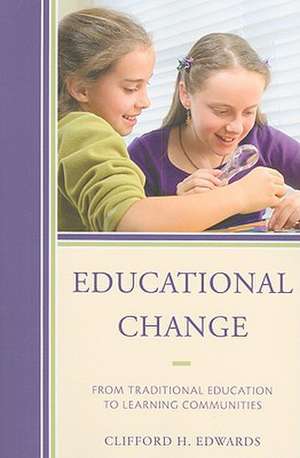
Educational Change: From Traditional Education to Learning Communities
Autor Clifford H. Edwardsen Limba Engleză Paperback – 16 ian 2011
Preț: 304.56 lei
Preț vechi: 389.44 lei
-22%
Puncte Express: 457
Carte tipărită la comandă
Livrare economică 04-18 decembrie
Livrare prin curier în România Termenul estimat este afișat lângă disponibilitate.
Transport gratuit de la 400.00 lei Plată online sau ramburs, în funcție de opțiunile comenzii.
Retur gratuit în 14 zile Comandă securizată și suport în română.
Specificații
ISBN-13: 9781607099888
ISBN-10: 1607099888
Pagini: 201
Dimensiuni: 155 x 236 x 13 mm
Greutate: 0.33 kg
Editura: Bloomsbury Publishing
Colecția R&L Education
Locul publicării:New York, United States
ISBN-10: 1607099888
Pagini: 201
Dimensiuni: 155 x 236 x 13 mm
Greutate: 0.33 kg
Editura: Bloomsbury Publishing
Colecția R&L Education
Locul publicării:New York, United States
Cuprins
Chapter 1-Philosophical Issues Regarding Curriculum and Instruction
Chapter 2-Issues Regarding Discipline
Chapter 3-School Discipline and Societal Implications
Chapter 4-Student Assessment in Learning Communities
Chapter 5-The Need for Change
Chapter 6-Instruction and Discipline in Learning Communities
Chapter 7-Instructional Leadership and Teacher Development
Chapter 8-Schoolwide Discipline and Outside Communities
Chapter 9-Issues Regarding a Transition to Learning Communities
Chapter 2-Issues Regarding Discipline
Chapter 3-School Discipline and Societal Implications
Chapter 4-Student Assessment in Learning Communities
Chapter 5-The Need for Change
Chapter 6-Instruction and Discipline in Learning Communities
Chapter 7-Instructional Leadership and Teacher Development
Chapter 8-Schoolwide Discipline and Outside Communities
Chapter 9-Issues Regarding a Transition to Learning Communities
Recenzii
Dr. Edwards presents a convincing case for the power of learning communities to more genuinely reflect the nature of the broader American society and to more authentically empower students as learners. How else can it be than the means necessarily being consistent with the ends? 'Shades of John Dewey,' you might say! Yes, but more validly, the research findings of Jean Piaget and Lev Vygotsky is extensively actualized. That is, knowledge is constructed by the individual child/learner, while immersed in a social context, whether family or school. Traditional education has always ignored how children truly learn resulting in very limited learning outcomes, while the classroom itself has often been a scene of contrary wills between teacher and student.
This book should be read by all who are involved with the education of our youth and who are deeply concerned about the widespread failure of our schools to meet student personal, social, and academic needs. It is a must read for teachers and administrators. Dr. Edwards has carefully reviewed and evaluated instructional theories and practices, both past and present, dealing with discipline, motivation, curriculum, evaluation, and moral development and has found them, at best, ineffective and, at worst, punitive and damaging to students' self confidence and motivation to learn. The creation of 'learning communities'-where intrinsic motivation and autonomy become central to the learning process and where students, teachers, and administrators work together in identifying and meeting student needs in a cooperative manner-provides a comprehensive road map for solving the current educational malaise where a 'one size fits all,' No Child Left Behind, teaching to the test mentality permeates our educational system. Change will not come easily. It will require a seismic shift in our attitudes and behaviors. But it must be done if our students are to reach their full potential as knowledgeable, autonomous, fully empowered contributors to our democratic society.
Edwards (formerly, science education, Illinois State Univ. and Brigham Young Univ.) has written an enlightening book for school administrators, teachers, and even parents who agree that educational change is long overdue. Traditional educational practices and standardized tests are analyzed and critiqued. Ideas that place emphasis on collaboration, collective thinking, and goal-orientated administration are presented. These are just some of the elements that can transform traditional schools into learning communities. Among the topics addressed is the assertion that teachers should consider the learning style of students and that learning should be more meaningful and based on real life. Educators will agree with Edwards's idea that discipline and instruction should be implemented simultaneously. This reviewer is impressed with how the author suggests connecting the classroom to the community so that students will feel like they can solve real-world problems. Summing Up: Highly recommended. All undergraduate, graduate, and research collections.
This book should be read by all who are involved with the education of our youth and who are deeply concerned about the widespread failure of our schools to meet student personal, social, and academic needs. It is a must read for teachers and administrators. Dr. Edwards has carefully reviewed and evaluated instructional theories and practices, both past and present, dealing with discipline, motivation, curriculum, evaluation, and moral development and has found them, at best, ineffective and, at worst, punitive and damaging to students' self confidence and motivation to learn. The creation of 'learning communities'-where intrinsic motivation and autonomy become central to the learning process and where students, teachers, and administrators work together in identifying and meeting student needs in a cooperative manner-provides a comprehensive road map for solving the current educational malaise where a 'one size fits all,' No Child Left Behind, teaching to the test mentality permeates our educational system. Change will not come easily. It will require a seismic shift in our attitudes and behaviors. But it must be done if our students are to reach their full potential as knowledgeable, autonomous, fully empowered contributors to our democratic society.
Edwards (formerly, science education, Illinois State Univ. and Brigham Young Univ.) has written an enlightening book for school administrators, teachers, and even parents who agree that educational change is long overdue. Traditional educational practices and standardized tests are analyzed and critiqued. Ideas that place emphasis on collaboration, collective thinking, and goal-orientated administration are presented. These are just some of the elements that can transform traditional schools into learning communities. Among the topics addressed is the assertion that teachers should consider the learning style of students and that learning should be more meaningful and based on real life. Educators will agree with Edwards's idea that discipline and instruction should be implemented simultaneously. This reviewer is impressed with how the author suggests connecting the classroom to the community so that students will feel like they can solve real-world problems. Summing Up: Highly recommended. All undergraduate, graduate, and research collections.