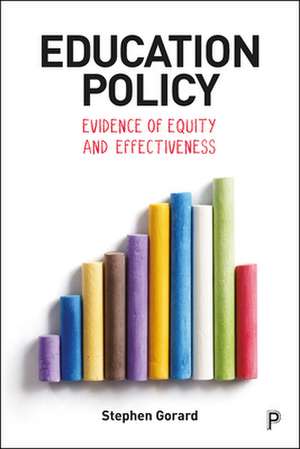
Education Policy: Evidence of Equity and Effectiveness
Autor Stephen Gorarden Limba Engleză Hardback – oct 2018
What has been done to achieve fairer and more efficient education systems, and what more can be done in the future? In Education Policy, Stephen Gorard provides a comprehensive examination of crucial policy areas for education—such as differential outcomes, the poverty gradient, and the allocation of resources to education—to identify likely causes of educational disadvantage among students and lifelong learners. This analysis is supported by twenty years of extensive research in the United Kingdom as well as across Europe, the United States, Pakistan, and Japan.This rich and approachable brings invaluable insights into the underlying problems within education policy and proposes practical solutions for a brighter future.
Preț: 684.86 lei
Preț vechi: 889.43 lei
-23%
Puncte Express: 1027
Carte tipărită la comandă
Livrare economică 18 noiembrie-02 decembrie
Livrare prin curier în România Termenul estimat este afișat lângă disponibilitate.
Transport gratuit pentru acest produs Plată online sau ramburs, în funcție de opțiunile comenzii.
Retur gratuit în 14 zile Comandă securizată și suport în română.
Specificații
ISBN-13: 9781447342144
ISBN-10: 1447342143
Pagini: 224
Dimensiuni: 159 x 235 x 20 mm
Greutate: 0.54 kg
Editura: Bristol University Press
Colecția Policy Press
ISBN-10: 1447342143
Pagini: 224
Dimensiuni: 159 x 235 x 20 mm
Greutate: 0.54 kg
Editura: Bristol University Press
Colecția Policy Press
Notă biografică
Stephen Gorard is professor of education and public policy at Durham University.
Recenzii
“A rather remarkable book by a rather remarkable academic. I know that students, education practitioners, and researchers will make good use of this book; I sincerely hope that it falls into the hands of politicians and policy-makers where it may interrupt some of the policy-problems it identifies.”