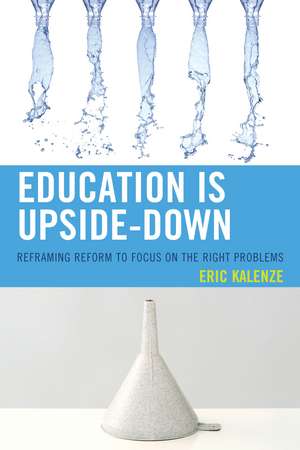
Education Is Upside-Down: Reframing Reform to Focus on the Right Problems
Autor Eric Kalenzeen Limba Engleză Hardback – 13 oct 2014
Recomandăm acest volum ca referință profesională esențială pentru decidenții din politici educaționale și cadrele didactice interesate de reforma sistemică. Education Is Upside-Down de Eric Kalenze nu este doar o critică a sistemului actual, ci o analiză riguroasă a modului în care filozofiile pedagogice din ultimul secol au creat o discrepanță între școală și nevoile societății. Observăm o abordare care refuză simplificările obișnuite ale „jocului de vinovății” între practicieni și reformatori, preferând să descâlcească nodul complex al educației prin argumente bazate pe date și experiență clinică.
Structura narativă este construită în jurul metaforei „pâlniei”, un instrument conceptual prin care Eric Kalenze explică fluxul instrucțional și erorile de implementare. Primele capitole, precum „Of Mismatches and Missions”, stabilesc cadrul teoretic al nealinierii, în timp ce secțiunile mediane („Building Skyscrapers on Sand”) analizează de ce reformele tehnice eșuează atunci când fundația ideologică este șubredă. Finalul cărții oferă o perspectivă constructivă, propunând un model ideal pentru viitor și acțiuni concrete care pot fi aplicate la nivel local.
Această lucrare completează perspectiva oferită de What Is Wrong With Our Schools? de Daniel Buck, adăugând o dimensiune administrativă și sistemică mai pronunțată. În timp ce Buck se concentrează pe ideologia care sărăcește educația la nivel de clasă, Kalenze extinde analiza către mecanismele de responsabilitate și structurile de management. Education Is Upside-Down reușește să pună sub semnul întrebării „adevăruri” acceptate de decenii, oferind o lectură densă, dar necesară pentru cei care doresc să înțeleagă de ce, în ciuda resurselor investite, rezultatele rămân adesea neschimbate.
Preț: 470.70 lei
Preț vechi: 642.47 lei
-27%
Carte tipărită la comandă
Livrare economică 20 noiembrie-04 decembrie
Specificații
ISBN-10: 147580993X
Pagini: 185
Dimensiuni: 161 x 236 x 20 mm
Greutate: 0.41 kg
Editura: Bloomsbury Publishing
Colecția Rowman & Littlefield
Locul publicării:New York, United States
V-ar putea interesa
-
 Educational Leadership PreparationG. Jean-Marie-8%Preț: 406.67 lei442.04 lei
 -
 The Routledge International Handbook of the Sociology of EducationMichael W. Apple-15%Preț: 614.73 lei723.21 lei
 -
 Preț: 440.19 lei
 -
 Language Policies in Education: Critical IssuesJames W. Tollefson-15%Preț: 518.89 lei610.47 lei
 -
 Engaging StudentsSchlechtyPreț: 229.37 lei
 -
 Gentrification and SchoolsJ. StillmanPreț: 303.33 lei
 -
 Wasted: Why Education Isn't EducatingProfessor Frank Furedi-40%Preț: 82.98 lei138.39 lei
 -
 -27%Preț: 1218.59 lei1660.24 lei
 -
 -26%Preț: 395.78 lei532.03 lei
 -
 School WarsMelissa BennPreț: 69.74 lei
 -
 Lockdown HighAnnette FuentesPreț: 164.36 lei
 -
 Transforming Education Policy: Shaping a Democratic FuturePhilip A. WoodsPreț: 259.31 lei
 -
 -18%Preț: 111.52 lei136.73 lei
 -
 Second International Handbook of Educational ChangeAndy Hargreaves-18%Preț: 5470.68 lei6671.57 lei
De ce să citești această carte
Adresată cercetătorilor și practicienilor, această carte oferă o diagnoză lucidă a eșecurilor din reforma școlară. Cititorul câștigă o înțelegere profundă a modului în care misiunea școlii a fost distorsionată și primește un set de acțiuni concrete pentru a realinia practicile de la clasă cu obiectivele sociale pe termen lung. Este un instrument critic pentru oricine dorește să depășească soluțiile superficiale în favoarea unei schimbări reale, structurale.
Descriere
Cuprins
Acknowledgments
Chapter 1
Of Mismatches and Missions
Chapter 2
How To Use a Funnel
Chapter 3
The Funnel Tips: A Brief Annotated History
Chapter 4
A Meaningless Engagement
Chapter 5
Building Skyscrapers on Sand
Chapter 6
How (Schools Should Help) Children Succeed
Chapter 7
What Gets Measured Gets Done (.but won't necessarily change anything)
Chapter 8
Outside the Box, But Standing Still
Chapter 9
Too Scattered to Matter
Chapter 10
Righting the Funnel: Issues to Solve, Actions to Take
Chapter 11
Funnel of the Future: An Audacious Ideal Model and What to Do Locally, Starting Today
Chapter 12
An Awesome Responsibility
Notes
Bibliography
About the Author
Recenzii
Our earliest thinkers about public education saw schools as indispensable institutions, endowing America's children with common knowledge, practical skills, civic dispositions and habits. We went to school to become Americans. Today, Eric Kalenze correctly observes, schools exist to provide the whole development of each individual child. The result is a kind of mission creep. We are doing too many things and none of them well. Current reform efforts are missing the mark badly, as did progressive education reform that preceded them. Kalenze's wise book Education Is Upside Down describes how American education lost its way and its founding purpose-and how we might get them back.
In Education Is Upside Down, Eric Kalenze offers a provocative critique of today's reform efforts. He argues that real transformation will require rethinking the larger purposes of education-that anything less will disappoint. This intriguing volume touches on educational philosophy, history, and some of the highlights of contemporary reform, while closing with a bracing call that we ask students themselves to share in the accountability we ask of educators.
In this broad survey of education in America today, Eric Kalenze offers a refreshing diagnosis of what is wrong, why and when it happened, and what to do. He is equally adept at tracing the genesis of bad ideas 100 years back as he is at analyzing the heated debate over Common Core. The arguments are brisk, the prose limpid--an excellent primer for young educators looking to understand current conditions.