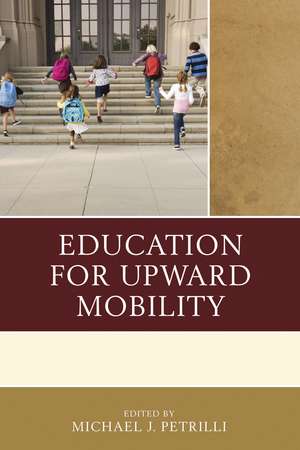
Education for Upward Mobility
Editat de Michael J. Petrillien Limba Engleză Paperback – 8 dec 2015
There's little doubt that education and opportunity are tightly joined in the twenty-first-century economy. Almost every week brings a new study demonstrating that highly skilled workers are being rewarded with stronger pay and excellent working conditions, while Americans with few skills are struggling mightily.
Expanding educational achievement, then, appears to be a clear route to expanding economic opportunity. Yet much of our public discourse ends there. Of course more young Americans need better education in order to succeed. But what kind of education? Is the goal "college for all"? What do we mean by "college"? Do our young people mostly need a strong foundation in academics? What about so-called "non-cognitive" skills? Should technical education make a comeback?
Education for Upward Mobility provides fresh perspectives and concrete ideas for policymakers at every level of government; for leaders and policy analysts in education reform organizations in the states and in Washington; for philanthropists and membership associations; and for local superintendents and school board members. It combines the latest research evidence on relevant topics with in-depth explorations of promising practices on the ground, in real places, achieving real successes.
Preț: 222.33 lei
Preț vechi: 294.03 lei
-24%
Puncte Express: 333
Carte tipărită la comandă
Livrare economică 21 noiembrie-05 decembrie
Livrare prin curier în România Termenul estimat este afișat lângă disponibilitate.
Transport gratuit de la 400.00 lei Plată online sau ramburs, în funcție de opțiunile comenzii.
Retur gratuit în 14 zile Comandă securizată și suport în română.
Specificații
ISBN-13: 9781475819762
ISBN-10: 1475819765
Pagini: 274
Dimensiuni: 153 x 229 x 20 mm
Greutate: 0.41 kg
Editura: Bloomsbury Publishing
Colecția Rowman & Littlefield
Locul publicării:New York, United States
ISBN-10: 1475819765
Pagini: 274
Dimensiuni: 153 x 229 x 20 mm
Greutate: 0.41 kg
Editura: Bloomsbury Publishing
Colecția Rowman & Littlefield
Locul publicării:New York, United States
Cuprins
Introduction
Part I: Transcending Poverty through Education, Work, and Personal Responsibility
Chapter 1: "Education and the 'Success Sequence,'" Ron Haskins
Chapter 2: "Big Payoff, Low Probability: Postsecondary Education and Economic Mobility in
America," Andrew Kelly
Chapter 3: "The Certification Revolution," Tamar Jacoby
Chapter 4: "How Apprenticeship Can Spur Upward Mobility in the United States," Robert Lerman
Part II: Multiple Pathways in High School: Tracking Revisited?
Chapter 5: "Small High Schools of Choice," Peter Meyer
Chapter 6: "College Prep High Schools for the Poor," Joanne Jacobs
Chapter 7: "High Quality Career and Technical Education," Robert Schwartz and Nancy Hoffman
Part III: The Early Years
Chapter 8: "Starting at Five is Too Late: Early Childhood Education and Upward Mobility," Elliot Regenstein, Bryce Marable, and Jelene Britten
Chapter 9: "Poverty-Fighting Elementary Schools: Knowledge Acquisition is Job One," Robert Pondiscio
Chapter 10: "Tracking in Middle School," Tom Loveless
Conclusion
Part I: Transcending Poverty through Education, Work, and Personal Responsibility
Chapter 1: "Education and the 'Success Sequence,'" Ron Haskins
Chapter 2: "Big Payoff, Low Probability: Postsecondary Education and Economic Mobility in
America," Andrew Kelly
Chapter 3: "The Certification Revolution," Tamar Jacoby
Chapter 4: "How Apprenticeship Can Spur Upward Mobility in the United States," Robert Lerman
Part II: Multiple Pathways in High School: Tracking Revisited?
Chapter 5: "Small High Schools of Choice," Peter Meyer
Chapter 6: "College Prep High Schools for the Poor," Joanne Jacobs
Chapter 7: "High Quality Career and Technical Education," Robert Schwartz and Nancy Hoffman
Part III: The Early Years
Chapter 8: "Starting at Five is Too Late: Early Childhood Education and Upward Mobility," Elliot Regenstein, Bryce Marable, and Jelene Britten
Chapter 9: "Poverty-Fighting Elementary Schools: Knowledge Acquisition is Job One," Robert Pondiscio
Chapter 10: "Tracking in Middle School," Tom Loveless
Conclusion
Recenzii
In Education for Upward Mobility, Michael Petrilli, president of the Thomas B. Fordham Institute, assembles a team of contributors to tackle how we can help children born into poverty transcend their disadvantages. . . .Fortunately, the contributors review real and workable strategies to overcome these barriers. You may not agree with all the proposed solutions or models examined in this book, but you will be inspired by the great work being done to address the challenge.
With this provocative volume, Mike Petrilli has rendered a real service. He and his contributors offer much-needed straight talk on what it means to promote educational opportunity and upward mobility. Whether one agrees with Petrilli's recommendations or not, this timely volume is a valuable resource for policymakers, educators, and everyone else.
It's an outrage that so many of our poorest children, particularly our poorest children of color will also face poverty as adults. A high quality education is not the only solution to this moral failure, but it can be a big part of improving the lives of individual children and hopefully THEIR families. This book gives people who are trying to reform education many concrete ideas for helping the children who need help the most have a fighting chance to change their life chances in America today.
With this provocative volume, Mike Petrilli has rendered a real service. He and his contributors offer much-needed straight talk on what it means to promote educational opportunity and upward mobility. Whether one agrees with Petrilli's recommendations or not, this timely volume is a valuable resource for policymakers, educators, and everyone else.
It's an outrage that so many of our poorest children, particularly our poorest children of color will also face poverty as adults. A high quality education is not the only solution to this moral failure, but it can be a big part of improving the lives of individual children and hopefully THEIR families. This book gives people who are trying to reform education many concrete ideas for helping the children who need help the most have a fighting chance to change their life chances in America today.