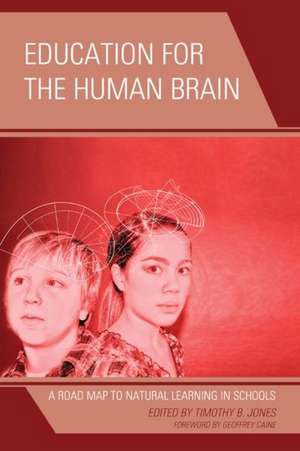
Education for the Human Brain: A Road Map to Natural Learning in Schools
Autor Timothy B. Jones Cuvânt înainte de Geoffrey Caineen Limba Engleză Paperback – 22 mai 2013
Preț: 271.35 lei
Preț vechi: 359.51 lei
-25%
Puncte Express: 407
Carte tipărită la comandă
Livrare economică 08-22 iunie
Specificații
ISBN-13: 9781475800937
ISBN-10: 1475800932
Pagini: 209
Ilustrații: 19 BW Photos, 1 Table
Dimensiuni: 152 x 225 x 18 mm
Greutate: 0.34 kg
Editura: Bloomsbury Publishing
Colecția R&L Education
Locul publicării:New York, United States
ISBN-10: 1475800932
Pagini: 209
Ilustrații: 19 BW Photos, 1 Table
Dimensiuni: 152 x 225 x 18 mm
Greutate: 0.34 kg
Editura: Bloomsbury Publishing
Colecția R&L Education
Locul publicării:New York, United States
V-ar putea interesa
-
 -28%Preț: 185.14 lei256.51 lei
 -
 Preț: 406.04 lei
 -
 Preț: 326.44 lei
 -
 Preț: 276.69 lei
 -
 Practical Tips for Teaching AssistantsSusan BenthamPreț: 388.03 lei
 -
 Preț: 400.19 lei
 -
 Preț: 206.15 lei
 -
 Chomsky on Mis-EducationNoam Chomsky-22%Preț: 136.43 lei175.24 lei
 -
 -24%Preț: 305.29 lei403.24 lei
 -
 -36%Preț: 161.17 lei252.85 lei
 -
 -12%Preț: 320.46 lei363.77 lei
 -
 The SAS Guide to TeachingBrian Carline-43%Preț: 76.18 lei133.14 lei
 -
 Getting the Buggers to ThinkSue Cowley-42%Preț: 97.00 lei166.43 lei
Cuprins
Acknowledgements
Foreword
Introduction: Education for the Human Brain: A Roadmap to Natural Learning in Schools
Part I - Exploration: Understanding the Brain and Learning
Chapter 1 - The Why!
Timothy B. Jones
Chapter 2. The Brain and High-Stakes Accountability Testing
Genie Linn
Chapter 3. The Brain/Mind Principles of Natural Learning
Renate Caine & Geoffrey Caine
Chapter 4. The Brain and Constructing Knowledge
Patrick M. Jenlink
Part II - Inspiration: Case Studies of Success
Chapter 5. Montessori Bilingual Education and Brain-Compatible Learning
Beverly J. Irby, Rafael Lara-Alecio, Fuhui Tong, & Linda Rodriguez
Chapter 6. Launch of Apollo: Brain-Compatible Algebra
Camille Malone
Part III - The Roadmap: Planning and Implementing the Work Ahead
Chapter 7. The Brain and the Learning Community
Laurence Kohn
Chapter 8. Schematic for Implementation: Creating the 'Cogito' for Innovative Schools
Ross B. Sherman
Chapter 9. The Courage to Lead: The Knowledge to Succeed
Peggy B. Gill
Chapter 10. Coda: There You Have It!
Timothy B. Jones
Author/Editor and Contributors Biographies
Foreword
Introduction: Education for the Human Brain: A Roadmap to Natural Learning in Schools
Part I - Exploration: Understanding the Brain and Learning
Chapter 1 - The Why!
Timothy B. Jones
Chapter 2. The Brain and High-Stakes Accountability Testing
Genie Linn
Chapter 3. The Brain/Mind Principles of Natural Learning
Renate Caine & Geoffrey Caine
Chapter 4. The Brain and Constructing Knowledge
Patrick M. Jenlink
Part II - Inspiration: Case Studies of Success
Chapter 5. Montessori Bilingual Education and Brain-Compatible Learning
Beverly J. Irby, Rafael Lara-Alecio, Fuhui Tong, & Linda Rodriguez
Chapter 6. Launch of Apollo: Brain-Compatible Algebra
Camille Malone
Part III - The Roadmap: Planning and Implementing the Work Ahead
Chapter 7. The Brain and the Learning Community
Laurence Kohn
Chapter 8. Schematic for Implementation: Creating the 'Cogito' for Innovative Schools
Ross B. Sherman
Chapter 9. The Courage to Lead: The Knowledge to Succeed
Peggy B. Gill
Chapter 10. Coda: There You Have It!
Timothy B. Jones
Author/Editor and Contributors Biographies
Recenzii
Cognitive psychology and neuroscience have increasingly found more common ground as they identify brain compatible strategies that enrich learning. Education for the Human Brain is a valuable, cutting-edge resource that will enable educators to explore research, implement new strategies, and ultimately, enhance student learning.
Much has been written about brain-based learning recently, but most fall short when looking for a comprehensive treatment of the topic. In Education for the Human Brain: A Roadmap to Natural Learning in Schools, Timothy B. Jones provides a very complete treatment of the subject. I would recommend it to anyone who is looking for an up-to-date and innovative book on natural and brain-compatible learning.
This definitive work about the brain, learning, and education will help school leaders plot a course for their instructional leadership thinking. In doing that, it reveals questions that must be dealt with in making 'ethical decisions'-providing the answers that leaders must evaluate in making instructional choices for making a difference for all students. Too often in the past leaders have been handed prescriptions for educating our young citizens-decisions made by the uninformed and those whose values are all about money, control and expedience. This volume helps one cut through the noise and debris in making meaningful educational and instructional decisions.
In Education for the Human Brain, Timothy B. Jones and his colleagues offer insights into a most powerful tool for transforming instruction and learning-the brain. Dr. Jones assembled this group to chronicle their joint experiences in training and modeling practices for school leaders who choose to accept the challenge of changing school operation and leading improved learning for all children. I will use this book in my Instructional Theory class.
Education for the Human Brain: A Road Map for Natural Learning in Schools is timely and greatly needed as education continues to be a hot public issue. Dr. Jones and his cadre of industry experts have operationalized the complex task of changing how learning occurs using a process that almost any educational leader can follow. The 'roadmap' facilitates implementation of the latest innovations in instruction by utilizing the professional learning community to make a difference for all learners! Bravo!
Knowledge of natural learning is as critical to educational leaders today as understanding the potential impact of computers and technology was to the last generation. Knowing how the brain learns physiologically and using brain-compatible teaching strategies are cutting-edge technology for the 21st century. Education for the Human Brain: A Road Map for Natural Learning in Schools provides educators an understanding of this technology, quantitative evidence of its success, and a method and means for implementing it in a high-stakes testing environment. It is the pedagogy of the future.
Much has been written about brain-based learning recently, but most fall short when looking for a comprehensive treatment of the topic. In Education for the Human Brain: A Roadmap to Natural Learning in Schools, Timothy B. Jones provides a very complete treatment of the subject. I would recommend it to anyone who is looking for an up-to-date and innovative book on natural and brain-compatible learning.
This definitive work about the brain, learning, and education will help school leaders plot a course for their instructional leadership thinking. In doing that, it reveals questions that must be dealt with in making 'ethical decisions'-providing the answers that leaders must evaluate in making instructional choices for making a difference for all students. Too often in the past leaders have been handed prescriptions for educating our young citizens-decisions made by the uninformed and those whose values are all about money, control and expedience. This volume helps one cut through the noise and debris in making meaningful educational and instructional decisions.
In Education for the Human Brain, Timothy B. Jones and his colleagues offer insights into a most powerful tool for transforming instruction and learning-the brain. Dr. Jones assembled this group to chronicle their joint experiences in training and modeling practices for school leaders who choose to accept the challenge of changing school operation and leading improved learning for all children. I will use this book in my Instructional Theory class.
Education for the Human Brain: A Road Map for Natural Learning in Schools is timely and greatly needed as education continues to be a hot public issue. Dr. Jones and his cadre of industry experts have operationalized the complex task of changing how learning occurs using a process that almost any educational leader can follow. The 'roadmap' facilitates implementation of the latest innovations in instruction by utilizing the professional learning community to make a difference for all learners! Bravo!
Knowledge of natural learning is as critical to educational leaders today as understanding the potential impact of computers and technology was to the last generation. Knowing how the brain learns physiologically and using brain-compatible teaching strategies are cutting-edge technology for the 21st century. Education for the Human Brain: A Road Map for Natural Learning in Schools provides educators an understanding of this technology, quantitative evidence of its success, and a method and means for implementing it in a high-stakes testing environment. It is the pedagogy of the future.