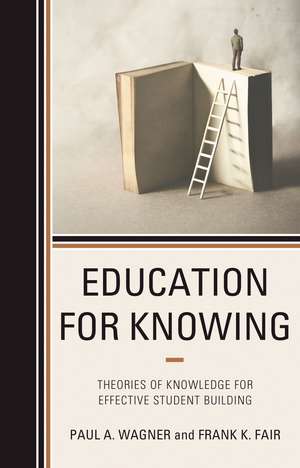
Education for Knowing: Theories of Knowledge for Effective Student Building
Autor Paul A. Wagner, Frank K. Fairen Limba Engleză Hardback – 30 oct 2020
Preț: 373.58 lei
Preț vechi: 507.78 lei
-26%
Puncte Express: 560
Carte tipărită la comandă
Livrare economică 28 noiembrie-12 decembrie
Livrare prin curier în România Termenul estimat este afișat lângă disponibilitate.
Transport gratuit de la 400.00 lei Plată online sau ramburs, în funcție de opțiunile comenzii.
Retur gratuit în 14 zile Comandă securizată și suport în română.
Specificații
ISBN-13: 9781475848137
ISBN-10: 1475848137
Pagini: 188
Dimensiuni: 161 x 228 x 20 mm
Greutate: 0.45 kg
Editura: Bloomsbury Publishing
Colecția Rowman & Littlefield
Locul publicării:New York, United States
ISBN-10: 1475848137
Pagini: 188
Dimensiuni: 161 x 228 x 20 mm
Greutate: 0.45 kg
Editura: Bloomsbury Publishing
Colecția Rowman & Littlefield
Locul publicării:New York, United States
Cuprins
DedicationPreface
Acknowledgements
Introduction
Chapter 1: Conceptions of Knowledge I: Realism Versus Skepticism Chapter 2 Why Children and Their Parents are Natural Realists Chapter 3: Conceptions of Knowledge II: Contextualism and PragmatismChap. 4 Policy-makers and Administrators as Contextualists and Pragmatists Chapter 5 Conceptions of Knowledge III: Instrumentalism , Evidentialism, and Social Constructivism Chapter. 6 Educational Researchers as Instrumentalists, Evidentailists, or Social ConstructivistsChapter 7 Bringing the Perspectives TogetherChapter 8 Sketching a Path Forward Glossary: 20-25 definitions of key terms ReferencesAbout the AuthorIndex
Acknowledgements
Introduction
Chapter 1: Conceptions of Knowledge I: Realism Versus Skepticism Chapter 2 Why Children and Their Parents are Natural Realists Chapter 3: Conceptions of Knowledge II: Contextualism and PragmatismChap. 4 Policy-makers and Administrators as Contextualists and Pragmatists Chapter 5 Conceptions of Knowledge III: Instrumentalism , Evidentialism, and Social Constructivism Chapter. 6 Educational Researchers as Instrumentalists, Evidentailists, or Social ConstructivistsChapter 7 Bringing the Perspectives TogetherChapter 8 Sketching a Path Forward Glossary: 20-25 definitions of key terms ReferencesAbout the AuthorIndex
Recenzii
Paul Wagner and Frank Fair ask readers to consider what is involved in engaging in an idealistic quest they call The Great Conversation of Humankind. They see schools as the constructed but necessary arenas for what they call student building, and part of that work is learning about domains of knowledge and engaging with them in a community of inquiry. Wagner and Fair draw upon philosophical texts and years of educational practice to make their case for student building, a vibrant metaphor for teaching and learning that captures the hope and energy of this text. I will use it in graduate classes.
This book embraces student-building, by emphasizing stakeholder understanding of interdependent knowledge bases among administrators and researchers in particular, and derivatively, teachers and parents as well. The authors create insight into foundational expectations that often separate and blur stakeholder expectations. I am telling all my associates in senior administration this is an essential read in both practice and theory.
This book is perfect for graduate education courses that aim to "dig deep" into the ways in which theories of knowledge impact classroom teaching, school systems, and education policy. A bridge between disciplines, stakeholders, theory, and practice Education for Knowing: Theories of Knowledge for Effective Student Building sparks critical conversations and dialogue between education policy makers, researchers, and teachers. It calls on all of us to revisit the purpose of schooling and what it means to be educated. An important resource for our changing times, the authors of this book inspire students to be truth-seekers, deeply engaged in "The Great Conversation of Humankind."
This book embraces student-building, by emphasizing stakeholder understanding of interdependent knowledge bases among administrators and researchers in particular, and derivatively, teachers and parents as well. The authors create insight into foundational expectations that often separate and blur stakeholder expectations. I am telling all my associates in senior administration this is an essential read in both practice and theory.
This book is perfect for graduate education courses that aim to "dig deep" into the ways in which theories of knowledge impact classroom teaching, school systems, and education policy. A bridge between disciplines, stakeholders, theory, and practice Education for Knowing: Theories of Knowledge for Effective Student Building sparks critical conversations and dialogue between education policy makers, researchers, and teachers. It calls on all of us to revisit the purpose of schooling and what it means to be educated. An important resource for our changing times, the authors of this book inspire students to be truth-seekers, deeply engaged in "The Great Conversation of Humankind."