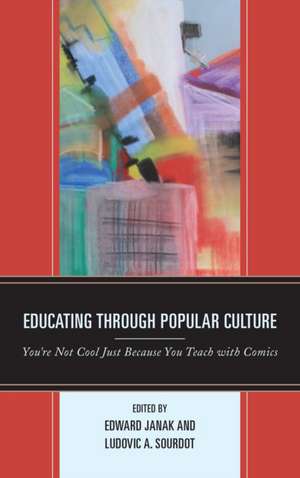
Educating through Popular Culture: You're Not Cool Just Because You Teach with Comics
Editat de Edward Janak, Ludovic A. Sourdot Contribuţii de Maha Al-Saati, Pearl Chaozon Bauer, Emily L. Brandon, Melissa Chapman, Paul A. Crutcher, Autumn M. Dodge, Tonia A. Dousay, Haley M. G. Ford, Andrew L. Grunzke, Jacob Hardesty, Richard Hartsell, Meghan Hawkins, Richard Hughes, Sarah Hunt-Barron, Cadey Korson, Weronika Kusek, Katie Lopez, Kimberley McMahon-Coleman, Tammy L. Mielke, Josh Thompson, Chad William Timm, Meredith J. Tolson, Jillian L. Wenburg, Kenya Wolff, Marc Wolterbeeken Limba Engleză Paperback – 15 sep 2018
Preț: 315.42 lei
Preț vechi: 408.61 lei
-23%
Puncte Express: 473
Carte tipărită la comandă
Livrare economică 06-20 iunie
Specificații
ISBN-13: 9781498549196
ISBN-10: 1498549195
Pagini: 364
Ilustrații: 7 tables;
Dimensiuni: 153 x 219 x 30 mm
Greutate: 0.75 kg
Editura: Bloomsbury Publishing
Colecția Lexington Books
Locul publicării:New York, United States
ISBN-10: 1498549195
Pagini: 364
Ilustrații: 7 tables;
Dimensiuni: 153 x 219 x 30 mm
Greutate: 0.75 kg
Editura: Bloomsbury Publishing
Colecția Lexington Books
Locul publicării:New York, United States
V-ar putea interesa
-
 Preț: 111.68 lei
 -
 -24%Preț: 324.04 lei424.12 lei
 -
 -26%Preț: 293.23 lei395.09 lei
 -
 Simulation in Media and Culture: Believing the HypeRobin DeRosa-30%Preț: 328.30 lei468.54 lei
 -
 Video Games and the LawElizabeth Townsend Gard-15%Preț: 582.42 lei685.20 lei
 -
 Numbers and Narratives: Sport, History and EconomicsWray Vamplew-18%Preț: 1066.08 lei1300.10 lei
 -
 White: Twentieth Anniversary EditionRichard DyerPreț: 337.73 lei
 -
 -18%Preț: 1304.43 lei1590.76 lei
 -
 The Aesthetics and Affects of CutenessJoshua Paul DalePreț: 344.84 lei
 -
 -18%Preț: 1070.28 lei1305.23 lei
 -
 Scandinavian Crime FictionDr Jakob Stougaard-Nielsen-21%Preț: 185.21 lei233.12 lei
 -
 Economies of DesignGuy JulierPreț: 400.13 lei
 -
 NeocitizenshipEva CherniavskyPreț: 257.11 lei
 -
 -28%Preț: 270.88 lei376.18 lei
 -
 -32%Preț: 508.55 lei743.24 lei
 -
 -30%Preț: 586.67 lei838.11 lei
 -
 The Function of Evil across Disciplinary ContextsMalcah Effron-14%Preț: 585.41 lei680.72 lei
 -
 -18%Preț: 771.73 lei941.14 lei
 -
 Intimate Strangers: The Culture of CelebrityRichard Schickel-16%Preț: 93.46 lei111.44 lei
 -
 -18%Preț: 103.70 lei126.07 lei
 -
 -33%Preț: 558.91 lei837.75 lei
Cuprins
Introduction - Educating through Popular Culture: "You're Not Cool Just Because You Teach with Comics"
Ludovic A. Sourdot and Edward Janak
Part I - Looking Behind: Teaching in the K-12 Schools With Popular Culture
Chapter 1 - Reclaimed Identity in Tak Toyoshima's Secret Asian Man and Gene Luen Yang's American Born Chinese
Tammy L. Mielke and Emily Brandon
Chapter 2 - History, Literacy, and Popular Culture: Using Graphic Novels to Teach the Struggle for Racial Justice
Richard Hughes, Meghan Hawkins, and Katie Lopez
Chapter 3 - Karma in Comics: Discovering Hidden Superpowers through Creating
Tonia A. Dousay Part II - Looking Around: Teaching in Postsecondary Schools with Popular Culture
Part II - Looking Around: Teaching in Postsecondary Schools with Popular Culture
Chapter 4 - Making Academia Cool: Serious Study of Sequential Art at the University
Pearl Chaozon Bauer and Marc Wolterbeek
Chapter 5 - Meditation: Mediating the Writing Process
Jillian L. Wenburg
Chapter 6 - Exploring Migrat
Ludovic A. Sourdot and Edward Janak
Part I - Looking Behind: Teaching in the K-12 Schools With Popular Culture
Chapter 1 - Reclaimed Identity in Tak Toyoshima's Secret Asian Man and Gene Luen Yang's American Born Chinese
Tammy L. Mielke and Emily Brandon
Chapter 2 - History, Literacy, and Popular Culture: Using Graphic Novels to Teach the Struggle for Racial Justice
Richard Hughes, Meghan Hawkins, and Katie Lopez
Chapter 3 - Karma in Comics: Discovering Hidden Superpowers through Creating
Tonia A. Dousay Part II - Looking Around: Teaching in Postsecondary Schools with Popular Culture
Part II - Looking Around: Teaching in Postsecondary Schools with Popular Culture
Chapter 4 - Making Academia Cool: Serious Study of Sequential Art at the University
Pearl Chaozon Bauer and Marc Wolterbeek
Chapter 5 - Meditation: Mediating the Writing Process
Jillian L. Wenburg
Chapter 6 - Exploring Migrat
Recenzii
Each of the articles in this thought-provoking volume provides information and insights about using popular culture in the classroom. The many topics covered, from philosophy of education to immigration and racism to autism, not only cite useful examples but stimulate further thinking on the part of the reader. The chapter on teaching science fiction and fantasy film in a Saudi classroom challenges many preconceptions and offers fresh perspectives. The various authors recognize that there is a range of literacies. Teachers at every level of education and in each discipline need to move beyond the areas in which they were academically successful to see how students construct knowledge from all of the different media currently available. Integrating visual literacy into the more traditional, text-based literacy is one of the challenges examined. The sophistication of the discourse is evidenced by the awareness of what can and cannot be achieved by using the various media. The notes and the extensive bibliographies at the end of each chapter will lead to further exploration on the part of the reader.
Summing Up: Highly recommended. Lower-division undergraduates through professionals.
This volume is chock full of creative, innovative, practical ideas for teaching popular culture. Janak and Sourdot have produced an impressive collection that covers a helpful range of educational approaches and practices. The book is an invaluable resource for teachers at all levels who wish to thoughtfully incorporate diverse popular forms and encourage students to think meaningfully and critically about the world of entertainment surrounding them.
This book would be a helpful addition to an education course that explores pedagogical approaches. It is relevant to those seeking inspiration as well as practical examples for including popular culture in their classrooms.
In addition to exploring relevant mediums that have not been considered carefully in previous anthologies, there are several other useful dimensions of Educating through Popular Culture. This volume integrates theory and practice in critical, innovative ways and also brings an important, global perspective to our ongoing conversation about education and popular culture.
Educating Through Popular Culture: You're Not Cool Just Because You Teach with Comics provides educators resources for effective teaching and research practices that engage popular culture. . . .educators of all levels who utilize popular culture in their curricula will find it a useful resource. Those who are considering introducing popular culture into the classroom will find this book a good place to harvest practical information. It raises useful questions relative to pedagogy and best practices that can help educators better engage students while retaining academic rigor. Few books on popular culture offer practical advice regarding its use in the classroom. Educating Through Popular Culture helps fill that void.
Summing Up: Highly recommended. Lower-division undergraduates through professionals.
This volume is chock full of creative, innovative, practical ideas for teaching popular culture. Janak and Sourdot have produced an impressive collection that covers a helpful range of educational approaches and practices. The book is an invaluable resource for teachers at all levels who wish to thoughtfully incorporate diverse popular forms and encourage students to think meaningfully and critically about the world of entertainment surrounding them.
This book would be a helpful addition to an education course that explores pedagogical approaches. It is relevant to those seeking inspiration as well as practical examples for including popular culture in their classrooms.
In addition to exploring relevant mediums that have not been considered carefully in previous anthologies, there are several other useful dimensions of Educating through Popular Culture. This volume integrates theory and practice in critical, innovative ways and also brings an important, global perspective to our ongoing conversation about education and popular culture.
Educating Through Popular Culture: You're Not Cool Just Because You Teach with Comics provides educators resources for effective teaching and research practices that engage popular culture. . . .educators of all levels who utilize popular culture in their curricula will find it a useful resource. Those who are considering introducing popular culture into the classroom will find this book a good place to harvest practical information. It raises useful questions relative to pedagogy and best practices that can help educators better engage students while retaining academic rigor. Few books on popular culture offer practical advice regarding its use in the classroom. Educating Through Popular Culture helps fill that void.