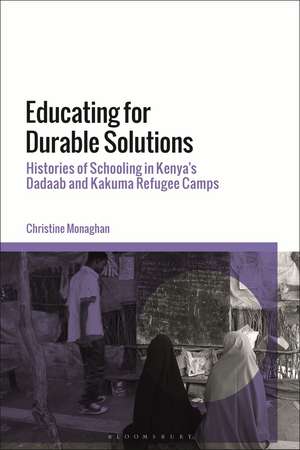
Educating for Durable Solutions: Histories of Schooling in Kenya’s Dadaab and Kakuma Refugee Camps
Autor Christine Monaghanen Limba Engleză Paperback – 17 noi 2022
The author shifts focus from debates over the impacts of specific policies and programs and explores instead how and why different policies and programs were implemented whether they led to meaningful changes in the long-standing challenges of refugee education. She finds that when and where real changes occurred, individuals or small groups of refugees and policymakers acted with tremendous agency and as tireless advocates.
Preț: 215.78 lei
Preț vechi: 291.95 lei
-26%
Puncte Express: 324
Carte tipărită la comandă
Livrare economică 26 noiembrie-10 decembrie
Livrare prin curier în România Termenul estimat este afișat lângă disponibilitate.
Transport gratuit de la 400.00 lei Plată online sau ramburs, în funcție de opțiunile comenzii.
Retur gratuit în 14 zile Comandă securizată și suport în română.
Specificații
ISBN-13: 9781350215245
ISBN-10: 1350215244
Pagini: 192
Dimensiuni: 156 x 234 mm
Greutate: 0.28 kg
Editura: Bloomsbury Publishing
Colecția Bloomsbury Academic
Locul publicării:London, United Kingdom
ISBN-10: 1350215244
Pagini: 192
Dimensiuni: 156 x 234 mm
Greutate: 0.28 kg
Editura: Bloomsbury Publishing
Colecția Bloomsbury Academic
Locul publicării:London, United Kingdom
Cuprins
Foreword, Carol Anne Spreen (New York University, USA)
Prologue
1. For the State, But Not By the State
2. Asking Why and How: A Historical Turn in Refugee Education Research
3. From Emergency Education to Education in Emergencies (1992-2002)
4. Education Guidelines, Standards, Priorities, and Strategies (2003-2012)
5. Critical Junctures
6. Driving Forward with the Rearview Mirror
References
Index
Prologue
1. For the State, But Not By the State
2. Asking Why and How: A Historical Turn in Refugee Education Research
3. From Emergency Education to Education in Emergencies (1992-2002)
4. Education Guidelines, Standards, Priorities, and Strategies (2003-2012)
5. Critical Junctures
6. Driving Forward with the Rearview Mirror
References
Index
Recenzii
A crucial account for anyone making policy decisions in what is the most fluid and complex arena for education globally. In tracing critical junctures in refugee programming, this fascinating and revealing book outlines possibilities as well as warnings about what and who determines the educational fate of refugees.
This is an excellent contribution to the field of education in emergencies. Christine Monaghan brilliantly provides a critical analysis of the role of state and international agencies in shaping educational processes in the era of neoliberalism in which education in refugee settings is a state regulated, market-oriented and transnational activity.
Christine Monaghan delves into the important but insufficiently understood issue of refugee education and, in so doing, provides us with a well-written and insightful narrative that sheds light on the global-local tensions that affect the development, implementation, and impact of education policies in these contexts.
This book brings fascinating historical insights into how refugee education is shaped by states, international organizations, and refugees themselves. Drawing on oral histories from over 200 students, teachers, administrators, and program officers, Monaghan illuminates the decisions that have affected generations of refugee children and provides critical lessons for moving forward.
This is an excellent contribution to the field of education in emergencies. Christine Monaghan brilliantly provides a critical analysis of the role of state and international agencies in shaping educational processes in the era of neoliberalism in which education in refugee settings is a state regulated, market-oriented and transnational activity.
Christine Monaghan delves into the important but insufficiently understood issue of refugee education and, in so doing, provides us with a well-written and insightful narrative that sheds light on the global-local tensions that affect the development, implementation, and impact of education policies in these contexts.
This book brings fascinating historical insights into how refugee education is shaped by states, international organizations, and refugees themselves. Drawing on oral histories from over 200 students, teachers, administrators, and program officers, Monaghan illuminates the decisions that have affected generations of refugee children and provides critical lessons for moving forward.