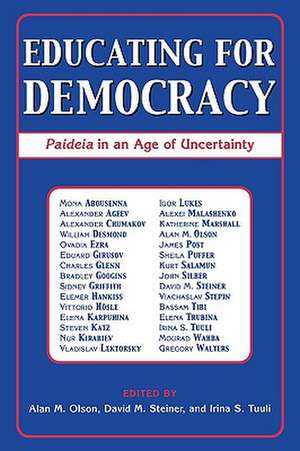
Educating for Democracy: Paideia in an Age of Uncertainty
Editat de Alan M. Olson, David M. Steiner, Irina S. Tuuli Contribuţii de Mona Abousenna, Alexander Ageev, Alexander Chumakov, William Desmond, Ovadia Ezra, Eduard Girusov, Charles L. Glenn, Bradley Googins, Sidney Griffith, Elmer Hankiss, Vittorio Hosle, Elena Karpuhina, Steven Katz, Nur Kirabiev, Vladislav Lektorsky, Igor Lukes, Alexei Malashenko, Katherine Marshall, Alan Olson, James Post, Sheila Puffer, Kurt Salamun, John Silbur, David Steiner, Viachaslav Stepin, Bassam Tibi, Elena Trubina, Irina Tuuli, Mourad Wahba, Gregory Waltersen Limba Engleză Paperback – 4 aug 2004
Preț: 347.71 lei
Preț vechi: 531.90 lei
-35%
Puncte Express: 522
Carte tipărită la comandă
Livrare economică 07-21 decembrie
Livrare prin curier în România Termenul estimat este afișat lângă disponibilitate.
Transport gratuit de la 400.00 lei Plată online sau ramburs, în funcție de opțiunile comenzii.
Retur gratuit în 14 zile Comandă securizată și suport în română.
Specificații
ISBN-13: 9780742535404
ISBN-10: 0742535401
Pagini: 307
Dimensiuni: 152 x 229 x 24 mm
Greutate: 0.47 kg
Editura: Bloomsbury Publishing
Colecția Rowman & Littlefield
Locul publicării:New York, United States
ISBN-10: 0742535401
Pagini: 307
Dimensiuni: 152 x 229 x 24 mm
Greutate: 0.47 kg
Editura: Bloomsbury Publishing
Colecția Rowman & Littlefield
Locul publicării:New York, United States
V-ar putea interesa
-
 Listening to GrasshoppersArundhati Roy-31%Preț: 63.84 lei92.71 lei
 -
 The Constitution of Equality: Democratic Authority and Its LimitsThomas Christiano-21%Preț: 537.87 lei684.89 lei
 -
 -20%Preț: 368.03 lei457.82 lei
 -
 Vital Democracy: A Theory of Democracy in ActionFrank Hendriks-30%Preț: 815.48 lei1166.58 lei
 -
 The Representative ClaimMichael Saward-30%Preț: 814.65 lei1166.08 lei
 -
 -31%Preț: 839.49 lei1213.39 lei
 -
 Changes for Democracy: Actors, Structures, ProcessesLeonardo Morlino-10%Preț: 351.68 lei388.70 lei
 -
 No One's World: The West, the Rising Rest, and the Coming Global TurnCharles A. Kupchan-23%Preț: 147.74 lei191.90 lei
 -
 Democracy and Schooling in CaliforniaK. WeilerPreț: 322.30 lei
 -
 Political Extremism in DemocraciesWilliam M DownsPreț: 402.72 lei
 -
 Empathy and DemocracyMichael E. MorrellPreț: 273.07 lei
 -
 Democratic GovernanceMark BevirPreț: 415.44 lei
 -
 Preț: 499.40 lei
 -
 Preț: 265.41 lei
 -
 The Uncivil WarDavid LebedoffPreț: 196.83 lei
 -
 The Future of PoliticsRobert CorfePreț: 138.47 lei
Cuprins
Part 1 Preface
Part 2 Foreword
Part 3 Paideia in Philosophy and Religion
Chapter 4 Introduction: Paideia, Philosophy, and Religion
Chapter 5 Paideia: Anachronism or Necessity?
Chapter 6 Paideia as the Unity of Knowledge and Enlightenment
Chapter 7 Science, Education, and the Transformation of Civilization in the Twenty-First Century
Chapter 8 The Noospheric Imperative for Paideia in the Twenty-First Century
Chapter 9 Paideia and Critical Thinking
Chapter 10 Inter-Religious Dialogues During the Middle Ages and Early Modernity
Chapter 11 The Impact of Modernity on Jewish Life
Chapter 12 Paideia and Adab in Islam
Chapter 13 The Changing Face of Islamic Radicalism
Chapter 14 Christian-Islamic Dialogue in the Twenty-First Century
Part 15 Paideia and Education
Chapter 16 Introduction: Paideia and Education
Chapter 17 Paideia: Anachronism or Necessity?
Chapter 18 Paideia in and Age of Uncertainty
Chapter 19 After NATO, Paideia?
Chapter 20 Liberal Education in the Fear of Anti-Democracy
Chapter 21 Prescribing Orthodoxy
Chapter 22 De-Dogmatizing Reason
Chapter 23 Education and Democratization in an Age of Islamism
Chapter 24 Education to Conscience and Political Disobedience: The Role of the Role Model
Chapter 25 Face to Face with Eudaimonia: The Post-Soviet Teacher's Identity
Chapter 26 Reformatting the Idea of a University
Part 27 Paideia and Economics
Chapter 28 The Ethics of Political Economy: A Roundtable
29
Part 30 About the Contributors
Part 2 Foreword
Part 3 Paideia in Philosophy and Religion
Chapter 4 Introduction: Paideia, Philosophy, and Religion
Chapter 5 Paideia: Anachronism or Necessity?
Chapter 6 Paideia as the Unity of Knowledge and Enlightenment
Chapter 7 Science, Education, and the Transformation of Civilization in the Twenty-First Century
Chapter 8 The Noospheric Imperative for Paideia in the Twenty-First Century
Chapter 9 Paideia and Critical Thinking
Chapter 10 Inter-Religious Dialogues During the Middle Ages and Early Modernity
Chapter 11 The Impact of Modernity on Jewish Life
Chapter 12 Paideia and Adab in Islam
Chapter 13 The Changing Face of Islamic Radicalism
Chapter 14 Christian-Islamic Dialogue in the Twenty-First Century
Part 15 Paideia and Education
Chapter 16 Introduction: Paideia and Education
Chapter 17 Paideia: Anachronism or Necessity?
Chapter 18 Paideia in and Age of Uncertainty
Chapter 19 After NATO, Paideia?
Chapter 20 Liberal Education in the Fear of Anti-Democracy
Chapter 21 Prescribing Orthodoxy
Chapter 22 De-Dogmatizing Reason
Chapter 23 Education and Democratization in an Age of Islamism
Chapter 24 Education to Conscience and Political Disobedience: The Role of the Role Model
Chapter 25 Face to Face with Eudaimonia: The Post-Soviet Teacher's Identity
Chapter 26 Reformatting the Idea of a University
Part 27 Paideia and Economics
Chapter 28 The Ethics of Political Economy: A Roundtable
29
Part 30 About the Contributors
Recenzii
Fundamentalist religion, identity politics, and post-modernism would seem to have driven us far from the Enlightenment preoccupation with integrative humanist paradigms of education of the kind the Greeks called Paideia, the Germans called Bildung, and the French called Formation. But as this penetrating collection shows, the aspiration to humanistic knowledge and liberal learning is challenged but not defeated by the post-modernity and its maladies. Indeed, as Olson, Steiner, Tuuli,and their thoughtful colleagues show, the striving for education and knowledge, whether in religion (the intersection with Islam is especially interesting), pedagogy, or economics, can be fortified without resorting to reactionary nostalgia for the ancients by a careful understanding of paideia. Don't let the anthology format fool you-this is an important book with a clear center of gravity that should be of value to scholars, teachers, and students alike..
Educating for Democracy: Paideia in an Age of Uncertainty is a breath of sorely needed fresh air. Situated in the ivory tower, philosophers must become pertinent to the current state of the world. No other profession manifests so explicitly the gap between theory and praxis, which threatens to make academia insignificant during transitional times. This book is a surprisingly successful attempt to bridge this divide by use of paideia, the calling of committed philosophers. Coming from several cultural contexts, both religious and secular, the contributors to this volume show-teach-the kind of critical work necessary for the politics of education and the education of and to politics.
Paideia: Anachronism or Necessity? is the question that runs as the principal theme throughout this volume. The answer is paideia as a possibility and a potential for democratic education. In an exciting effort to draw on an ancient idea in an historical moment facing new and unheard of problems, the authors explore the meaning of the classical Greek concept of paideia in the fields of philosophy, religion, education, and economics. Bringing together contributions from the United States and Russia, from the Middle East and Europe, this volume engages in an international conversation on some of the most pressing questions of our time.
Educating for Democracy marks an important effort by an international group of philosophers...to bring their disciplined insights and classical educational heritage together toward analysis of religious, political, and economic conflicts playing out on the world stage.
This volume, due substantially to the leadership of Alan Olson, continues the work that led to the XXth World Congress of Philosophy, held in Boston in the summer of 1998, whose invited program appeared shortly thereafter in twelve volumes! This new volume contains papers delivered in two subsequent conferences that successfully continued the most welcome and admirable international cooperation of the Congress, on some of the same main themes.
Educating for Democracy: Paideia in an Age of Uncertainty is a breath of sorely needed fresh air. Situated in the ivory tower, philosophers must become pertinent to the current state of the world. No other profession manifests so explicitly the gap between theory and praxis, which threatens to make academia insignificant during transitional times. This book is a surprisingly successful attempt to bridge this divide by use of paideia, the calling of committed philosophers. Coming from several cultural contexts, both religious and secular, the contributors to this volume show-teach-the kind of critical work necessary for the politics of education and the education of and to politics.
Paideia: Anachronism or Necessity? is the question that runs as the principal theme throughout this volume. The answer is paideia as a possibility and a potential for democratic education. In an exciting effort to draw on an ancient idea in an historical moment facing new and unheard of problems, the authors explore the meaning of the classical Greek concept of paideia in the fields of philosophy, religion, education, and economics. Bringing together contributions from the United States and Russia, from the Middle East and Europe, this volume engages in an international conversation on some of the most pressing questions of our time.
Educating for Democracy marks an important effort by an international group of philosophers...to bring their disciplined insights and classical educational heritage together toward analysis of religious, political, and economic conflicts playing out on the world stage.
This volume, due substantially to the leadership of Alan Olson, continues the work that led to the XXth World Congress of Philosophy, held in Boston in the summer of 1998, whose invited program appeared shortly thereafter in twelve volumes! This new volume contains papers delivered in two subsequent conferences that successfully continued the most welcome and admirable international cooperation of the Congress, on some of the same main themes.