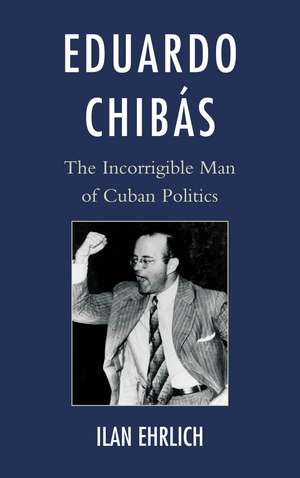
Eduardo Chibás: The Incorrigible Man of Cuban Politics
Autor Ilan Ehrlichen Limba Engleză Paperback – 29 dec 2017
Preț: 222.20 lei
Preț vechi: 309.15 lei
-28%
Puncte Express: 333
Carte tipărită la comandă
Livrare economică 05-19 decembrie
Livrare prin curier în România Termenul estimat este afișat lângă disponibilitate.
Transport gratuit de la 400.00 lei Plată online sau ramburs, în funcție de opțiunile comenzii.
Retur gratuit în 14 zile Comandă securizată și suport în română.
Specificații
ISBN-13: 9780810895157
ISBN-10: 0810895153
Pagini: 336
Ilustrații: 20 b/w photos;
Dimensiuni: 151 x 229 x 19 mm
Greutate: 0.48 kg
Editura: Bloomsbury Publishing
Colecția Rowman & Littlefield
Locul publicării:New York, United States
ISBN-10: 0810895153
Pagini: 336
Ilustrații: 20 b/w photos;
Dimensiuni: 151 x 229 x 19 mm
Greutate: 0.48 kg
Editura: Bloomsbury Publishing
Colecția Rowman & Littlefield
Locul publicării:New York, United States
Cuprins
Acknowledgments
Introduction
Chapter One: "As Long As Any Cuban Suffers, I Will Fight for Him"
Chapter Two: "Shoot Me in the Heart, the Ortodoxos Need a Martyr"
Chapter Three: "No One Respects the Constitution"
Chapter Four: "We are Alone With the People"
Chapter Five: "The Miracle of Chibás"
Chapter Six: "I Would Proudly Go to Prison to Defend the Cuban People"
Chapter Seven: "The Cave of Ali Baba and His 40,000 Thieves"
Chapter Eight: "I'm Not One of Those Generals Who Dies in Bed"
Chapter Nine: "Time Will Prove Me Right Once Again"
Chapter Ten: "I Am Going to Open My Briefcase"
Epilogue
Notes
Bibliography
Index
Introduction
Chapter One: "As Long As Any Cuban Suffers, I Will Fight for Him"
Chapter Two: "Shoot Me in the Heart, the Ortodoxos Need a Martyr"
Chapter Three: "No One Respects the Constitution"
Chapter Four: "We are Alone With the People"
Chapter Five: "The Miracle of Chibás"
Chapter Six: "I Would Proudly Go to Prison to Defend the Cuban People"
Chapter Seven: "The Cave of Ali Baba and His 40,000 Thieves"
Chapter Eight: "I'm Not One of Those Generals Who Dies in Bed"
Chapter Nine: "Time Will Prove Me Right Once Again"
Chapter Ten: "I Am Going to Open My Briefcase"
Epilogue
Notes
Bibliography
Index
Recenzii
Ehrlich's extensive recounting of this dynamic era provides a lucid argument for affirming Chibás' importance in the Cuban pantheon. . . .Ehrlich's meticulous description of this period and his retelling of the ascent of Chibás as the main opposition candidate in the election cycle to follow leaves no stone unturned. . . .This publication excels at illustrating the impact on the island's zeitgeist during a pivotal point by one of the most dynamic political leaders in Cuba's history.
A much-welcome and long-overdue English-language biography of the public life of Eddy Chibás. But more than a biography, Ehrlich's account serves to provide deeper insight into the Cuban political landscape of the 1940s, and hence a deeper insight into the complexities of the 1950s. An important gap in our knowledge has been filled.
A well-written and indispensable account of the late political life of Eduardo Chibás, a major figure in the first half of the twentieth century in Cuba and a forerunner of the revolution that overthrew the Batista dictatorship in 1959.
An important addition to this new scholarship on republican Cuba (1902-59). . . . The book provides much needed insight on one of the most important, yet neglected, figures of modern Cuban history, Eduardo Chibás. . . . [Ehrlich offers] much needed historical detail, nuance, and analysis about a period and a man whose life (and death) decisively changed Cuban history. The book is organized in ten well-written chapters which chronicle the decisive moments of Chibás's struggle against corruption and gangsterism. Each one is rich with detail about his activities, . . . such detailed accounts of both the man and his times provide us with a nuanced, multidimensional picture of Cuban political culture at a particular time in the country's history. . . . By telling these stories-by focusing on the choices particular people made at particular times-Ehrlich shows us that nothing was inevitable in Cuban politics, least of all the revolution of 1959.
A much-welcome and long-overdue English-language biography of the public life of Eddy Chibás. But more than a biography, Ehrlich's account serves to provide deeper insight into the Cuban political landscape of the 1940s, and hence a deeper insight into the complexities of the 1950s. An important gap in our knowledge has been filled.
A well-written and indispensable account of the late political life of Eduardo Chibás, a major figure in the first half of the twentieth century in Cuba and a forerunner of the revolution that overthrew the Batista dictatorship in 1959.
An important addition to this new scholarship on republican Cuba (1902-59). . . . The book provides much needed insight on one of the most important, yet neglected, figures of modern Cuban history, Eduardo Chibás. . . . [Ehrlich offers] much needed historical detail, nuance, and analysis about a period and a man whose life (and death) decisively changed Cuban history. The book is organized in ten well-written chapters which chronicle the decisive moments of Chibás's struggle against corruption and gangsterism. Each one is rich with detail about his activities, . . . such detailed accounts of both the man and his times provide us with a nuanced, multidimensional picture of Cuban political culture at a particular time in the country's history. . . . By telling these stories-by focusing on the choices particular people made at particular times-Ehrlich shows us that nothing was inevitable in Cuban politics, least of all the revolution of 1959.