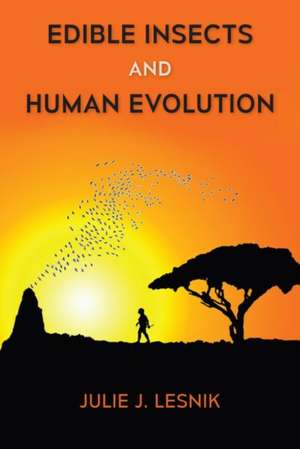
Edible Insects and Human Evolution
Autor Julie J. Lesniken Limba Engleză Hardback – 17 iul 2018
Lesnik investigates the role of insects in the diets of hunter-gatherers and our nonhuman primate cousins in order to deduce what insect consumption looked like in the past. She approaches the question from the perspectives of primatology, sociocultural anthropology, reproductive physiology, and paleoanthropology. Lesnik posits that women would likely spend more time foraging for and eating insects than men, arguing that this pattern is important to note because women are too often ignored in reconstructions of ancient human behavior. Because of the abundance of insects and the low risk of acquiring them, insects were a reliable food source that mothers used to feed their families over the past five million years.
Although they are consumed worldwide to this day, insects are not usually considered to be food in Western societies. Tying together ancient history with our modern lives, Lesnik points out that insects are a highly nutritious and very sustainable food. Lesnik believes that if we accept that edible insects are a part of the human legacy, we may have new conversations about what is good to eat--both in past diets and for the future of food.
Preț: 491.24 lei
Preț vechi: 577.93 lei
-15%
Puncte Express: 737
Carte tipărită la comandă
Livrare economică 07-21 decembrie
Livrare prin curier în România Termenul estimat este afișat lângă disponibilitate.
Transport gratuit pentru acest produs Plată online sau ramburs, în funcție de opțiunile comenzii.
Retur gratuit în 14 zile Comandă securizată și suport în română.
Specificații
ISBN-13: 9780813056999
ISBN-10: 0813056993
Pagini: 206
Dimensiuni: 157 x 235 x 17 mm
Greutate: 0.49 kg
Editura: University Press of Florida
ISBN-10: 0813056993
Pagini: 206
Dimensiuni: 157 x 235 x 17 mm
Greutate: 0.49 kg
Editura: University Press of Florida
V-ar putea interesa
-
 Preț: 479.22 lei
-
 Objects: Reluctant Witnesses to the PastChris CaplePreț: 388.82 lei
-
 -18%Preț: 1122.50 lei1368.90 lei
-
 Preț: 440.06 lei
-
 Digital Archaeology: Bridging Method and TheoryPatrick DalyPreț: 413.84 lei
-
 Archaeological InvestigationMartin CarverPreț: 376.00 lei
-
 The Next Archaeology WorkbookNicholas DavidPreț: 282.77 lei
-
 Modes of Production and ArchaeologyRobert M Rosenswig-15%Preț: 588.08 lei691.85 lei
-
 How to Do Archaeology the Right WayBarbara PurdyPreț: 291.41 lei
-
 Bones of ComplexityHaagen D. Klaus-15%Preț: 628.37 lei739.26 lei
-
 The Archaeology of CitizenshipStacey Lynn CampPreț: 163.95 lei
-
 Laser Ablation ICP-MS in Archaeological ResearchRobert J. Speakman-23%Preț: 598.38 lei777.12 lei
-
 Archaeological Approaches to Breaking BoundariesJulia Binnberg-8%Preț: 646.48 lei702.69 lei
-
 Le site de Bey-144Dina Frangié-JolyPreț: 410.97 lei
-
 The Early Mesoamerican Village: Updated EditionKent V FlanneryPreț: 498.67 lei
-
 ArchaeologyJoe FlatmanPreț: 71.03 lei
-
 Alexandria and Qumran: Back to the BeginningKenneth SilverPreț: 407.86 lei
Descriere
Descriere de la o altă ediție sau format:
Researchers who study ancient human diets tend to focus on meat eating because the practice of butchery is very apparent in the archaeological record. In this volume, Julie Lesnik highlights a different food source, tracing evidence that humans and their hominin ancestors also consumed insects throughout the entire course of human evolution.
Researchers who study ancient human diets tend to focus on meat eating because the practice of butchery is very apparent in the archaeological record. In this volume, Julie Lesnik highlights a different food source, tracing evidence that humans and their hominin ancestors also consumed insects throughout the entire course of human evolution.