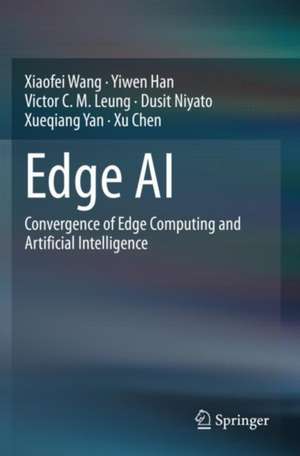
Edge AI
Autor Xiaofei Wang, Yiwen Han, Victor C. M. Leung, Dusit Niyato, Xueqiang Yan, Xu Chenen Limba Engleză Paperback – sep 2021
Prin parcurgerea Edge AI, cititorul va dobândi capacitatea de a implementa servicii de inteligență artificială direct la periferia rețelei, optimizând drastic timpul de răspuns și eficiența resurselor. Volumul reprezintă o sinteză tehnică a informațiilor care, până acum, erau dispersate între domeniile comunicațiilor, networking-ului și inteligenței artificiale, oferind un cadru unificat pentru fuziunea dintre Edge Computing și Deep Learning. Structura lucrării este riguroasă, pornind de la fundamentele hardware și paradigmele de calcul — precum Fog Computing și Mobile Edge Computing (MEC) — și avansând către tehnici de virtualizare și Network Slicing. Apreciem în mod deosebit modul în care autorii descompun ecosistemul în cinci axe esențiale: de la antrenarea modelelor la edge până la utilizarea algoritmilor de AI pentru a optimiza performanța rețelei în sine. Pe linia practică a volumului Machine Learning for Edge Computing, dar cu un focus mai pronunțat pe arhitecturile de Deep Learning (CNN, GAN, RNN), această carte detaliază modul în care modelele complexe pot fi adaptate pentru dispozitive cu resurse limitate. Credem că valoarea adăugată a acestui titlu constă în abordarea bidirecțională: „edge intelligence” și „intelligent edge”. Autorii, printre care se numără experți precum Xiaofei Wang și Victor C. M. Leung, poziționează această lucrare ca un fundament necesar pentru înțelegerea noilor standarde de conectivitate. Această perspectivă continuă explorările lor anterioare din 6GN for Future Wireless Networks, făcând trecerea de la infrastructura de comunicații la logica computațională avansată necesară în era 5G și post-5G.
Preț: 1003.17 lei
Preț vechi: 1253.97 lei
-20%
Carte disponibilă
Livrare economică 11-25 noiembrie
Specificații
ISBN-10: 9811561885
Pagini: 168
Ilustrații: XVII, 149 p. 38 illus., 34 illus. in color.
Dimensiuni: 155 x 235 x 9 mm
Greutate: 0.3 kg
Ediția:1st ed. 2020
Editura: Springer
Locul publicării:Singapore, Singapore
V-ar putea interesa
-
 Using Artificial Intelligence Absolute Beginner's GuideMichael Miller-20%Preț: 201.72 lei252.15 lei
 -
 Exam Ref Ai-900 Microsoft Azure AI FundamentalsJulian Sharp-20%Preț: 191.75 lei239.69 lei
 -
 Understanding Deep LearningSimon J. D. Prince-20%Preț: 636.22 lei795.27 lei
 -
 -27%Preț: 465.12 lei640.28 lei
 -
 -39%Preț: 622.57 lei1028.93 lei
 -
 Artificial Intelligence Hardware DesignAlbert Chun-Chen Liu-20%Preț: 716.17 lei895.22 lei
 -
 Agentic AI For DummiesPam Baker-20%Preț: 145.95 lei182.44 lei
 -
 The Essential Book of AIAnne Rooney-20%Preț: 76.61 lei95.77 lei
 -
 Deep Learning Design PatternsAndrew Ferlitsch-20%Preț: 428.22 lei535.26 lei
 -
 Deep Learning Crash CourseGiovanni Volpe-35%Preț: 290.92 lei445.81 lei
 -
 Practical Deep Learning, 2nd Edition: A Python-Based IntroductionRonald T. Kneusel-35%Preț: 333.73 lei515.68 lei
 -
 Advances in AI for Cloud, Edge, and Mobile Computing ApplicationsShrikaant Kulkarni-20%Preț: 1296.62 lei1620.78 lei
 -
 Web, Artificial Intelligence and Network ApplicationsLeonard Barolli-20%Preț: 1255.62 lei1569.53 lei
 -
 Deep Learning-Powered TechnologiesKhaled Salah MohamedPreț: 440.85 lei
 -
 -18%Preț: 1368.94 lei1669.44 lei
 -
 Practical Deep Learning with PyTorchDeepak Gowda-20%Preț: 225.42 lei281.77 lei
 -
 Recent Advances in Artificial Intelligence and Smart ApplicationsJyotsna K. Mandal-18%Preț: 1017.19 lei1240.48 lei
 -
 Intelligent Mobile Edge Computing and SensingWanming Hao-20%Preț: 1322.14 lei1652.68 lei
 -
 Human Edge in the AI AgeNitin Seth-20%Preț: 128.69 lei160.86 lei
 -
 AI and MicroservicesDileep Kumar Pandiya-20%Preț: 263.90 lei329.88 lei
De ce să citești această carte
Această carte se adresează inginerilor de sistem și cercetătorilor care doresc să depășească limitările arhitecturilor cloud tradiționale. Cititorul câștigă o înțelegere clară a modului în care poate implementa inferența și antrenarea AI pe hardware local, reducând latența. Este un ghid esențial pentru oricine dorește să construiască sisteme inteligente autonome, de la orașe inteligente la aplicații IoT industriale, unde viteza de procesare la sursă este critică.
Despre autor
Echipa de autori este formată din cercetători de prestigiu în domeniul comunicațiilor și informaticii. Xiaofei Wang și colegii săi, inclusiv Victor C. M. Leung și Dusit Niyato, au o vastă experiență în rețele wireless de ultimă generație și sisteme distribuite. Lucrările lor anterioare, precum Integrating Edge Intelligence and Blockchain sau cercetările despre 6GN for Future Wireless Networks, demonstrează un interes constant pentru convergența tehnologiilor emergente. Expertiza lor colectivă oferă o perspectivă solidă asupra modului în care inteligența artificială poate fi descentralizată pentru a servi nevoilor de calcul în timp real ale societății moderne.
Descriere scurtă
Cuprins
2: Fundamentals of Edge Computing
2.1 Paradigms of Edge Computing
Cloudlet and Micro Data Centers
Fog Computing
Mobile (Multi-access) Edge Computing (MEC)
Definition of Edge Computing Terminologies
Collaborative End-Edge-Cloud Computing
2.2 Hardware for Edge Computing AI Hardware for Edge Computing
Integrated Commodities Potentially for Edge Nodes
Edge Computing Frameworks
2.3 Virtualizing the Edge
Virtualization Techniques
Network Virtualization
Network Slicing
3. Fundamentals of Deep Learning
3.1 Neural Networks in Deep Learning
Fully Connected Neural Network (FCNN)
Auto-Encoder (AE)
Convolutional Neural Network (CNN)
Generative Adversarial Network (GAN)
Recurrent Neural Network (RNN)
Transfer Learning (TL)
3.2 Deep Reinforcement Learning (DRL)
Value-based DRL
Policy-gradient-based DRL
3.3 Distributed DL Training
3.4 Potential DL Libraries for Edge
4. Deep Learning Applications on Edge
4.1 Real-time Video Analytic
4.2 Autonomous Internet of Vehicles (IoVs)
4.3 Intelligent Manufacturing
4.4 Smart Home and City
5. Deep Learning Inference in Edge
5.1 Optimization of DL Models in Edge
General Methods for Model Optimization
Model Optimization for Edge Devices
5.2 Segmentation of DL Models
5.3 Early Exit of Inference (EEoI)
5.4 Sharing of DL Computation
6. Edge Computing for Deep Learning
6.1 Edge Hardware for DL
Mobile CPUs and GPUs
FPGA-based Solutions
6.2 Communication and Computation Modes for Edge DL
Integral Offloading Partial Offloading
Vertical Collaboration
Horizontal Collaboration
6.3 Tailoring Edge Frameworks for DL
6.4 Performance Evaluation for Edge DL
7. Deep Learning Training at Edge
7.1 Distributed Training at Edge
7.2 Vanilla Federated Learning at Edge 7.3 Communication-efficient FL
7.4 Resource-optimized FL
7.5 Security-enhanced FL
8. Deep Learning for Optimizing Edge
8.1 DL for Adaptive Edge Caching
8.2 DL for Optimizing Edge Task Offloading
8.3 DL for Edge Management and Maintenance
Edge Communication
Edge Security
Joint Edge Optimization
9. Lessons Learned and Open Challenges
9.1 More Promising Applications
9.2 General DL Model for Inference
9.3 Complete Edge Architecture for DL
9.4 Practical Training Principles at Edge
9.5 Deployment and Improvement of Intelligent Edge
Notă biografică
Mr. Yiwen Han received his B.S. degree from Nanchang University, China, and M.S. degree from Tianjin University, China, in 2015 and 2018, respectively, both in communication engineering. He received the Outstanding B.S. Graduates in 2015 and M.S. National Scholarship of China in 2016. He is currently pursuing the Ph.D. degree in computer science at Tianjin University. His current research interests include edge computing, reinforcement learning, and deep learning.
Prof. Victor C. M. Leung is a Distinguished Professor of Computer Science and Software Engineering at Shenzhen University. He was a Professor of Electrical and Computer Engineering and holder of the TELUS Mobility Research Chair at the University of British Columbia (UBC) when he retired from UBC in 2018 and became a Professor Emeritus. His research is in the broad areas of wireless networks and mobile systems. He has co-authored more than 1300 journal/conference papers and book chapters. Dr. Leung is serving on the editorial boards of the IEEE Transactions on Green Communications and Networking, IEEE Transactions on Cloud Computing, IEEE Access, IEEE Network, and several other journals. He received the IEEE Vancouver Section Centennial Award, 2011 UBC Killam Research Prize, 2017 Canadian Award for Telecommunications Research, and 2018 IEEE TCGCC Distinguished Technical Achievement Recognition Award. He co-authored papers that won the 2017 IEEE ComSoc Fred W. Ellersick Prize, 2017 IEEE Systems Journal Best Paper Award, 2018 IEEE CSIM Best Journal Paper Award, and 2019 IEEE TCGCC Best Journal Paper Award. He is a Fellow of IEEE, the Royal Society of Canada, Canadian Academy of Engineering, and Engineering Institute of Canada. He is named in the current Clarivate Analytics list of “Highly Cited Researchers”.
Prof. Dusit Niyato is currently a Professor in the School of Computer Science and Engineering, at Nanyang Technological University, Singapore. He was a Distinguished Lecturer of the IEEE Communications Society for 2016-2017. He was named the 2017, 2018 highly cited researcher in computer science. He is a Fellow of IEEE. His research interests are in the area of Internet of Things (IoT) and network resource pricing.
Xueqiang Yan is currently a technology expert with Wireless Technology Lab at Huawei Technologies. He was a member of technical staff of Bell Labs from 2000 to 2004. From 2004 to 2016 he was a director of Strategy Department of Alcatel-Lucent Shanghai Bell. His current research interests include wireless networking, Internet of Things, edge AI, future mobile network architecture, network convergence and evolution.
Xu Chen is a Full Professor with Sun Yatsen University, Guangzhou, China, and the vice director of National and Local Joint Engineering Laboratory of Digital Home Interactive Applications. He received the Ph.D. degree in information engineering from the Chinese University of Hong Kong in 2012, and worked as a Postdoctoral Research Associate at Arizona State University, Tempe, USA from 2012 to 2014, and a Humboldt Scholar Fellow at Institute of Computer Science of University of Goettingen, Germany from 2014 to 2016. He received the prestigious Humboldt research fellowship awarded by Alexander von Humboldt Foundation of Germany, 2014 Hong Kong Young Scientist Runner-up Award, 2016 Thousand Talents Plan Award for Young Professionals of China, 2017 IEEE Communication Society Asia-Pacific Outstanding Young Researcher Award, 2017 IEEE ComSoc Young Professional Best Paper Award, Honorable Mention Award of 2010 IEEE international conference on Intelligence and Security Informatics (ISI), Best Paper Runner-up Award of 2014 IEEE International Conference on Computer Communications (INFOCOM), and Best Paper Award of 2017 IEEE Intranational Conference on Communications (ICC). He is currently an Associate Editor of IEEE Internet of Things Journal and IEEE Transactions on Wireless Communications, and Area Editor of IEEE Open Journal of the Communications Society.
Caracteristici
Helps readers to understand the connections between enabling technologies for edge computing and artificial intelligence
Outlines potential future trends in emerging edge intelligence and intelligent edge