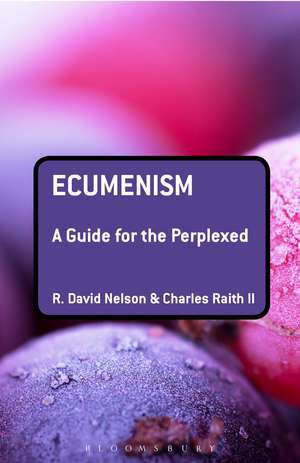
Ecumenism: A Guide for the Perplexed: Guides for the Perplexed
Autor Dr R. David Nelson, Dr Charles Raith IIen Limba Engleză Paperback – 27 iul 2017
Din seria Guides for the Perplexed
- 26%
 Preț: 185.21 lei
 - 26%
 Preț: 169.37 lei
 - 21%
 Preț: 157.30 lei
 - 25%
 Preț: 180.82 lei
 - 26%
 Preț: 582.64 lei
 - 22%
 Preț: 167.89 lei
 - 10%
 Preț: 163.77 lei
 - 25%
 Preț: 182.24 lei
 - 21%
 Preț: 175.78 lei
 -
 Preț: 232.61 lei
 - 17%
 Preț: 163.77 lei
 - 16%
 Preț: 277.08 lei
 - 17%
 Preț: 177.02 lei
 - 22%
 Preț: 186.57 lei
 - 26%
 Preț: 613.10 lei
 - 25%
 Preț: 833.45 lei
 - 17%
 Preț: 176.16 lei
 - 17%
 Preț: 177.10 lei
 - 17%
 Preț: 156.65 lei
 - 22%
 Preț: 192.03 lei
 - 23%
 Preț: 190.40 lei
 - 14%
 Preț: 643.66 lei
 - 17%
 Preț: 164.57 lei
 - 18%
 Preț: 157.43 lei
 - 17%
 Preț: 177.40 lei
 - 24%
 Preț: 645.19 lei
 - 17%
 Preț: 177.30 lei
 - 17%
 Preț: 177.97 lei
 - 17%
 Preț: 156.75 lei
 - 21%
 Preț: 156.45 lei
 - 17%
 Preț: 191.06 lei
 - 22%
 Preț: 205.81 lei
 - 17%
 Preț: 190.40 lei
 - 24%
 Preț: 612.60 lei
 - 25%
 Preț: 1022.81 lei
 - 24%
 Preț: 611.29 lei
 - 23%
 Preț: 176.92 lei
 - 25%
 Preț: 610.86 lei
Preț: 167.47 lei
Puncte Express: 251
Carte tipărită la comandă
Livrare economică 30 noiembrie-14 decembrie
Livrare prin curier în România Termenul estimat este afișat lângă disponibilitate.
Transport gratuit de la 400.00 lei Plată online sau ramburs, în funcție de opțiunile comenzii.
Retur gratuit în 14 zile Comandă securizată și suport în română.
Specificații
ISBN-13: 9780567573469
ISBN-10: 056757346X
Pagini: 206
Dimensiuni: 138 x 216 mm
Greutate: 0.25 kg
Editura: Bloomsbury Publishing
Colecția T&T Clark
Seria Guides for the Perplexed
Locul publicării:London, United Kingdom
ISBN-10: 056757346X
Pagini: 206
Dimensiuni: 138 x 216 mm
Greutate: 0.25 kg
Editura: Bloomsbury Publishing
Colecția T&T Clark
Seria Guides for the Perplexed
Locul publicării:London, United Kingdom
V-ar putea interesa
-
 The Hastening that Waits: Karl Barth's EthicsNigel Biggar-29%Preț: 389.67 lei545.95 lei
 -
 Thomas Aquinas: A Very Short IntroductionFergus Kerr-20%Preț: 56.65 lei70.82 lei
 -
 Mere Theology – Christian Faith And The Discipleship Of The MindAlister McgrathPreț: 89.74 lei
 -
 Preț: 93.51 lei
 -
 The Reason for God: Belief in an age of scepticismTimothy KellerPreț: 93.33 lei
 -
 Preț: 92.84 lei
 -
 Bernard of ClairvauxDennis TamburelloPreț: 110.40 lei
 -
 Saints in ArtRosa GiorgiPreț: 157.28 lei
 -
 Preț: 71.22 lei
Cuprins
Preface
Ch. 1: Introduction: What is Ecumenism? Toward a Definition of A Perplexing Term
Part I: The History of the Modern Ecumenical Movement
Ch.2: From Edinburgh 1910 to the World Council of Churches: Early Trajectories of the Modern Ecumenical Impulse
Ch. 3: The Great Decade: Ecumenical Advances During the 1960s
Ch. 4: Conciliar Breakthroughs and the Flowering of the Ecumenical Dialogues
Ch. 5: The Evangelical Trajectory of Modern Ecumenism
Part II: Three Ecumenical Challenges for Christianity's Third Millennium
Ch. 6: The Problem of Basic Differences
Ch. 7: The Challenge of Ecumenical Reception
Ch. 8: Criticisms of the Modern Ecumenical Movement
Epilogue
Notes
Bibliography
Index
Ch. 1: Introduction: What is Ecumenism? Toward a Definition of A Perplexing Term
Part I: The History of the Modern Ecumenical Movement
Ch.2: From Edinburgh 1910 to the World Council of Churches: Early Trajectories of the Modern Ecumenical Impulse
Ch. 3: The Great Decade: Ecumenical Advances During the 1960s
Ch. 4: Conciliar Breakthroughs and the Flowering of the Ecumenical Dialogues
Ch. 5: The Evangelical Trajectory of Modern Ecumenism
Part II: Three Ecumenical Challenges for Christianity's Third Millennium
Ch. 6: The Problem of Basic Differences
Ch. 7: The Challenge of Ecumenical Reception
Ch. 8: Criticisms of the Modern Ecumenical Movement
Epilogue
Notes
Bibliography
Index
Recenzii
Nelson and Raith provide an introduction to ecumenism that is positive though not uncritical, concise yet thorough, scholarly but accessible.
It is well designed for use as an introductory textbook for a classroom setting, though it could also serve as a stand-alone book. It is written for and highly recommended for those with a formal theological education but no prior experience in ecumenism.
This lucid introduction to the modern ecumenical movement offers an informative and reliable overview of its history and obstacles. The result is a broad, yet theologically astute orientation to ecumenism. Particularly noteworthy is the claim that contemporary ecumenism is unintelligible apart from the contributions of evangelical Christianity. Nelson and Raith's passion for the church's unity will draw in many of those skeptical of ecumenism.
Nelson and Raith here offer a perceptive and penetrating analysis of the history, accomplishments, and difficulties attending the ecumenical movement. In briskly written chapters, entirely suitable for students, they summarize the debates over "basic theological difference", over the ongoing reception of agreements, and over the ultimate goal of ecumenical dialogue. This volume is an exceedingly useful and deeply significant milestone in contemporary ecumenical studies.
This volume is a work of penitence. Recognizing the disjunction between Jesus' prayer for unity and the indifference among contemporary Christians over the fragmented state of the church, Nelson and Raith come to us not as dispassionate commentators or naive idealists; they are personal guides on an honest journey toward ecclesial unity. Erudite and warmhearted, they explain why ecumenism is an imperative for all Christians in whom the Spirit dwells.
As a Catholic theologian, I know that I cannot do justice to any doctrinal topic without carefully reading and learning from what Orthodox and Protestant Christians teach about it - but before reading this book I doubted that anyone needed a book on the ecumenical movement itself. Nelson and Raith's eloquent and incisive book has completely converted me. One finds here not only a short masterwork of historical theology, but also a properly theological approach to measuring the history and purposes of the past century of Christian ecumenism, attentive to important areas of difference and agreement alike. This jewel of a book is an extraordinary resource for all Christians who today hear the Spirit's urgent call to draw near to each other in Christ.
It is well designed for use as an introductory textbook for a classroom setting, though it could also serve as a stand-alone book. It is written for and highly recommended for those with a formal theological education but no prior experience in ecumenism.
This lucid introduction to the modern ecumenical movement offers an informative and reliable overview of its history and obstacles. The result is a broad, yet theologically astute orientation to ecumenism. Particularly noteworthy is the claim that contemporary ecumenism is unintelligible apart from the contributions of evangelical Christianity. Nelson and Raith's passion for the church's unity will draw in many of those skeptical of ecumenism.
Nelson and Raith here offer a perceptive and penetrating analysis of the history, accomplishments, and difficulties attending the ecumenical movement. In briskly written chapters, entirely suitable for students, they summarize the debates over "basic theological difference", over the ongoing reception of agreements, and over the ultimate goal of ecumenical dialogue. This volume is an exceedingly useful and deeply significant milestone in contemporary ecumenical studies.
This volume is a work of penitence. Recognizing the disjunction between Jesus' prayer for unity and the indifference among contemporary Christians over the fragmented state of the church, Nelson and Raith come to us not as dispassionate commentators or naive idealists; they are personal guides on an honest journey toward ecclesial unity. Erudite and warmhearted, they explain why ecumenism is an imperative for all Christians in whom the Spirit dwells.
As a Catholic theologian, I know that I cannot do justice to any doctrinal topic without carefully reading and learning from what Orthodox and Protestant Christians teach about it - but before reading this book I doubted that anyone needed a book on the ecumenical movement itself. Nelson and Raith's eloquent and incisive book has completely converted me. One finds here not only a short masterwork of historical theology, but also a properly theological approach to measuring the history and purposes of the past century of Christian ecumenism, attentive to important areas of difference and agreement alike. This jewel of a book is an extraordinary resource for all Christians who today hear the Spirit's urgent call to draw near to each other in Christ.