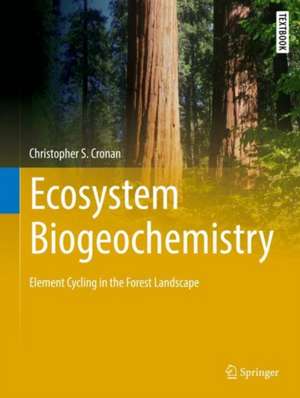
Ecosystem Biogeochemistry
Autor Christopher S. Cronanen Limba Engleză Hardback – 17 oct 2017
Included with the text are figures, tables of comparative data, extensive literature citations, a glossary of terms, an index, and a set of 24 biogeochemical problems with answers. The problems are intended to support chapter concepts and to demonstrate how critical thinking skills, simple algebra, and thoughtful human logic can be used to solve applied problems in biogeochemistry that might be encountered by a research scientist or a resource manager.
Using this book as an introduction to biogeochemistry, students will achieve a level of subject mastery and disciplinary perspective that will permit them to see and to interpret the individual components, interactions, and synergies that are represented in the dynamic element cycling patterns of watershed ecosystems.
Preț: 650.59 lei
Preț vechi: 803.21 lei
-19%
Puncte Express: 976
Carte tipărită la comandă
Livrare economică 15-21 decembrie
Livrare prin curier în România Termenul estimat este afișat lângă disponibilitate.
Transport gratuit pentru acest produs Plată online sau ramburs, în funcție de opțiunile comenzii.
Retur gratuit în 14 zile Comandă securizată și suport în română.
Specificații
ISBN-13: 9783319664439
ISBN-10: 3319664433
Pagini: 220
Ilustrații: XIII, 203 p. 181 illus., 35 illus. in color.
Dimensiuni: 215 x 285 x 18 mm
Greutate: 0.72 kg
Ediția:1st edition 2018
Editura: Springer
Locul publicării:Cham, Switzerland
ISBN-10: 3319664433
Pagini: 220
Ilustrații: XIII, 203 p. 181 illus., 35 illus. in color.
Dimensiuni: 215 x 285 x 18 mm
Greutate: 0.72 kg
Ediția:1st edition 2018
Editura: Springer
Locul publicării:Cham, Switzerland
Cuprins
Preface.- Chapter 1. General Chemical Concepts.- Chapter 2. Soil Biogeochemistry.- Chapter 3. Microbial Biogeochemistry.- Chapter 4. Plant Biogeochemistry.- Chapter 5. Cycling of Organic Matter.- Chapter 6. Atmospheric Deposition.- Chapter 7. Mineral Weathering.- Chapter 8. Watershed Hydrology.- Chapter 9. Aqueous Chemistry.- Chapter 10. Integrated Element Cycling.- Chapter 11. Biogeochemical Modeling.- Chapter 12. Ecosystem Disturbance and Stress.- Epilogue.- Problem Sets in Biogeochemistry.- Problem set answers.- Glossary.- Index.
Notă biografică
Christopher S. Cronan is a Professor Emeritus in the School of Biology and Ecology at the University of Maine. The author earned a B.A. in ecology at the University of Pennsylvania, a Ph.D. in Biological Sciences at Dartmouth College, and was a Charles Bullard Fellow in Forest Resources at Harvard Forest and Harvard University. He is a former director in the School of Biology and Ecology, served as interim director of the Senator George Mitchell Center, and was founding director of the Graduate Program in Ecology and Environmental Science (EES) at the University of Maine. His research with interdisciplinary teams of scientists included fieldwork in the U.S., Canada, and Europe, and his teaching involved courses in ecology, biogeochemistry, general biology, plant physiology, limnology, natural resource policy, plant biology, and field ecology. He published a textbook entitled Ecosystem Biogeochemistry - Element Cycling in the Forest Landscape with Springer NaturePublishing in 2018 and is the author or co-author of 72 peer-reviewed scientific articles in the journals Science, Nature, BioScience, Water Resources Research, Environmental Science and Technology, Ecological Modeling, Landscape Ecology, Tree Physiology, Biogeochemistry, Analytical Chemistry, Geochimica Cosmochimica Acta, Soil Science Society of America Journal, Environmental Management, Canadian Journal of Forest Research, Oecologia, Forest Ecology and Management, Biological Conservation, Environment, Limnology and Oceanography, Landscape and Urban Planning, Applied Geography, Plant and Soil, Journal of Environmental Quality, Water, Air, & Soil Pollution, Environmental Monitoring and Assessment, Ecological Indicators, and Holarctic Ecology.
Textul de pe ultima copertă
This textbook presents a comprehensive process-oriented approach to biogeochemistry that is intended to appeal to readers who want to go beyond a general exposure to topics in biogeochemistry, and instead are seeking a holistic understanding of the interplay of biotic and environmental drivers in the cycling of elements in forested watersheds. The book is organized around a core set of ecosystem processes and attributes that collectively help to generate the whole-system structure and function of a terrestrial ecosystem. In the first nine chapters, a conceptual framework is developed based on distinct soil, microbial, plant, atmospheric, hydrologic, and geochemical processes that are integrated in the element cycling behavior of watershed ecosystems. With that conceptual foundation in place, students then proceed to the final three chapters where they are challenged to think critically about integrated element cycling patterns; roles for biogeochemical models; the likely impacts of disturbance, stress, and management on watershed biogeochemistry; and linkages among patterns and processes in watersheds experiencing novel environmental changes.
Included with the text are figures, tables of comparative data, extensive literature citations, a glossary of terms, an index, and a set of 24 biogeochemical problems with answers. The problems are intended to support chapter concepts and to demonstrate how critical thinking skills, simple algebra, and thoughtful human logic can be used to solve applied problems in biogeochemistry that might be encountered by a research scientist or a resource manager.
Using this book as an introduction to biogeochemistry, students will achieve a level of subject mastery and disciplinary perspective that will permit them to see and to interpret the individual components, interactions, and synergies that are represented in the dynamic element cycling
patterns of watershed ecosystems.- Provides a unified emphasis on forested watershed ecosystems that is more process-oriented, comprehensive, and pedagogical than existing single watershed case studies;
- Delivers a coherent synthesis of biogeochemistry at the watershed ecosystem scale - the most common landscape unit for current research and resource management;
- Enables students to interpret the individual components, interactions, and synergies represented in the dynamic element cycling patterns of watershed ecosystem;
- Presents an operational manual that examines how forested watersheds work with respect to fundamental parts, processes, interrelationships, whole-system behavior, and responses to changing conditions.