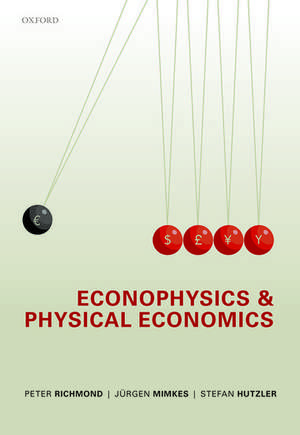
Econophysics and Physical Economics
Autor Peter Richmond, Jürgen Mimkes, Stefan Hutzleren Limba Engleză Hardback – 5 sep 2013
Preț: 593.41 lei
Preț vechi: 645.38 lei
-8%
Puncte Express: 890
Carte disponibilă
Livrare economică 05-10 noiembrie
Livrare prin curier în România Termenul estimat este afișat lângă disponibilitate.
Transport gratuit pentru acest produs Plată online sau ramburs, în funcție de opțiunile comenzii.
Retur gratuit în 14 zile Comandă securizată și suport în română.
Specificații
ISBN-13: 9780199674701
ISBN-10: 0199674701
Pagini: 258
Ilustrații: 111 b/w illustrations
Dimensiuni: 180 x 253 x 20 mm
Greutate: 0.72 kg
Editura: OUP OXFORD
Colecția OUP Oxford
Locul publicării:Oxford, United Kingdom
ISBN-10: 0199674701
Pagini: 258
Ilustrații: 111 b/w illustrations
Dimensiuni: 180 x 253 x 20 mm
Greutate: 0.72 kg
Editura: OUP OXFORD
Colecția OUP Oxford
Locul publicării:Oxford, United Kingdom
V-ar putea interesa
-
 BadassesPeter RichmondPreț: 108.94 lei
 -
 The Physics of FoamsDenis Weaire-31%Preț: 562.04 lei815.94 lei
 -
 Theory of Molecular Fluids: Volume 2: ApplicationsChristopher G. Gray-30%Preț: 791.02 lei1134.00 lei
 -
 Excitons and Cooper Pairs: Two Composite Bosons in Many-Body PhysicsMonique Combescot-23%Preț: 635.50 lei828.55 lei
 -
 Viscoelastic Behavior of Rubbery MaterialsC. Michael Roland-31%Preț: 826.15 lei1196.07 lei
 -
 Structural Inorganic ChemistryAlexander Frank Wells-30%Preț: 729.89 lei1042.62 lei
 -
 -31%Preț: 940.92 lei1360.67 lei
 -
 Basic Aspects of the Quantum Theory of SolidsDaniel I. Khomskii-11%Preț: 517.73 lei581.72 lei
 -
 BallparkPeter RichmondPreț: 123.29 lei
 -
 The Constitution of GlassAdrian C. WrightPreț: 305.94 lei
 -
 Polymineral-Metasomatic CrystallogenesisArkady Eduardovich Glikin-15%Preț: 671.37 lei789.85 lei
 -
 Handbook of Spin Transport and MagnetismEvgeny Y. Tsymbal-18%Preț: 1740.86 lei2123.00 lei
 -
 An Introduction to Metamaterials and Waves in CompositesBiswajit Banerjee-18%Preț: 1263.19 lei1540.48 lei
 -
 SOLVING THE SCHRODINGER EQUATIONPopelier Paul-18%Preț: 815.28 lei994.25 lei
 -
 FLEXOELECTRICITY IN LIQUID CRYSTALSBuka Agnes-15%Preț: 705.24 lei829.69 lei
 -
 SCATTER MATRIX APPR NON-STATION QUANT ..Moskalets Michael V-15%Preț: 648.52 lei762.96 lei
 -
 BCS: 50 YearsLeon N. CooperPreț: 369.41 lei
Recenzii
We argue that similarlaws apply to assemblies of interacting economic agents for which repeatable experiments are also not always possible. The theory leads naturally to an understanding of a range of financial and economic phenomena. One central issue, namely that of non-equilibrium, is also discussed by drawing on recent ideas developed to explore the phenomenon in physical systems, which leads to new insights into the distribution functions of the interacting agents. It is our view that this approach, which combines both theory and empiricism, offers scope for further development and application.
Notă biografică
Peter Richmond studied physics at Queen Mary College, University of London. His career included periods in academia including the Institute of Advanced Studies, ANU Canberra, and the Physics Laboratories, University of Kent. Most recently, in particular during the period spanning the volatile financial era from 1997-2007 and the great housing crash, he was with the School of Physics, Trinity College Dublin. During this period he introduced new research activity concerned with econophysics and gave a course on the subject to final year undergraduates. From 2003-2012 he was chair of two major concerted actions spanning 26 countries across Europe and sponsored by COST; 'Physics of Risk' (2003-2007) and 'Physics of Cooperation and Conflict' (2008-2012). He holds a DSc from the University of London and is a Fellow of the UK Institute of Physics. His publications cover aspects of condensed matter physics, colloids, econophysics, and sociophysics.Jürgen Mimkes studied physics at Georgia Augusta University, Göttingen and the Free University Berlin from 1959 to 1967. After a postdoctoral position at the University of Missouri, Rolla, USA he was Assistant Professor in solid-state thermodynamics at the Technical Universities in both Berlin and Clausthal. From 1977 to retirement in 2004, he was Professor of Physics at the University of Paderborn. He has held visiting appointments in College Park, Maryland, and Chuo University, Tokyo.Stefan Hutzler studied physics at the Universität Regensburg, Germany, and the University of Reading, UK. In 1997 he obtained his PhD from Trinity College Dublin, Ireland, where he is now Associate Professor in the School of Physics. He is also a Fellow of the College. His research interests are the physics of foams, packing problems, and complex systems. He has co-authored over 120 publications in these areas, including 'The Physics of Foams' (together with Prof. Denis Weaire), published by Oxford University Press in 1999.
Cuprins
- 1: Introduction
- 2: Reading financial data
- 3: Basics of probability
- 4: Time dependent processes and the Chapman-Kolmogorov equation
- 5: The Langevin approach to modelling Brownian motion
- 6: The Brownian motion model of asset prices
- 7: Generalized diffusion processes and the Fokker-Planck equation
- 8: Derivatives and options
- 9: Asset fluctuations and scaling
- 10: Models of asset fluctuations
- 11: Risk
- 12: Why markets crash
- 13: Two non-financial markets
- 14: An introduction to physical economics
- 15: Laws of physical economics
- 16: Markets
- 17: A simple model of trade
- 18: Production and economic growth
- 19: Economics and entropy
- 20: Approaches to non-equilibrium economics
- 21: The distribution of wealth in society
- 22: Conclusions and outlook