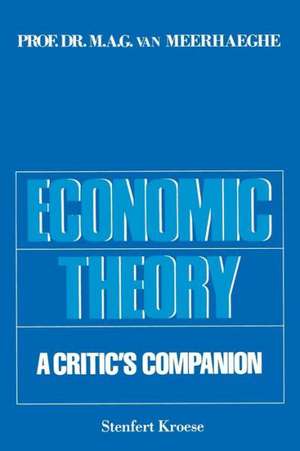
Economic Theory
Autor Marcel Alfons Gilbert van Meerhaegheen Limba Engleză Paperback – 4 noi 2011
Preț: 366.29 lei
Puncte Express: 549
Carte tipărită la comandă
Livrare economică 21 noiembrie-05 decembrie
Livrare prin curier în România Termenul estimat este afișat lângă disponibilitate.
Transport gratuit de la 400.00 lei Plată online sau ramburs, în funcție de opțiunile comenzii.
Retur gratuit în 14 zile Comandă securizată și suport în română.
Specificații
ISBN-13: 9789400987760
ISBN-10: 9400987765
Pagini: 140
Ilustrații: X, 126 p.
Dimensiuni: 152 x 229 x 8 mm
Greutate: 0.22 kg
Ediția:Softcover reprint of the original 1st ed. 1980
Editura: Springer
Locul publicării:Dordrecht, Netherlands
ISBN-10: 9400987765
Pagini: 140
Ilustrații: X, 126 p.
Dimensiuni: 152 x 229 x 8 mm
Greutate: 0.22 kg
Ediția:Softcover reprint of the original 1st ed. 1980
Editura: Springer
Locul publicării:Dordrecht, Netherlands
V-ar putea interesa
-
 Managing Risk in ProjectsDavid HillsonPreț: 441.32 lei
 -
 Preț: 458.01 lei
 -
 Just BusinessGeraint AndersonPreț: 199.83 lei
 -
 Preț: 114.00 lei
 -
 Business Analytics for ManagersWolfgang Jank-15%Preț: 525.61 lei618.36 lei
 -
 Spatial Statistics and ModelingCarlo Gaetan-18%Preț: 1114.35 lei1358.96 lei
 -
 Retire Young Retire RichRobert KiyosakiPreț: 71.34 lei
 -
 Trends in the Economic Well-Being of Female-Headed HouseholdsGabrielle Young-27%Preț: 889.05 lei1210.69 lei
 -
 New Introduction to Multiple Time Series AnalysisHelmut Lütkepohl-18%Preț: 878.32 lei1071.12 lei
 -
 Macroeconomic Patterns and StoriesEdward E. Leamer-18%Preț: 760.45 lei927.38 lei
 -
 Don't Worry About MicroDominik HecknerPreț: 319.17 lei
 -
 Handbook of New Institutional EconomicsClaude Ménard-18%Preț: 728.59 lei888.52 lei
 -
 EconometricsBadi H. BaltagiPreț: 510.27 lei
 -
 -15%Preț: 574.50 lei675.88 lei
 -
 Führen lernenPeter Gräser-11%Preț: 500.38 lei562.23 lei
 -
 -11%Preț: 106.97 lei120.85 lei
Public țintă
ResearchCuprins
1 Introduction.- 1. Terminology.- 2. Originality.- 3. Ideology.- 2 The theory of the consumer’s behaviour.- 1. Gossen’s ‘laws’.- 2. The indifference curves.- 3. The influence of the other consumers.- 4. Demand.- 5. Consumption and saving.- 6. Conclusion.- 3 The theory of producer’s behaviour.- 1. Substitutability and complementarity of production factors.- 2. The optimum combination of factors for a given level of output.- 3. Optimum level of production.- 4. Supply and revenue.- 5. The investment decision.- 6. Conclusion.- 4 The theory of pricing.- 1. Marginalism.- 2. Corporate objectives.- 3. Instruments of corporate policy.- 4. Price interdependence.- 5. The ‘laws’ of supply and demand.- 6. Conclusion.- 5 The theory of income distribution.- 1. The labour market.- 2. The market for loanable funds.- 3. Conclusion.- 6 The theory of the general level of national income and of prices.- 1. Monetary equilibrium and the level of national income.- 2. Inflation.- 3. The transactions equation and the quantity theory.- 4. The cash-balance theory.- 5. Conclusion.- 7 The theory of economic growth.- 1. The Harrod-Domar theory.- 2. The neoclassical theory.- 3. W. Rostow’s theory.- 4. The factors of economic growth.- 5. Conclusion.- 8 The theory of international trade.- 1. The theory of comparative cost.- 2. The Heckscher-Ohlin theory.- 3. Trade and economic growth.- 4. The theory of purchasing-power parity.- 5. The theory of balance-of-payments equilibrium.- 6. Conclusion.- 9 The limited practicability of the theory.- 1. Isolation from other sciences.- 2. Unrealistic hypotheses.- 3. Mathematization of economics.- 4. Conclusion.- 10 The significance of economic theory.- 1. Determinism.- 2. Predictability.- 3. Theory or method?.- 4. Conclusion.- Appendix EconomicDoctrines.- 1. Ancient and Medieval times.- 2. Mercantilism.- 3. Physiocracy.- 4. The classical school.- 5. The historical school.- 6. Socialism.- 7. The Austrian school and the Lausanne school.- 8. Neoclassicism and the Swedish school.- 9. Institutionalism.- 10. The Keynesian ‘revolution’ 104.- 11. J.A. Schumpeter.- 12. Neo-Marxism.- 13. Neoliberalism.- Endnotes.