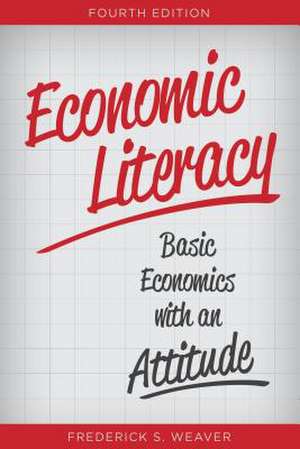
Economic Literacy: Basic Economics with an Attitude
Autor Frederick S. Weaveren Limba Engleză Paperback – 22 aug 2017
Preț: 264.19 lei
Preț vechi: 350.54 lei
-25%
Puncte Express: 396
Carte tipărită la comandă
Livrare economică 08-22 iunie
Specificații
ISBN-13: 9781442273429
ISBN-10: 1442273429
Pagini: 191
Ilustrații: 14 tables; 21 graphs; 10 textboxes
Dimensiuni: 152 x 231 x 16 mm
Greutate: 0.32 kg
Ediția:4
Editura: Bloomsbury Publishing
Colecția Rowman & Littlefield
Locul publicării:New York, United States
ISBN-10: 1442273429
Pagini: 191
Ilustrații: 14 tables; 21 graphs; 10 textboxes
Dimensiuni: 152 x 231 x 16 mm
Greutate: 0.32 kg
Ediția:4
Editura: Bloomsbury Publishing
Colecția Rowman & Littlefield
Locul publicării:New York, United States
Cuprins
List of Figures
List of Tables
Preface and Acknowledgments
Introduction
Part I: Microeconomics and the Theory of Markets
Chapter 1: Demand and Supply
Chapter 2: The Theory of the Firm, Market Structures, Factor Markets, and the Distribution of Income
Part II: Macroeconomics
Chapter 3: The Economy as a Whole: Definitions and Analyses
Chapter 4: Fiscal Policy, Monetary Policy, Recession, and Inflation
Part III: International Economics and National Economies
Chapter 5: Comparative Advantage, Foreign Investment, and the Post-World War II Creation of the International Economy
Chapter 6: Crises and the Transformation of the International Economy
Appendix: Websites of Related Interest
Index
About the Author
List of Tables
Preface and Acknowledgments
Introduction
Part I: Microeconomics and the Theory of Markets
Chapter 1: Demand and Supply
Chapter 2: The Theory of the Firm, Market Structures, Factor Markets, and the Distribution of Income
Part II: Macroeconomics
Chapter 3: The Economy as a Whole: Definitions and Analyses
Chapter 4: Fiscal Policy, Monetary Policy, Recession, and Inflation
Part III: International Economics and National Economies
Chapter 5: Comparative Advantage, Foreign Investment, and the Post-World War II Creation of the International Economy
Chapter 6: Crises and the Transformation of the International Economy
Appendix: Websites of Related Interest
Index
About the Author
Recenzii
Economic Literacy is an excellent introduction to the basics of microeconomics, macroeconomics, and international economics. I have used the first three editions of the book to teach political economy to undergraduates for the past decade; it provides an extremely accessible and readable discussion of the core economic concepts that students need, while requiring little more than basic arithmetic skills to understand. The fourth edition of the work improves on its treatment of American political economy and updates the data and examples to retain its relevance to today's student population. Accurate, readable, and concise, Economic Literacy is highly recommended for interdisciplinary courses that involve economic reasoning.?
"Economic Literacy is recommended reading for all my political economy classes. Weaver provides a concise, clear, and accessible primer on economics that is perfect for students seeking plain-English explanations of the economic principles and terminology referenced in political economy readings. The new edition helpfully tackles the complicated concepts of the Global Financial Crisis, further solidifying the book's utility."
"Weaver's colloquial prose inevitably makes economics more accessible than ever. Since Economic Literacy also parallels standard texts topically, it can be readily used as either the primary text with another serving as an extra-for-experts supplement, or as a secondary text to assuage the less technically savvy reader. The lack of dense, turgid language and the modicum of graphs and charts enables a casual weekend read while simultaneously facilitating critical economics thinking. And, after all, the latter is the job of teachers of economics--to encourage our students to apply an economics lens as they gaze at the world around them."
"Economic Literacy is recommended reading for all my political economy classes. Weaver provides a concise, clear, and accessible primer on economics that is perfect for students seeking plain-English explanations of the economic principles and terminology referenced in political economy readings. The new edition helpfully tackles the complicated concepts of the Global Financial Crisis, further solidifying the book's utility."
"Weaver's colloquial prose inevitably makes economics more accessible than ever. Since Economic Literacy also parallels standard texts topically, it can be readily used as either the primary text with another serving as an extra-for-experts supplement, or as a secondary text to assuage the less technically savvy reader. The lack of dense, turgid language and the modicum of graphs and charts enables a casual weekend read while simultaneously facilitating critical economics thinking. And, after all, the latter is the job of teachers of economics--to encourage our students to apply an economics lens as they gaze at the world around them."