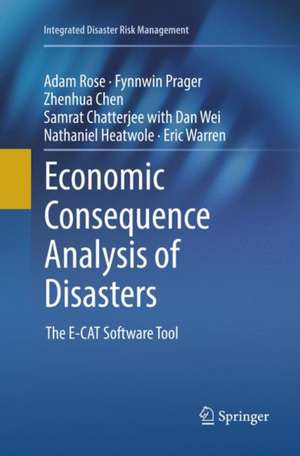
Economic Consequence Analysis of Disasters: Integrated Disaster Risk Management
Autor Adam Rose, Fynnwin Prager, Zhenhua Chen, Samrat Chatterjee, Dan Wei, Nathaniel Heatwole, Eric Warrenen Limba Engleză Paperback – 9 mai 2018
This study develops a methodology for rapidly obtaining approximate estimates of the economic consequences from numerous natural, man-made and technological threats. This software tool is intended for use by various decision makers and analysts to obtain estimates rapidly. It is programmed in Excel and Visual Basic for Applications (VBA) to facilitate its use. This tool is called E-CAT (Economic Consequence Analysis Tool) and accounts for the cumulative direct and indirect impacts (including resilience and behavioral factors that significantly affect base estimates) on the U.S. economy. E-CAT is intended to be a major step toward advancing the current state of economic consequence analysis (ECA) and also contributing to and developing interest in further research into complex but rapid turnaround approaches.
The essence of the methodology involves running numerous simulations in a computable general equilibrium (CGE) model for each threat, yielding synthetic data for the estimation of a single regression equation based on the identification of key explanatory variables (threat characteristics and background conditions). This transforms the results of a complex model, which is beyond the reach of most users, into a "reduced form" model that is readily comprehensible. Functionality has been built into E-CAT so that its users can switch various consequence categories on and off in order to create customized profiles of economic consequences of numerous risk events. E-CAT incorporates uncertainty on both the input and output side in the course of the analysis.

Preț: 452.26 lei
Puncte Express: 678
Carte tipărită la comandă
Livrare economică 04-10 iunie
Specificații
ISBN-13: 9789811096532
ISBN-10: 9811096538
Pagini: 184
Ilustrații: XLV, 137 p. 28 illus., 14 illus. in color.
Dimensiuni: 155 x 235 x 10 mm
Greutate: 0.32 kg
Ediția:Softcover reprint of the original 1st edition 2017
Editura: Springer
Colecția Integrated Disaster Risk Management
Seria Integrated Disaster Risk Management
Locul publicării:Singapore, Singapore
ISBN-10: 9811096538
Pagini: 184
Ilustrații: XLV, 137 p. 28 illus., 14 illus. in color.
Dimensiuni: 155 x 235 x 10 mm
Greutate: 0.32 kg
Ediția:Softcover reprint of the original 1st edition 2017
Editura: Springer
Colecția Integrated Disaster Risk Management
Seria Integrated Disaster Risk Management
Locul publicării:Singapore, Singapore
V-ar putea interesa
-
 The Plundered PlanetPaul Collier-20%Preț: 59.88 lei75.32 lei
 -
 Preț: 368.82 lei
 -
 Plundered Nations?Paul Collier-15%Preț: 456.14 lei536.64 lei
 -
 Preț: 126.37 lei
 -
 The Green to Gold Business PlaybookDaniel C. EstyPreț: 266.19 lei
 -
 Preț: 311.47 lei
 -
 Pricing Carbon: The European Union Emissions Trading SchemeA. Denny Ellerman-11%Preț: 428.94 lei481.95 lei
 -
 Sustainable Development in PracticeMohan Munasinghe-25%Preț: 440.73 lei589.10 lei
 -
 Consumption and Its ConsequencesDaniel MillerPreț: 143.46 lei
 -
 Modeling Dynamic Economic SystemsMatthias Ruth-15%Preț: 572.82 lei673.90 lei
 -
 Energy, Environment and DevelopmentJose GoldembergPreț: 420.41 lei
 -
 Preț: 271.87 lei
 -
 An Introduction to Climate Change Economics and PolicyFelix R. Fitzroy-21%Preț: 198.21 lei250.18 lei
 -
 Preț: 340.97 lei
Cuprins
Introduction.- Enumeration of Categories of Economic Consequences.- Threat Scenarios and Direct Impacts.- Computable General Equilibrium Modeling and Its Application.- User Interface Variable.- Estimation of the Reduced Form Coefficients for the E-CAT User Interface.- Uncertainty Analysis.- Validation of Computable General Equilibrium Based Models.- E-CAT User Interface Tool.
Notă biografică
Adam Rose: Price School of Public Policy and Center for Risk and Economic Analysis of Terrorism Events (CREATE), University of Southern California
Fynnwin Prager: College of Business Administration and Public Policy, California State University, Dominguez Hills
Zhenhua Chen: Center for Risk and Economic Analysis of Terrorism Events (CREATE), University of Southern California
Samrat Chatterjee: Applied Statistics and Computational Modeling, Pacific Northwest National Laboratory
Dan Wei: Price School of Public Policy and Center for Risk and Economic Analysis of Terrorism Events (CREATE), University of Southern California
Nathaniel Heatwole: Acumen, LLC
Eric Warren: Center for Risk and Economic Analysis of Terrorism Events (CREATE), University of Southern California
Textul de pe ultima copertă
This study develops a methodology for rapidly obtaining approximate estimates of the economic consequences from numerous natural, man-made and technological threats. This software tool is intended for use by various decision makers and analysts to obtain estimates rapidly. It is programmed in Excel and Visual Basic for Applications (VBA) to facilitate its use. This tool is called E-CAT (Economic Consequence Analysis Tool) and accounts for the cumulative direct and indirect impacts (including resilience and behavioral factors that significantly affect base estimates) on the U.S. economy. E-CAT is intended to be a major step toward advancing the current state of economic consequence analysis (ECA) and also contributing to and developing interest in further research into complex but rapid turnaround approaches.
Caracteristici
Provides comprehensive assessment of economic consequences of disasters Studies measurement of resilience and behavioral responses to disasters Contains computable general equilibrium analysis of direct and indirect impacts Introduces reduced-form analysis of disasters Presents measurement of uncertainty of input parameters and results