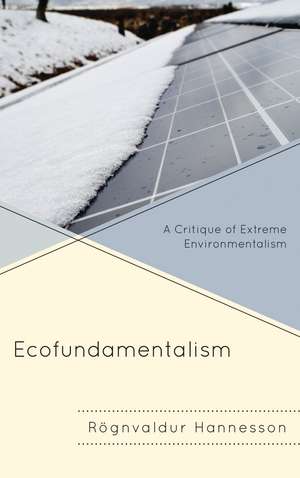
Ecofundamentalism: A Critique of Extreme Environmentalism
Autor Rögnvaldur Hannessonen Limba Engleză Paperback – 15 dec 2015
Without massive monocultures, supported by pesticides and fertilizer, we could never feed ourselves. Almost 90 percent of our primary energy comes from fossil fuels, without which there would be no air travel, cars and trucks, reliable electricity, and even much of our food supply. Putting a premium on biodiversity and getting serious about greenhouse gas emissions would force us to go without these things, putting us back in the Middle Ages.
Fortunately, there is no need to heed any of these environmentalist prescriptions. Contrary to the notion that economic growth is unsustainable and our core problem, it is actually the core solution. Economic growth and technology has made it possible for food production to outpace population growth since the industrial revolution. Economic growth is one reason why population growth worldwide has fallen so that the "population bomb" may never explode. It has also made us largely independent of the weather except for growing our crops. Meanwhile, ecofundamentalism would cause more harm than good.
Preț: 333.77 lei
Preț vechi: 434.31 lei
-23%
Puncte Express: 501
Carte tipărită la comandă
Livrare economică 04-18 decembrie
Livrare prin curier în România Termenul estimat este afișat lângă disponibilitate.
Transport gratuit de la 400.00 lei Plată online sau ramburs, în funcție de opțiunile comenzii.
Retur gratuit în 14 zile Comandă securizată și suport în română.
Specificații
ISBN-13: 9781498532280
ISBN-10: 1498532284
Pagini: 130
Ilustrații: 16 BW Illustrations, 16 Graphs
Dimensiuni: 152 x 229 x 10 mm
Greutate: 0.23 kg
Editura: Bloomsbury Publishing
Colecția Lexington Books
Locul publicării:New York, United States
ISBN-10: 1498532284
Pagini: 130
Ilustrații: 16 BW Illustrations, 16 Graphs
Dimensiuni: 152 x 229 x 10 mm
Greutate: 0.23 kg
Editura: Bloomsbury Publishing
Colecția Lexington Books
Locul publicării:New York, United States
Cuprins
Environmentalism: a Critique
Contents
Acknowledgement
Chapter 1: Introduction
Chapter 2: Environmentalism: what is it?
Chapter 3: Sustainability
Chapter 4: Biodiversity, alien species, and "iconic" animals
Chapter 5: Energy
Chapter 6: Global warming, forest death, and the ozone hole
Chapter 7: Is the world overpopulated?
Chapter 8: Fisheries, aquaculture, and the oceans
Chapter 9: Conclusion
Literature
Contents
Acknowledgement
Chapter 1: Introduction
Chapter 2: Environmentalism: what is it?
Chapter 3: Sustainability
Chapter 4: Biodiversity, alien species, and "iconic" animals
Chapter 5: Energy
Chapter 6: Global warming, forest death, and the ozone hole
Chapter 7: Is the world overpopulated?
Chapter 8: Fisheries, aquaculture, and the oceans
Chapter 9: Conclusion
Literature
Recenzii
In this book, world-renowned fisheries economist Hannesson states that his goal is to debunk environmentalism of the ecofundamentalist variety as ahistorical, unscientific, and an outright threat to progress. Putting aside his technical and statistical tools to critically evaluate his subject, the author defines ecofundamentalists as people who put nature above humans and accuses them of being hypocrites benefiting from the comforts of the industry they deride and of self-aggrandizement promoting doom and gloom. According to the author, ecofundamentalists may be a minority and represent marginal opinion, but they are capable of shaping public thinking to an unwarranted degree. He does admit there are limits to the use of nonrenewable resources, but if experience is any guide, he concludes, people will probably do just fine. To environmentalists who urge precaution, Hannesson says the only way to learn about the dangers of a product is by using it. Possibly his most striking opinion is that people have learned the laws of nature and turned them to their advantage. A nonanalytical critique, this book is recommended as a reasoned counter to some of the arguments of environmentalism. Summing Up: Recommended. Lower-division undergraduates and above; general readers.
Professor Rögnvaldur Hannesson, an authority on natural resource management, has written a well-argued, even if polemical, book against ecofundamentalism, which, for him, puts nature before man. . . .Hannesson has written an instructive, concise book, successfully debunking many myths about the environment, with sober analysis rather than rhetoric.
Ecofundamentalism: A Critique of Extreme Environmentalism is a valuable book for presenting a careful and reasoned counter to some of the arguments of environmentalism. Rögnvaldur Hannesson is an accomplished scholar and an environmentalist in his own right. His arguments point to the critical need for positive analysis of the tradeoffs encountered in confronting environmental and natural resource problems in order to enhance the wellbeing of the planet and its inhabitants of all kinds.
Rögnvaldur Hannesson is a world-renowned fisheries economist, but in this book he puts aside his technical and statistical tools to critically evaluate "ecofundamentalism" through an economic lens anyone can understand. If you are an open-minded environmentalist, you will have to re-evaluate your position on many issues including global warming, and if you are an "ecofundamentalist," your foundation will be shaken.
Professor Rögnvaldur Hannesson, an authority on natural resource management, has written a well-argued, even if polemical, book against ecofundamentalism, which, for him, puts nature before man. . . .Hannesson has written an instructive, concise book, successfully debunking many myths about the environment, with sober analysis rather than rhetoric.
Ecofundamentalism: A Critique of Extreme Environmentalism is a valuable book for presenting a careful and reasoned counter to some of the arguments of environmentalism. Rögnvaldur Hannesson is an accomplished scholar and an environmentalist in his own right. His arguments point to the critical need for positive analysis of the tradeoffs encountered in confronting environmental and natural resource problems in order to enhance the wellbeing of the planet and its inhabitants of all kinds.
Rögnvaldur Hannesson is a world-renowned fisheries economist, but in this book he puts aside his technical and statistical tools to critically evaluate "ecofundamentalism" through an economic lens anyone can understand. If you are an open-minded environmentalist, you will have to re-evaluate your position on many issues including global warming, and if you are an "ecofundamentalist," your foundation will be shaken.