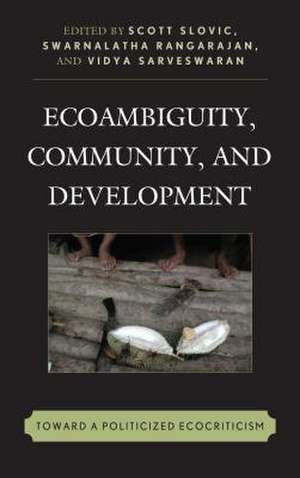
Ecoambiguity, Community, and Development: Toward a Politicized Ecocriticism: Ecocritical Theory and Practice
Editat de Scott Slovic, Swarnalatha Rangarajan, Vidya Sarveswaran Contribuţii de Karen Thornber, Gang Yue, Cheng Li, Yanjun Liu, Tsutomu Takahashi, Jyotirmaya Tripathy, Pamod Nayar, Laura A. White, Inna Sukhenko, Salma Monani, Dora Alicia Ramírez, Aarti Madan, George B. Handleyen Limba Engleză Paperback – 16 oct 2015
While not all the authors explicitly invoke Karen Thornber's term "ecoambiguity" or the concepts and terminology of postcolonial ecocriticism, their articles frequently bring to light various ironies. For example, the fact that Ukrainian environmental experience in the twenty-first century is defined by one of the world's most infamous industrial disasters, the Chernobyl nuclear accident of 1986, yet Ukrainian culture, like many throughout the world, actually cherishes a profound, even animistic, attachment to the wonders of nature. The repetition of this and other paradoxes in human cultural responses to the more-than-human world reinforces our sense of the congruities and idiosyncrasies of human culture. Every human culture, regardless of its condition of economic and industrial development, has produced its own version of "environmental literature and art"-but the nuances of this work reflect that culture's precise social and geophysical circumstances. In various ways, these stories of community and development from across the planet converge and diverge, as told and explained by distinguished scholars, many of whom come from the cultures represented in these articles.
Din seria Ecocritical Theory and Practice
- 32%
 Preț: 528.45 lei
 - 31%
 Preț: 531.25 lei
 - 33%
 Preț: 581.25 lei
 - 26%
 Preț: 293.65 lei
 - 23%
 Preț: 328.98 lei
 -
 Preț: 325.23 lei
 - 26%
 Preț: 286.85 lei
 - 31%
 Preț: 529.58 lei
 - 33%
 Preț: 582.81 lei
 - 27%
 Preț: 284.27 lei
 - 33%
 Preț: 550.43 lei
 - 36%
 Preț: 690.52 lei
 - 28%
 Preț: 353.14 lei
 - 25%
 Preț: 367.77 lei
 - 33%
 Preț: 640.50 lei
 - 33%
 Preț: 550.88 lei
 - 27%
 Preț: 352.24 lei
 - 33%
 Preț: 705.42 lei
 - 34%
 Preț: 569.73 lei
 - 26%
 Preț: 360.79 lei
 - 25%
 Preț: 571.04 lei
 - 36%
 Preț: 679.30 lei
 - 33%
 Preț: 549.31 lei
 - 33%
 Preț: 581.55 lei
 - 32%
 Preț: 616.15 lei
 - 36%
 Preț: 679.30 lei
 - 27%
 Preț: 362.06 lei
 - 29%
 Preț: 343.17 lei
 - 23%
 Preț: 320.61 lei
 - 27%
 Preț: 285.65 lei
 - 33%
 Preț: 614.26 lei
 - 35%
 Preț: 561.12 lei
 - 33%
 Preț: 582.62 lei
 - 34%
 Preț: 574.47 lei
 - 22%
 Preț: 326.87 lei
 - 34%
 Preț: 600.88 lei
 - 26%
 Preț: 286.85 lei
 - 34%
 Preț: 601.74 lei
 - 30%
 Preț: 545.83 lei
 - 28%
 Preț: 347.76 lei
 - 34%
 Preț: 575.01 lei
Preț: 377.48 lei
Preț vechi: 578.58 lei
-35%
Puncte Express: 566
Carte tipărită la comandă
Livrare economică 04-18 decembrie
Livrare prin curier în România Termenul estimat este afișat lângă disponibilitate.
Transport gratuit de la 400.00 lei Plată online sau ramburs, în funcție de opțiunile comenzii.
Retur gratuit în 14 zile Comandă securizată și suport în română.
Specificații
ISBN-13: 9781498525367
ISBN-10: 1498525369
Pagini: 214
Dimensiuni: 149 x 232 x 15 mm
Greutate: 0.33 kg
Editura: Bloomsbury Publishing
Colecția Lexington Books
Seria Ecocritical Theory and Practice
Locul publicării:New York, United States
ISBN-10: 1498525369
Pagini: 214
Dimensiuni: 149 x 232 x 15 mm
Greutate: 0.33 kg
Editura: Bloomsbury Publishing
Colecția Lexington Books
Seria Ecocritical Theory and Practice
Locul publicării:New York, United States
V-ar putea interesa
-
 -30%Preț: 442.56 lei627.86 lei
 -
 Preț: 174.19 lei
 -
 Preț: 191.69 lei
 -
 Preț: 422.48 lei
 -
 Preț: 405.48 lei
 -
 Cancer Ecologies: A Queer Femme PortalProfessor Nina Lykke-31%Preț: 570.84 lei832.62 lei
 -
 -32%Preț: 564.69 lei830.84 lei
 -
 Preț: 239.90 lei
 -
 Ecocide in UkraineDarya TsymbalyukPreț: 132.48 lei
 -
 An Ecotopian LexiconMatthew Schneider-MayersonPreț: 192.78 lei
 -
 Wild FictionsAmitav Ghosh-24%Preț: 105.83 lei139.60 lei
 -
 -33%Preț: 558.25 lei837.65 lei
 -
 Environmental FuturesCaren IrrPreț: 258.47 lei
 -
 -14%Preț: 108.39 lei126.68 lei
 -
 SunbirthAn YuPreț: 108.24 lei
 -
 Writing EcofictionKevan ManwaringPreț: 233.57 lei
 -
 Preț: 234.61 lei
 -
 Life on a Little-Known PlanetElizabeth KolbertPreț: 193.02 lei
Cuprins
Table of Contents
Introduction
Scott Slovic, Swarnalatha Rangarajan, and Vidya Sarveswaran
Chapter 1: Plundering Borderlands North and South
Karen Thornber
Chapter 2: Tibet, a Topos in Ecopolitics of the Global South
Gang Yue
Chapter 3: Red China, Green Amnesia: Locating Environmental Justice in Contemporary Chinese Literature
Cheng Li and Yanjun Liu
Chapter 4: Minamata and the Symbolic Discourse of the South
Tsutomu Takahashi
Chapter 5: Indian Environmentalism and Its Fragments
Jyotirmaya Tripathy
Chapter 6: From Bhopal to Biometrics: Biological Citizenship in the Age of Globalization
Pamod Nayar
Chapter 7: Beyond the Eco-flaneur's Footsteps: Perambulatory Narration in Zakes Mda's Ways of Dying
Laura A. White
Chapter 8: Reconsidering the Eco-Imperatives of Ukrainian Consciousness: An Introduction to Ukrainian Environmental Literature
Inna Sukhenko
Chapter 9: Kissed by Lightning and Fourth Cinema's Natureculture Continuum
Salma Monani
Chapter 10: Under all the laws, natural, human, and divine: Reinterpreting La Leyenda Negra's Colonial Purpose
Dora Ramirez-Dhoore
Chapter 11: Mapmaking, Rubbertapping: Cartography and Social Ecology in Euclides da Cunha's The Amazon: Land Without History
Aarti Madan
Chapter 12: Down Under: New World Literatures and Ecocriticism
George B. Handley
Index
Contributors
Introduction
Scott Slovic, Swarnalatha Rangarajan, and Vidya Sarveswaran
Chapter 1: Plundering Borderlands North and South
Karen Thornber
Chapter 2: Tibet, a Topos in Ecopolitics of the Global South
Gang Yue
Chapter 3: Red China, Green Amnesia: Locating Environmental Justice in Contemporary Chinese Literature
Cheng Li and Yanjun Liu
Chapter 4: Minamata and the Symbolic Discourse of the South
Tsutomu Takahashi
Chapter 5: Indian Environmentalism and Its Fragments
Jyotirmaya Tripathy
Chapter 6: From Bhopal to Biometrics: Biological Citizenship in the Age of Globalization
Pamod Nayar
Chapter 7: Beyond the Eco-flaneur's Footsteps: Perambulatory Narration in Zakes Mda's Ways of Dying
Laura A. White
Chapter 8: Reconsidering the Eco-Imperatives of Ukrainian Consciousness: An Introduction to Ukrainian Environmental Literature
Inna Sukhenko
Chapter 9: Kissed by Lightning and Fourth Cinema's Natureculture Continuum
Salma Monani
Chapter 10: Under all the laws, natural, human, and divine: Reinterpreting La Leyenda Negra's Colonial Purpose
Dora Ramirez-Dhoore
Chapter 11: Mapmaking, Rubbertapping: Cartography and Social Ecology in Euclides da Cunha's The Amazon: Land Without History
Aarti Madan
Chapter 12: Down Under: New World Literatures and Ecocriticism
George B. Handley
Index
Contributors
Recenzii
A new critical formation, sometimes called environmental humanities, has been successfully interrogating the assumptions about nature, history, and culture made by an earlier generation of largely European and North American writers, scholars, and activists. This collection of thoughtful and stimulating essays, arranged and introduced superbly by the editors, continues with this essential task of building a properly worldly analysis and interpretation of our current environmental crises-a task on which, quite literally, our lives might depend.
This intriguing collection is like an odyssey into the hermeneutics of "ecoambiguity." It sheds light on the problematic entanglements of ecodegradation and social repression with vivid local examples from the Global South. The essays here explore how ecoambiguity emerges from the contested intersectional sites of environmental and social justice. They reveal the contingencies of nature-culture interactions when pressing environmental problems are materially bound up with social distress and cultural oppression. Zeroing in on a particular local narrative, each essay unravels the spectral lines that disclose ecoambiguity as a historical and political process of inadvertent collisions between people and the environment. The co-extensivity of ecological devastation with poverty, pollution, domestic colonialism, and industrial development is so well expressed that the ambivalences of eco-deterioration immediately make sense.
This is a dynamic, wide-ranging collection. It offers powerful testimony to the entanglement between cultural and environmental challenges. It also reminds us of the power of literature and film as imaginative resources for deepening our understanding of those challenges. The book's geographical reach is unusual and impressive.
This innovative collection decisively outlines why environmental justice and postcolonial theories are taking hold among the ecocritics at work in China, Japan, India, Ukraine, Mexico, and Brazil, and other indigenous or first nations-such as the Mohawk. Distinguished established scholars, and important new voices in the field, many from the cultures about which they write, confront the paradoxical tendencies of selective cultural appreciation and destruction found in some of the globe's most talked-about 'developing' nations. The result is a powerful and highly engaging new contribution to the field that will challenge conventional assumptions about the environmentalism(s), literatures, and films of the nations, regions, and communities under analysis.
An excellent and timely collection, consolidating recent advances in postcolonial ecocriticism but pushing it in new directions and applying its theories and methods to under-represented parts of an increasingly connected but unevenly developed and culturally differentiated world. The early chapters on China, Tibet, and Japan are especially useful insofar as these complex regions rarely feature in more conventional accounts of postcolonial ecocriticism; but all the essays here make significant contributions to a densely political field which, in lead author Karen Thornber's words, 'further ambiguates [rather than resolves] the ecological conundrums it describes.'
This intriguing collection is like an odyssey into the hermeneutics of "ecoambiguity." It sheds light on the problematic entanglements of ecodegradation and social repression with vivid local examples from the Global South. The essays here explore how ecoambiguity emerges from the contested intersectional sites of environmental and social justice. They reveal the contingencies of nature-culture interactions when pressing environmental problems are materially bound up with social distress and cultural oppression. Zeroing in on a particular local narrative, each essay unravels the spectral lines that disclose ecoambiguity as a historical and political process of inadvertent collisions between people and the environment. The co-extensivity of ecological devastation with poverty, pollution, domestic colonialism, and industrial development is so well expressed that the ambivalences of eco-deterioration immediately make sense.
This is a dynamic, wide-ranging collection. It offers powerful testimony to the entanglement between cultural and environmental challenges. It also reminds us of the power of literature and film as imaginative resources for deepening our understanding of those challenges. The book's geographical reach is unusual and impressive.
This innovative collection decisively outlines why environmental justice and postcolonial theories are taking hold among the ecocritics at work in China, Japan, India, Ukraine, Mexico, and Brazil, and other indigenous or first nations-such as the Mohawk. Distinguished established scholars, and important new voices in the field, many from the cultures about which they write, confront the paradoxical tendencies of selective cultural appreciation and destruction found in some of the globe's most talked-about 'developing' nations. The result is a powerful and highly engaging new contribution to the field that will challenge conventional assumptions about the environmentalism(s), literatures, and films of the nations, regions, and communities under analysis.
An excellent and timely collection, consolidating recent advances in postcolonial ecocriticism but pushing it in new directions and applying its theories and methods to under-represented parts of an increasingly connected but unevenly developed and culturally differentiated world. The early chapters on China, Tibet, and Japan are especially useful insofar as these complex regions rarely feature in more conventional accounts of postcolonial ecocriticism; but all the essays here make significant contributions to a densely political field which, in lead author Karen Thornber's words, 'further ambiguates [rather than resolves] the ecological conundrums it describes.'