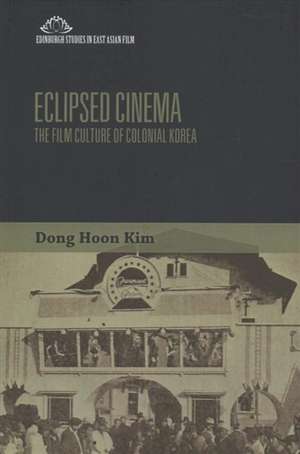
Eclipsed Cinema
Autor Dong Hoon Kimen Limba Engleză Paperback – 10 aug 2018
Preț: 208.69 lei
Preț vechi: 249.05 lei
-16%
Puncte Express: 313
Carte disponibilă
Livrare economică 09-23 noiembrie
Livrare prin curier în România Termenul estimat este afișat lângă disponibilitate.
Transport gratuit de la 400.00 lei Plată online sau ramburs, în funcție de opțiunile comenzii.
Retur gratuit în 14 zile Comandă securizată și suport în română.
Specificații
ISBN-13: 9781474437547
ISBN-10: 1474437540
Pagini: 304
Ilustrații: Illustrations, unspecified
Dimensiuni: 155 x 234 x 23 mm
Greutate: 0.43 kg
Ediția:113,000 edition
Editura: EDINBURGH UNIVERSITY PRESS
ISBN-10: 1474437540
Pagini: 304
Ilustrații: Illustrations, unspecified
Dimensiuni: 155 x 234 x 23 mm
Greutate: 0.43 kg
Ediția:113,000 edition
Editura: EDINBURGH UNIVERSITY PRESS
Cuprins
List of Illustrations
Acknowledgements
INTRODUCTION
INTRODUCING JOSEON CINEMA: THE QUESTION OF FILM HISTORY AND THE FILM CULTURE OF COLONIAL KOREA
CHAPTER 1
THE BEGINNING: TOWARD A MASS ENTERTAINMENT
Film Culture Begins: The Development of Early Film Culture
Film Production Begins: Moving Picture Unit of the Office of the Governor-General
CHAPTER 2
JOSEON CINEMA, CINEMATIC JOSEON: ON SOME CRITICAL QUESTIONS OF JOSEON CINEMA
Desperately Seeking the Joseon Image: Arirang (1926) and the Making of Joseon Film Aesthetics
Joseon Film Lyricism: Joseon Colour and Joseon Films 'Exported' to Japan
CHAPTER 3
MIGRATING WITH THE MOVIES: JAPANESE SETTLER FILM CULTURE
The Formation and Characteristics of Settler Film Culture
'A Film Practice Distinctly Joseon': The Ethnic Segregation of Movie Theatres
CHAPTER 4
COLONIAL FILM SPECTATORSHIP: NATIONALIST ENOUGH?
Korean Spectators or How They Learned to Stop Worrying and Love Hollywood
Performing Colonial Identity: The Transcolonial Practice of Byeonsa/Benshi
CHAPTER 5
FILM SPECTATORSHIP AND THE TENSIONS OF MODERNITY
Modern Girls and Boys Go to the Movies: Cinema, Modernity, and the Colonised Nation
Mobility, Movie Theatres, and Female Film Spectatorship
CONCLUSION
INTEGRATING INTO THE IMPERIAL CINEMA
Appendix
Bibliography
Acknowledgements
INTRODUCTION
INTRODUCING JOSEON CINEMA: THE QUESTION OF FILM HISTORY AND THE FILM CULTURE OF COLONIAL KOREA
CHAPTER 1
THE BEGINNING: TOWARD A MASS ENTERTAINMENT
Film Culture Begins: The Development of Early Film Culture
Film Production Begins: Moving Picture Unit of the Office of the Governor-General
CHAPTER 2
JOSEON CINEMA, CINEMATIC JOSEON: ON SOME CRITICAL QUESTIONS OF JOSEON CINEMA
Desperately Seeking the Joseon Image: Arirang (1926) and the Making of Joseon Film Aesthetics
Joseon Film Lyricism: Joseon Colour and Joseon Films 'Exported' to Japan
CHAPTER 3
MIGRATING WITH THE MOVIES: JAPANESE SETTLER FILM CULTURE
The Formation and Characteristics of Settler Film Culture
'A Film Practice Distinctly Joseon': The Ethnic Segregation of Movie Theatres
CHAPTER 4
COLONIAL FILM SPECTATORSHIP: NATIONALIST ENOUGH?
Korean Spectators or How They Learned to Stop Worrying and Love Hollywood
Performing Colonial Identity: The Transcolonial Practice of Byeonsa/Benshi
CHAPTER 5
FILM SPECTATORSHIP AND THE TENSIONS OF MODERNITY
Modern Girls and Boys Go to the Movies: Cinema, Modernity, and the Colonised Nation
Mobility, Movie Theatres, and Female Film Spectatorship
CONCLUSION
INTEGRATING INTO THE IMPERIAL CINEMA
Appendix
Bibliography
Descriere
In this ground-breaking investigation into the seldom-studied film culture of colonial Korea (1910-1945), Dong Hoon Kim brings new perspectives to the associations between colonialism, modernity, film historiography and national cinema.