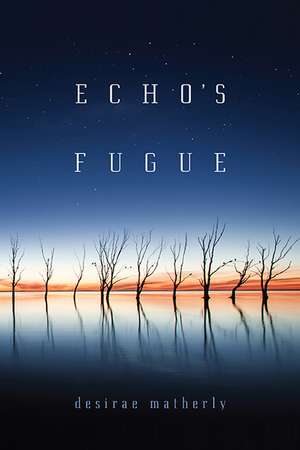
Echo’s Fugue: 21st Century Essays
Autor Desirae Matherlyen Limba Engleză Paperback – 12 sep 2019
Through a series of variations on the theme of love—unrequited, polyamorous, monogomous, scandalous, adulterous—Desirae Matherly’s Echo’s Fugue explores love in all its failures and delusions. Patterned on the unfinished The Art of Fugue by Johann Sebastian Bach which has been a mystery for centuries, Echo’s Fugue undertakes Bach’s project in prose—the tantalizing numerical correspondences throughout, the repetition of a single theme, the unfinished final piece. Matherly’s essays appear as letters, indexes, narrative, or sentence diagrams, each defying the rules of the blank page. Song lyrics, obsession, Greek mythology, psychology, game theory, and human sexuality form a fragmented narrative about loss and unhealthy attachments. Mimicry of Bach’s fugues leads the author to questions about love, sex, desire, the “Bach or Stravinsky” paradigm in game theory, and relationships considered taboo by mainstream standards. What authority speaks clearest with regard to love, sex, and desire—and is objectivity even possible? The final essay attempts to resolve this question while echoing the puzzle of Bach’s final unfinished fugue.
Din seria 21st Century Essays
-
 Preț: 103.81 lei
 -
 Preț: 99.82 lei
 -
 Preț: 101.79 lei
 -
 Preț: 149.61 lei
 -
 Preț: 122.02 lei
 -
 Preț: 103.92 lei
 -
 Preț: 149.61 lei
 -
 Preț: 116.61 lei
 -
 Preț: 132.38 lei
 -
 Preț: 107.95 lei
 -
 Preț: 105.72 lei
 -
 Preț: 133.85 lei
 -
 Preț: 130.09 lei
 -
 Preț: 101.03 lei
 -
 Preț: 108.07 lei
 -
 Preț: 102.03 lei
 -
 Preț: 97.17 lei
 -
 Preț: 183.41 lei
 -
 Preț: 105.72 lei
 -
 Preț: 155.17 lei
 -
 Preț: 161.54 lei
 -
 Preț: 122.43 lei
 -
 Preț: 153.98 lei
 -
 Preț: 180.45 lei
 -
 Preț: 134.95 lei
 -
 Preț: 187.00 lei
 -
 Preț: 169.75 lei
 -
 Preț: 103.81 lei
 -
 Preț: 124.80 lei
 -
 Preț: 114.50 lei
 -
 Preț: 116.66 lei
 - nou
 Preț: 173.65 lei
Preț: 126.41 lei
Puncte Express: 190
Preț estimativ în valută:
22.36€ • 26.14$ • 19.44£
22.36€ • 26.14$ • 19.44£
Carte disponibilă
Livrare economică 14-28 februarie
Specificații
ISBN-13: 9780814255414
ISBN-10: 0814255418
Pagini: 288
Dimensiuni: 152 x 229 x 41 mm
Greutate: 0.34 kg
Ediția:1
Editura: Ohio State University Press
Colecția Mad Creek Books
Seria 21st Century Essays
ISBN-10: 0814255418
Pagini: 288
Dimensiuni: 152 x 229 x 41 mm
Greutate: 0.34 kg
Ediția:1
Editura: Ohio State University Press
Colecția Mad Creek Books
Seria 21st Century Essays
V-ar putea interesa
-
 Hunter with HarpoonMarkoosie PatsauqPreț: 140.86 lei
 -
 -23%Preț: 429.50 lei557.80 lei
 -
 Preț: 484.49 lei
 -
 Preț: 301.72 lei
 -
 Brief Interviews with the Romantic PastKathryn NuernbergerPreț: 104.48 lei
 -
 Albertus Magnus On Animals V1: A Medieval Summa Zoologica Revised EditionKenneth F. Kitchell Jr.Preț: 493.40 lei
 -
 Albertus Magnus On Animals V2: A Medieval Summa Zoologica Revised EditionKenneth F. Kitchell Jr.Preț: 500.81 lei
 -
 Preț: 185.61 lei
 -
 The Columbus AnthologyAmanda PagePreț: 103.00 lei
 -
 Sign Here If You Exist and Other EssaysJill Sisson QuinnPreț: 150.02 lei
 -
 Wild Women of the WestSociety MembersPreț: 83.87 lei
 -
 Vanishing EnglandP. H. DitchfieldPreț: 53.86 lei
 -
 Cuentos del PanaderoLuis Brenia GomezPreț: 52.64 lei
 -
 Relatos del Corazon y Otras Estrellas Errantes.Miguel Angel Seoane MarquezPreț: 66.88 lei
 -
 I SussurratoriMrs Maddalena CiocePreț: 52.28 lei
 -
 Flyleaf Volume OneFlyleaf JournalPreț: 63.13 lei
 -
 El Tesoro de GastonEmilia Pardo BazanPreț: 40.29 lei
Recenzii
“Echo’s Fugue transforms the personal essay into a listening essay, a fugue-flight, a ‘covert correspondence,’ and an interactive diagram of the heart. Marked by the signature attunement that is the hallmark of her art, Desirae Matherly’s wide-ranging experiments with form and vantage achieve a self-betraying clarity that is unsurpassed.” —Mary Cappello
“Echo’s Fugue is heartbreaking, precise, and wild. Matherly’s book is the work of a master.” —Julija Šukys
Notă biografică
Desirae Matherly is Chair of the English and Fine Arts Department at Tusculum University. She is a featured writer for the Ninth Letter website. Her writing has appeared in Fourth Genre, The Essay Review, Hotel Amerika, Descent, and Pleiades, as well as in After Montaigne: Contemporary Essayists Cover the Essays and Best Creative Nonfiction.
Extras
Tunings
Bach was a lover of puzzles and games, and while learning about his composition process I found myself equally engaged by the opportunities to play, to make what I worked on more indicative of exercise than of flawless execution. What little we actually know about the man, Johann Sebastian Bach, is made up for by the enormity of his work that was really only appreciated long after his death. He seems to have been a hard worker; a lover of coffee, tobacco, and beer; and perhaps an amorous husband considering he fathered twenty kids. Only half of his children lived into adulthood, typical of his time. He knew something about loss. When I admit to having conversed with an imaginary Bach on New Year’s Day 2012, I only mean that I had the peculiar sense that he was with me that morning, and I had great fun imagining his frequent visitations after that, as ludicrous as they might seem in hindsight. I decided that Bach’s dexterous hands probably made him one hell of a gamer, and I imagined coming home after having been at work all day to a nacho chip-eating, 18th century North German engaged in marathon sessions on the Xbox. I also saw him wagging his finger at me whenever I shirked my writing duties. By the time I wrote our dialogue together, it occurred to me that a guru is no less real for lacking corporeality. I heard him, I saw him, and in whatever way we were linked, I could not deny that my only reason for mimicry was to honor him, and to learn what I could about composition, form, and his Magnum Opus, given that it is different for every individual who encounters it.
Stravinsky was a late-comer to my project. I felt that I had much more of Stravinsky’s personality available to me, and so my imagination sought other ways to bring him into my world, to learn from him. I take greater liberties with Stravinsky’s imagined persona than I do with Bach’s, but this emerges as much from what his dissonant music invokes in my thinking as it does from his personal life, made intriguing by difficulty, patronage, and infidelity. As a writer, how faithful am I required to be to him, when reconstructing and editing his words or personality? In a popular film a great actor performs a famous character posthumously, through the miracle of digital innovation. Advertisers use computer generated avatars to sell us our idealized desires. Anyone who writes historical fiction resurrects or creates someone who existed beside those who do not. A song’s covers become more famous and enduring than the initial recording. A machine composes new music in the style of the dead composer.4 In retrospect, whatever life is breathed into Stravinsky’s words so many years after their delivery are meant to extend his influence, given that the original context for them has evolved. To find a new context for everything, to make it new even if it no longer is—this seems a noble undertaking for any artist. I hope that any use of his work will encourage recognition of the ways one area of art influences another.
The timing of Stravinsky’s entrance into the essays is also especially relevant, considering that I was questioning the sustainability of serial monoamory, and uncovering a possible narcissist (or becoming one), while dabbling in reading about game theory. Stravinsky and Bach seem to be polar opposites, both in terms of their music and their personal lives. In game theory, the “Bach or Stravinsky?” paradigm is alternate nomenclature for the game strategy known as “Battle of the Sexes.” The clickpoint of the correspondence was too delicious to pass up as a culminating question, given that I was finding the end of my belief in romantic love. The “Battle of the Sexes” for me becomes the competition between two expressions of human sexuality: the monoamorous (monogamous) and the polyamorous. I cannot pretend to have been successful in this last matter, especially given that my understanding of game theory is limited. But I do ask the question that seems appropriate to this late age of posteverything, with all of time and the humanities undergoing revelatory and apocalyptic fits: what is my ethical obligation to love others, when I cannot count on anything (or anyone) to stay the same for long?
Bach was a lover of puzzles and games, and while learning about his composition process I found myself equally engaged by the opportunities to play, to make what I worked on more indicative of exercise than of flawless execution. What little we actually know about the man, Johann Sebastian Bach, is made up for by the enormity of his work that was really only appreciated long after his death. He seems to have been a hard worker; a lover of coffee, tobacco, and beer; and perhaps an amorous husband considering he fathered twenty kids. Only half of his children lived into adulthood, typical of his time. He knew something about loss. When I admit to having conversed with an imaginary Bach on New Year’s Day 2012, I only mean that I had the peculiar sense that he was with me that morning, and I had great fun imagining his frequent visitations after that, as ludicrous as they might seem in hindsight. I decided that Bach’s dexterous hands probably made him one hell of a gamer, and I imagined coming home after having been at work all day to a nacho chip-eating, 18th century North German engaged in marathon sessions on the Xbox. I also saw him wagging his finger at me whenever I shirked my writing duties. By the time I wrote our dialogue together, it occurred to me that a guru is no less real for lacking corporeality. I heard him, I saw him, and in whatever way we were linked, I could not deny that my only reason for mimicry was to honor him, and to learn what I could about composition, form, and his Magnum Opus, given that it is different for every individual who encounters it.
Stravinsky was a late-comer to my project. I felt that I had much more of Stravinsky’s personality available to me, and so my imagination sought other ways to bring him into my world, to learn from him. I take greater liberties with Stravinsky’s imagined persona than I do with Bach’s, but this emerges as much from what his dissonant music invokes in my thinking as it does from his personal life, made intriguing by difficulty, patronage, and infidelity. As a writer, how faithful am I required to be to him, when reconstructing and editing his words or personality? In a popular film a great actor performs a famous character posthumously, through the miracle of digital innovation. Advertisers use computer generated avatars to sell us our idealized desires. Anyone who writes historical fiction resurrects or creates someone who existed beside those who do not. A song’s covers become more famous and enduring than the initial recording. A machine composes new music in the style of the dead composer.4 In retrospect, whatever life is breathed into Stravinsky’s words so many years after their delivery are meant to extend his influence, given that the original context for them has evolved. To find a new context for everything, to make it new even if it no longer is—this seems a noble undertaking for any artist. I hope that any use of his work will encourage recognition of the ways one area of art influences another.
The timing of Stravinsky’s entrance into the essays is also especially relevant, considering that I was questioning the sustainability of serial monoamory, and uncovering a possible narcissist (or becoming one), while dabbling in reading about game theory. Stravinsky and Bach seem to be polar opposites, both in terms of their music and their personal lives. In game theory, the “Bach or Stravinsky?” paradigm is alternate nomenclature for the game strategy known as “Battle of the Sexes.” The clickpoint of the correspondence was too delicious to pass up as a culminating question, given that I was finding the end of my belief in romantic love. The “Battle of the Sexes” for me becomes the competition between two expressions of human sexuality: the monoamorous (monogamous) and the polyamorous. I cannot pretend to have been successful in this last matter, especially given that my understanding of game theory is limited. But I do ask the question that seems appropriate to this late age of posteverything, with all of time and the humanities undergoing revelatory and apocalyptic fits: what is my ethical obligation to love others, when I cannot count on anything (or anyone) to stay the same for long?
Cuprins
Contents Acknowledgments Introduction Tunings Contrapunctus I Blueprint Contrapunctus II Echo III, II, I, [null] Contrapunctus III Mimesis Contrapunctus IV B-Sides Canon One Fugue Year Contrapunctus V Fragments Toward an Index of Birds Contrapunctus VI Muses and Magpies Contrapunctus VII Spectator at a Train Wreck Canon Two Metronome Contrapunctus VIII Tensity Contrapunctus IX Solo Contrapunctus X Circle of Fifths: Lessons in Syntax Contrapunctus XI Intervals Canon Three Game Theory Contrapunctus XII Rite of Mirrors Contrapunctus XIII An Interview with Composer Igor Stravinsky Canon Four Echo’s Fugue Contrapunctus XIV Endgame: On Some Versions of Venery
Descriere
As love, sex, and art intersect in an elaborate game, these essays explore a mystery encoded in Bach’s The Art of Fugue.