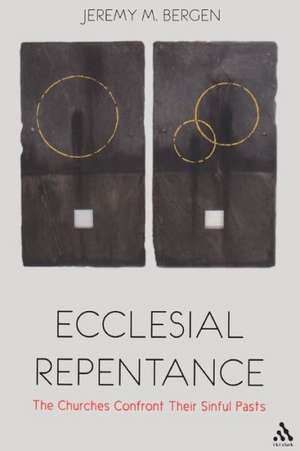
Ecclesial Repentance: The Churches Confront Their Sinful Pasts
Autor Dr Jeremy M. Bergenen Limba Engleză Paperback – 27 ian 2011
Preț: 283.64 lei
Preț vechi: 332.58 lei
-15%
Puncte Express: 425
Carte tipărită la comandă
Livrare economică 30 noiembrie-14 decembrie
Livrare prin curier în România Termenul estimat este afișat lângă disponibilitate.
Transport gratuit de la 400.00 lei Plată online sau ramburs, în funcție de opțiunile comenzii.
Retur gratuit în 14 zile Comandă securizată și suport în română.
Specificații
ISBN-13: 9780567523686
ISBN-10: 0567523683
Pagini: 352
Dimensiuni: 156 x 234 x 23 mm
Greutate: 0.61 kg
Editura: Bloomsbury Publishing
Colecția T&T Clark
Locul publicării:London, United Kingdom
ISBN-10: 0567523683
Pagini: 352
Dimensiuni: 156 x 234 x 23 mm
Greutate: 0.61 kg
Editura: Bloomsbury Publishing
Colecția T&T Clark
Locul publicării:London, United Kingdom
V-ar putea interesa
-
 Mere ChristianityClive Staples LewisPreț: 98.37 lei
 -
 Their Rock Is Not Like Our Rock: A Theology of ReligionsDaniel StrangePreț: 164.87 lei
 -
 Leadership in the Church for a People of HopeDr Mervyn DaviesPreț: 210.38 lei
 -
 A Reader in Contemporary Philosophical TheologyProfessor Oliver Crisp-28%Preț: 1054.44 lei1470.76 lei
 -
 Christian Bioethics: A Guide for the PerplexedPhD Agneta Sutton-17%Preț: 177.10 lei213.22 lei
 -
 Christian Apologetics as Cross-Cultural DialogueDr Benno van den Toren-15%Preț: 287.56 lei337.57 lei
 -
 Atonement: A Guide for the PerplexedDr Adam J. Johnson-17%Preț: 192.03 lei230.70 lei
 -
 Lutheran TheologyRev'd Dr Steven D. Paulson-16%Preț: 179.99 lei215.45 lei
 -
 The Case for JesusBrant PitrePreț: 155.73 lei
 -
 Resurrection of JesusJohn Dominic CrossanPreț: 186.18 lei
 -
 The Gospel According to HereticsDavid E. WilhitePreț: 244.26 lei
 -
 Exploring Catholic TheologyRobert BarronPreț: 157.63 lei
 -
 Christ CrucifiedDonald Mac LeodPreț: 197.29 lei
 -
 The Mosaic of Christian BeliefRoger E. OlsonPreț: 194.38 lei
 -
 On the Path of the ImmortalsThomas HornPreț: 172.98 lei
 -
 The Reason for GodTimothy KellerPreț: 107.58 lei
 -
 Stealing from GodFrank TurekPreț: 105.61 lei
 -
 The Atonement and Intercession of Jesus ChristWilliam SymingtonPreț: 147.32 lei
Cuprins
Introduction\PART I: Counter-Witness and Scandal: Repentance for Historical Wrongs. Four chapters that tell the story of ecclesial repentance in the 20th and 21st centuries, in breadth and in depth\Chapter 1: Division Among the People of God. An account of churches' repentance for sin against the unity of the church, and against the Jewish people\Chapter 2: Western Colonialism and its Legacy. Repentance for the oppression of Aboriginal people, African slaves, South African apartheid, and ongoing racism\Chapter 3: Sexual Abuse, Violence, Injustice. Repentance with respect to clergy sexual abuse, war, crusades, women, homosexual persons, science, and the environment\Chapter 4: Day of Pardon. Examination of one complex and high profile instances of ecclesial repentance - the Roman Catholic Church's "Day of Pardon" during Lent 2000\PART II: Doctrine and Practice: Frameworks and Implications. Three consecutive chapters draw from the doctrinal tradition in order to explain the theological bases of ecclesial repentance, and then show how ecclesial repentance and the sinful histories it names require a reshaping of doctrine\Chapter 5: The Communion of Saints. This docrtine makes it possible, meaningful, and even necessary for a present church to repent for the actions of the church in the past. Repentance for sins against the unity of the church presupposes the Christological constitution of the church and promotes a healing memories\Chapter 6: Sin and the Holiness of the Church. Both Protestant and Catholic conceptions of the holiness of the church are unable to respond to the challenge of historical particularity implied by the acnkowledgment of sins of the church. Repentance for sins against Jewish people and Judaism is an occasion for the church to recover holiness as n unmerited gift to the whole people of God, rather than an institutional or moral possession\Chapter 7: Forgiveness and Reconciliation. Drawing from the sacrament of reconciliation and instances repentance for slavery, racism, and colonialism, I argue that the church's mission of reconciliation is grounded in its reception of forgiveness. This has particular implications for how a penitent church pursues concrete reconciliation with those it has offended\Conclusion\Bibliography\Appendix: Instances of Ecclesial Repentance\Index
Recenzii
Should the church-can the church-repent? How can the living be held responsible for the faults of past generations? If the church is constantly "apologizing" for everything imaginable, does she not risk trivializing herself? In this remarkable book, Jeremy Bergen displays a sure hand in addressing questions like these. It is not political correctness bids the church repent, he argues, but love of neighbor and fidelity to the Crucified. An important and timely study.
This is a wonderful example of systematic ecclesiological inquiry that is disciplined both by faithful dialogue with the doctrinal tradition and by critical engagement with what churches and church people are actually doing. In the first part of the book, Bergen present an immensely helpful analytic description and assessment of a wide range of concrete examples of acts of apology and repentance performed in recent years by churches, governments and other groups, together with their varied receptions. Reflecting upon this material in the second part, he constructs a bold yet deeply thoughtful ecclesiological proposal that deserves careful consideration, not least for its ecumenical benefits. Particularly significant is his proposal that the Church's continuity over time derives not from claims about some ideal or institutional element. Rather, he reworks the creedal 'communion of saints' - and sinners! - to argue that it is these practices of repentance and forgiveness, enabled by the Holy Spirit, that enable us both to appropriate our churches' pasts and be drawn up in Christ into the life of God. It is thus 'through repentance the Church may be granted a share of its own continuity in God's triune life', and thus truly be the Church.
In a context in which churches, as well as national governments, are increasingly offering public apologies for past acts of injustice and failure, this book represents an important contribution. Rather than seeing ecclesial repentance as undermining the Church's reputation, or functioning as a self-serving public relations strategy, Bergen offers a theological account of how they help the Church be faithful to its mission. The discussion is attentive to both concrete historical failures of churches, as well as to the richness of the Christian theological tradition's treatment of reconciliation. The result is a sensitive reflection on the complexities and perils of public apologies, as well as a thoughtful appreciation for their potential to facilitate the healing of past wounds.
With grace, courage, and a discerning spirit, Jeremy Bergen offers an account of ecclesial repentance worthy of a pilgrim people, a church at once reconciled and always on the journey toward full reconciliation. Christian communities would do well to use this volume in a process of communal examination of conscience.
... there is much here that is rich and deserving of careful attention.
Those who join Bergen in some 'theological heavy lifting' will discover themselves being led by God's Spirit deeper into forgiveness, holiness, mission, and ultimately, Christ.
For some decades now the effort of churches far and wide to address and redress their "sinful past" has piqued public interest in the church and beyond. Thus it is timely that Jeremy Bergsen offers for public consumption the results of his careful research into an issue that has come to plague the church in our day and that begs for in-depth theological scrutiny. Jeremy Bergsen has offered the wider church a most important book on a vital topic.
This is a wonderful example of systematic ecclesiological inquiry that is disciplined both by faithful dialogue with the doctrinal tradition and by critical engagement with what churches and church people are actually doing. In the first part of the book, Bergen present an immensely helpful analytic description and assessment of a wide range of concrete examples of acts of apology and repentance performed in recent years by churches, governments and other groups, together with their varied receptions. Reflecting upon this material in the second part, he constructs a bold yet deeply thoughtful ecclesiological proposal that deserves careful consideration, not least for its ecumenical benefits. Particularly significant is his proposal that the Church's continuity over time derives not from claims about some ideal or institutional element. Rather, he reworks the creedal 'communion of saints' - and sinners! - to argue that it is these practices of repentance and forgiveness, enabled by the Holy Spirit, that enable us both to appropriate our churches' pasts and be drawn up in Christ into the life of God. It is thus 'through repentance the Church may be granted a share of its own continuity in God's triune life', and thus truly be the Church.
In a context in which churches, as well as national governments, are increasingly offering public apologies for past acts of injustice and failure, this book represents an important contribution. Rather than seeing ecclesial repentance as undermining the Church's reputation, or functioning as a self-serving public relations strategy, Bergen offers a theological account of how they help the Church be faithful to its mission. The discussion is attentive to both concrete historical failures of churches, as well as to the richness of the Christian theological tradition's treatment of reconciliation. The result is a sensitive reflection on the complexities and perils of public apologies, as well as a thoughtful appreciation for their potential to facilitate the healing of past wounds.
With grace, courage, and a discerning spirit, Jeremy Bergen offers an account of ecclesial repentance worthy of a pilgrim people, a church at once reconciled and always on the journey toward full reconciliation. Christian communities would do well to use this volume in a process of communal examination of conscience.
... there is much here that is rich and deserving of careful attention.
Those who join Bergen in some 'theological heavy lifting' will discover themselves being led by God's Spirit deeper into forgiveness, holiness, mission, and ultimately, Christ.
For some decades now the effort of churches far and wide to address and redress their "sinful past" has piqued public interest in the church and beyond. Thus it is timely that Jeremy Bergsen offers for public consumption the results of his careful research into an issue that has come to plague the church in our day and that begs for in-depth theological scrutiny. Jeremy Bergsen has offered the wider church a most important book on a vital topic.