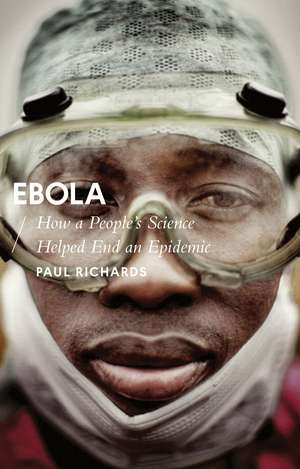
Ebola: How a People's Science Helped End an Epidemic: African Arguments
Autor Paul Richardsen Limba Engleză Hardback – 15 sep 2016
From December 2013, the largest Ebola outbreak in history swept across West Africa, claiming thousands of lives in Liberia, Sierra Leone and Guinea. By the middle of 2014, the international community was gripped by hysteria. Experts grimly predicted that millions would be infected within months, and a huge international control effort was mounted to contain the virus. Yet paradoxically, by this point the disease was already going into decline in Africa itself. So why did outside observers get it so wrong?
Paul Richards draws on his extensive first-hand experience in Sierra Leone to argue that the international community's panicky response failed to take account of local expertise and common sense. Crucially, Richards shows that the humanitarian response to the disease was most effective in those areas where it supported these initiatives and that it hampered recovery when it ignored or disregarded local knowledge.
Din seria African Arguments
- 40%
 Preț: 79.29 lei
 - 17%
 Preț: 136.27 lei
 - 17%
 Preț: 135.68 lei
 -
 Preț: 219.78 lei
 - 15%
 Preț: 154.67 lei
 - 16%
 Preț: 152.57 lei
 - 34%
 Preț: 92.22 lei
 -
 Preț: 236.47 lei
 -
 Preț: 231.27 lei
 -
 Preț: 236.36 lei
 - 15%
 Preț: 154.28 lei
 - 17%
 Preț: 148.52 lei
 - 16%
 Preț: 153.54 lei
 - 18%
 Preț: 128.24 lei
 - 18%
 Preț: 129.04 lei
 - 11%
 Preț: 123.32 lei
 - 17%
 Preț: 130.44 lei
 - 24%
 Preț: 557.39 lei
 - 17%
 Preț: 157.73 lei
 - 16%
 Preț: 122.67 lei
 - 18%
 Preț: 129.04 lei
 - 15%
 Preț: 123.32 lei
 - 16%
 Preț: 122.23 lei
 - 20%
 Preț: 140.45 lei
 - 16%
 Preț: 132.87 lei
 - 25%
 Preț: 161.11 lei
 - 15%
 Preț: 89.24 lei
 - 23%
 Preț: 129.77 lei
 - 30%
 Preț: 523.45 lei
 - 24%
 Preț: 564.50 lei
 - 30%
 Preț: 525.31 lei
 - 17%
 Preț: 157.73 lei
 - 38%
 Preț: 447.91 lei
 - 18%
 Preț: 129.63 lei
 - 34%
 Preț: 529.38 lei
 - 26%
 Preț: 524.46 lei
 - 17%
 Preț: 158.93 lei
Preț: 526.56 lei
Preț vechi: 705.36 lei
-25%
Puncte Express: 790
Carte tipărită la comandă
Livrare economică 07-21 decembrie
Livrare prin curier în România Termenul estimat este afișat lângă disponibilitate.
Transport gratuit pentru acest produs Plată online sau ramburs, în funcție de opțiunile comenzii.
Retur gratuit în 14 zile Comandă securizată și suport în română.
Specificații
ISBN-13: 9781783608591
ISBN-10: 1783608595
Pagini: 300
Ilustrații: Tables, black and white 8 ; Figures 11
Dimensiuni: 140 x 222 x 18 mm
Greutate: 0.57 kg
Editura: Bloomsbury Publishing
Colecția Zed Books
Seria African Arguments
Locul publicării:London, United Kingdom
ISBN-10: 1783608595
Pagini: 300
Ilustrații: Tables, black and white 8 ; Figures 11
Dimensiuni: 140 x 222 x 18 mm
Greutate: 0.57 kg
Editura: Bloomsbury Publishing
Colecția Zed Books
Seria African Arguments
Locul publicării:London, United Kingdom
V-ar putea interesa
-
 Genetic Heavy Metal ToxicityTara Lang ChapmanPreț: 97.29 lei
 -
 Preț: 60.12 lei
 -
 The Story of Ethel and Julius RosenbergNina SerranoPreț: 52.00 lei
 -
 Preț: 124.05 lei
 -
 How to Prepare Your Body for Biological and Chemical WarfareJo-Ann Daniel-LemoinePreț: 117.26 lei
 -
 What If?: Pioneering Iowa EntrepreneurBrittnee BurkePreț: 110.45 lei
 -
 Do I Have Ibs?!!!Ashkan FarhadiPreț: 93.91 lei
 -
 There Is No Place Like Home I: Caring for Someone You Love When They Have DementiaLnha Charles Kennedy RnPreț: 299.48 lei
 -
 Just a Word: Friends Encounter Alzheimer'sRose LamattPreț: 54.82 lei
 -
 Preț: 75.94 lei
 -
 Preventing Better Than HealingVan Der Merwe, MR Cobus C.Preț: 66.09 lei
 -
 Do Not Go GentlyMR Patric MorganPreț: 51.06 lei
 -
 Coconut Head's Cancer Survival GuideHolly J. BertonePreț: 59.55 lei
 -
 Preț: 125.46 lei
 -
 The 4th KindPaul RichardsPreț: 84.08 lei
 -
 Life UnexpectedNaomi L. BaumPreț: 88.67 lei
 -
 The Global Challenge of AutismCommittee on F. House of RepresentativesPreț: 81.34 lei
 -
 Through the RainPaul RichardsPreț: 132.11 lei
 -
 Ketogenic DietChristopher SmithPreț: 53.78 lei
 -
 ChemoBrainEllen CleggPreț: 116.01 lei
 -
 The Fibromyalgia ControversyM Clement HallPreț: 115.85 lei
 -
 Mary DouglasPerriPreț: 157.40 lei
 -
 Six Essays in Hanseatic HistoryPaul RichardsPreț: 75.92 lei
 -
 Adventures with AgitatorsPaul RichardsPreț: 211.79 lei
Cuprins
Introduction
1. The World's First Ebola Epidemic
2. The Epidemic's Rise and Decline
3. Washing the Dead: Does Culture Spread Ebola?
4. Ebola in Rural Sierra Leone: A Technography
5. Burial Technique
6. Community Responses to Ebola
Conclusion: Strengthening an African People's Science
Postscript
Appendices
1. The World's First Ebola Epidemic
2. The Epidemic's Rise and Decline
3. Washing the Dead: Does Culture Spread Ebola?
4. Ebola in Rural Sierra Leone: A Technography
5. Burial Technique
6. Community Responses to Ebola
Conclusion: Strengthening an African People's Science
Postscript
Appendices
Recenzii
Policymakers involved in responding to global pandemics [should] read this book and to think more seriously about how to develop approaches that really listen to affected communities.
The importance of this work for fighting future epidemics cannot be overstated.
The book is useful for any individual teaching or practicing in the fields of psychology or medical education, as well as those in social work, education, and public health.
In this provocative book, Richards argues that the international response may actually have extended the epidemic's duration.
With some 40 years' experience living, working and writing about the Mano River Region, Paul Richards' manuscript provides a succinct, erudite and important contribution to this debate.
[A] first-hand analysis of the complicated situation that arose from the outbreak, a fascinating story of the success and failures of experts, volunteers and village people ... eye-opening reading.
A must-read for all involved in epidemics, epidemiology and public health.
A book rich in practical examples from extensive knowledge of the region, with theory to underpin observation...fascinating.
A scholarly exercise that will appeal to medical and health policy academics ... convincingly argues the broader lesson for containing future epidemics.
Represents the first serious attempt to grapple with some of the practical as well as epistemological questions posed by the local response to the outbreak...Offers important insights, especially concerning the central issue of burial practices, one of the epidemic's main routes of infection.
A valuable reflection of the experiences of affected communities and aid workers in Sierra Leone. This book is a must for all disease control professionals in Africa and beyond. The book is also exceptionally well written and easily accessible to interested novices.
With his decades of experience in rural Sierra Leone, Richards is almost uniquely placed to write this book, which highlights the strong potential at community level for learning about and acting against a deadly disease. We would do well to implement these principles in future emergency responses of all kinds, as well as within long-term development work.
The importance of this work for fighting future epidemics cannot be overstated.
The book is useful for any individual teaching or practicing in the fields of psychology or medical education, as well as those in social work, education, and public health.
In this provocative book, Richards argues that the international response may actually have extended the epidemic's duration.
With some 40 years' experience living, working and writing about the Mano River Region, Paul Richards' manuscript provides a succinct, erudite and important contribution to this debate.
[A] first-hand analysis of the complicated situation that arose from the outbreak, a fascinating story of the success and failures of experts, volunteers and village people ... eye-opening reading.
A must-read for all involved in epidemics, epidemiology and public health.
A book rich in practical examples from extensive knowledge of the region, with theory to underpin observation...fascinating.
A scholarly exercise that will appeal to medical and health policy academics ... convincingly argues the broader lesson for containing future epidemics.
Represents the first serious attempt to grapple with some of the practical as well as epistemological questions posed by the local response to the outbreak...Offers important insights, especially concerning the central issue of burial practices, one of the epidemic's main routes of infection.
A valuable reflection of the experiences of affected communities and aid workers in Sierra Leone. This book is a must for all disease control professionals in Africa and beyond. The book is also exceptionally well written and easily accessible to interested novices.
With his decades of experience in rural Sierra Leone, Richards is almost uniquely placed to write this book, which highlights the strong potential at community level for learning about and acting against a deadly disease. We would do well to implement these principles in future emergency responses of all kinds, as well as within long-term development work.