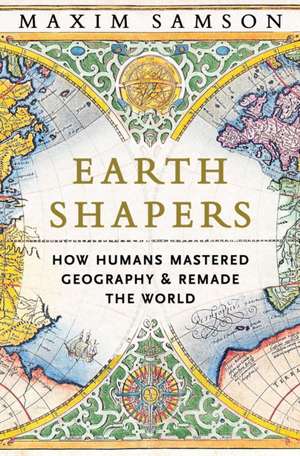
Earth Shapers: How Humans Mastered Geography and Remade the World
Autor Maxim Samsonen Limba Engleză Hardback – 7 aug 2025
Preț: 131.31 lei
Preț vechi: 159.86 lei
-18%
Puncte Express: 197
Carte disponibilă
Livrare economică 12-26 noiembrie
Livrare express 28 octombrie-03 noiembrie pentru 64.46 lei
Livrare prin curier în România Termenul estimat este afișat lângă disponibilitate.
Transport gratuit de la 400.00 lei Plată online sau ramburs, în funcție de opțiunile comenzii.
Retur gratuit în 14 zile Comandă securizată și suport în română.
Specificații
ISBN-13: 9781800815230
ISBN-10: 1800815239
Pagini: 352
Ilustrații: b/w 8 integrated maps
Dimensiuni: 164 x 244 x 44 mm
Greutate: 0.55 kg
Ediția:Main
Editura: Profile
Colecția Profile Books
Locul publicării:London, United Kingdom
ISBN-10: 1800815239
Pagini: 352
Ilustrații: b/w 8 integrated maps
Dimensiuni: 164 x 244 x 44 mm
Greutate: 0.55 kg
Ediția:Main
Editura: Profile
Colecția Profile Books
Locul publicării:London, United Kingdom
V-ar putea interesa
-
 LandSimon WinchesterPreț: 95.44 lei
 -
 -18%Preț: 76.63 lei93.84 lei
 -
 Four Points of the CompassJerry BrottonPreț: 92.56 lei
 -
 Human Geography: A Very Short IntroductionPatricia Daley-20%Preț: 57.15 lei71.12 lei
 -
 Preț: 203.40 lei
 -
 -11%Preț: 224.73 lei252.11 leiRecomandat
 -
 -13%Preț: 215.32 lei246.92 lei
 -
 Remaking the Earth, Exhausting the PeopleMicah S. MuscolinoPreț: 252.47 lei
 -
 Myths of Geography: Eight Ways We Get the World WrongPaul Richardson-27%Preț: 67.85 lei92.98 lei
 -
 40 Maps That Will Change How You See the WorldAlastair Bonnett-17%Preț: 123.53 lei148.13 lei
 -
 This Earthly GlobeAndrea Di RobilantPreț: 92.01 lei
 -
 Our StoryColin Butfield-21%Preț: 133.36 lei168.13 lei
 -
 -24%Preț: 60.96 lei80.65 lei
 -
 Preț: 125.03 lei
 -
 Radical CartographyWilliam Rankin-44%Preț: 133.13 lei237.71 lei
 -
 OriginsLewis Dartnell-17%Preț: 66.28 lei80.25 lei
 -
 -19%Preț: 76.16 lei93.78 lei
 -
 All Mapped Out: How Maps Shape UsMike DugganPreț: 113.44 lei
 -
 -18%Preț: 70.70 lei86.09 lei
 -
 On The Map: Why the world looks the way it doesSimon Garfield-17%Preț: 78.24 lei94.83 lei
Notă biografică
Maxim Samson is an independent researcher, specialising in cultural geography and geography of religion. He holds a PhD in geography from the University of Leeds and has researched, taught and presented keynote lectures at universities the United Kingdom, United States and Indonesia. Prior to his current role as geography teacher and head of EPQ, he worked for seven years as an award-winning adjunct professor at DePaul University in Chicago, where he additionally chaired an international research group and served as associate editor of a peer-reviewed academic journal. He is the author of Invisible Lines and Earth Shapers.
Recenzii
A captivating and compelling account of how civilisations have made use of natural landscapes for their long-term benefit. From the astounding Incan road system to the building of Chicago and the Panama canal, humans have a long history of shaping the Earth to build connections between ourselves. Samson demonstrates how we are not always prisoners of geography, but increasingly its masters
[A] thought-provoking exploration
Samson takes a fresh look at humanity's imprint on the planet ... A riposte to the idea that geography is destiny by charting the ways humans have reshaped their surroundings
From railroads colonisers dreamed of building turning in projects designed by Africans, through to what travel routes will be used again when there is no longer a border within Korea, Earth Shapers tells stories that have been ignored because they do not fit the old narrative; a book that reshapes our story of global human geography
Samson maps the underlying topography of places that we like to think we know
Accessible and erudite, Earth Shapers makes for a refreshing perspective on the relationship between human and physical geography. Ranging confidently from Chicago to Mozambique to Korea just as it travels across the history of technology, cities, nationalism, colonialism and liberation ... it is an original look at the geography of connection in an age where so much attention is given to the geography of division, to walls and borders
This bold and rich collection ranges widely across five continents and an array of fascinating case studies, casting light on various meanings of geographical connectivity. Reading this book it's impossible not to learn something new
Modern geography is the geography of our personal, political and sociological souls. We urgently need to know what we are. Samson holds up a mirror, showing us ourselves reflected in what we've done. Fascinating, original and prescient
Well researched and wide-ranging, this book joins the dots, showing the power of connections between places
Humans are inveterate environmental meddlers. No guide to their excesses is more eloquent, more learned, more surprising, more amusing or more convincing than Maxim Samson. His lively language and minatory message are as entertaining as they are unsettling
Samson's book . . . examines the way humans have shaped the earth through connections over millenniums and focuses on Chicago and seven other examples. In some but not all cases, this earth-shaping has been physical inasmuch as it involved an actual shaping of the earth. But, in all of the eight, it's had to do with a way of seeing and using the land-and for a particular purpose
Focused and substantive ... It is in part the unexpected diversity of Samson's wide-ranging examples - the connections between the connections, if that isn't too meta - that makes Earth Shapers such an engaging read
Praise for INVISIBLE LINES
An illuminating glimpse of the chain reactions of human and physical geography ... Invisible Lines shows the unexpected side-effects of human-drawn borders
Fascinating...a truly original adventure into new ways of exploring a sense of place
A chance to see the world anew through the eyes of a wonderfully curious new writer
Endlessly interesting
Old worlds enhanced, new worlds exposed and challenged ... a wise and thought-provoking series of raids across borders we thought we knew and others made visible to us, by Maxim Samson's forensic eye
Invisible Lines is a fascinating, detailed exploration of the hidden boundaries that carve up the world ... it is a pleasure to accompany Samson to the Malaria Belt, inside eruvim (markers of a single domestic space within which fewer Sabbath regulations apply), or along the border of Portugal to discover why vultures prefer not to cross it
Utterly engrossing! Samson's literary atlas of the world's unseen boundaries and how they've shaped our lives demands to be read
A fascinating exploration of the lesser-known and more subtle borders across the earth and the surprising ways in which they shape our lives
[A] thought-provoking exploration
Samson takes a fresh look at humanity's imprint on the planet ... A riposte to the idea that geography is destiny by charting the ways humans have reshaped their surroundings
From railroads colonisers dreamed of building turning in projects designed by Africans, through to what travel routes will be used again when there is no longer a border within Korea, Earth Shapers tells stories that have been ignored because they do not fit the old narrative; a book that reshapes our story of global human geography
Samson maps the underlying topography of places that we like to think we know
Accessible and erudite, Earth Shapers makes for a refreshing perspective on the relationship between human and physical geography. Ranging confidently from Chicago to Mozambique to Korea just as it travels across the history of technology, cities, nationalism, colonialism and liberation ... it is an original look at the geography of connection in an age where so much attention is given to the geography of division, to walls and borders
This bold and rich collection ranges widely across five continents and an array of fascinating case studies, casting light on various meanings of geographical connectivity. Reading this book it's impossible not to learn something new
Modern geography is the geography of our personal, political and sociological souls. We urgently need to know what we are. Samson holds up a mirror, showing us ourselves reflected in what we've done. Fascinating, original and prescient
Well researched and wide-ranging, this book joins the dots, showing the power of connections between places
Humans are inveterate environmental meddlers. No guide to their excesses is more eloquent, more learned, more surprising, more amusing or more convincing than Maxim Samson. His lively language and minatory message are as entertaining as they are unsettling
Samson's book . . . examines the way humans have shaped the earth through connections over millenniums and focuses on Chicago and seven other examples. In some but not all cases, this earth-shaping has been physical inasmuch as it involved an actual shaping of the earth. But, in all of the eight, it's had to do with a way of seeing and using the land-and for a particular purpose
Focused and substantive ... It is in part the unexpected diversity of Samson's wide-ranging examples - the connections between the connections, if that isn't too meta - that makes Earth Shapers such an engaging read
Praise for INVISIBLE LINES
An illuminating glimpse of the chain reactions of human and physical geography ... Invisible Lines shows the unexpected side-effects of human-drawn borders
Fascinating...a truly original adventure into new ways of exploring a sense of place
A chance to see the world anew through the eyes of a wonderfully curious new writer
Endlessly interesting
Old worlds enhanced, new worlds exposed and challenged ... a wise and thought-provoking series of raids across borders we thought we knew and others made visible to us, by Maxim Samson's forensic eye
Invisible Lines is a fascinating, detailed exploration of the hidden boundaries that carve up the world ... it is a pleasure to accompany Samson to the Malaria Belt, inside eruvim (markers of a single domestic space within which fewer Sabbath regulations apply), or along the border of Portugal to discover why vultures prefer not to cross it
Utterly engrossing! Samson's literary atlas of the world's unseen boundaries and how they've shaped our lives demands to be read
A fascinating exploration of the lesser-known and more subtle borders across the earth and the surprising ways in which they shape our lives
Cuprins
Introduction
1. Order: The Qhapaq Ñan
2. Extraction: Mozambique’s railways
3. Convenience: The Panama Canal
4. Reimagination: THE LINE
5. Resistance: The Baltic Way
6. Restoration: The Great Green Wall
7. Co-option: Chicago’s ridges and waterways
8. Vitality: The Baekdu-daegan
Epilogue
Notes
Acknowledgements
Index
1. Order: The Qhapaq Ñan
2. Extraction: Mozambique’s railways
3. Convenience: The Panama Canal
4. Reimagination: THE LINE
5. Resistance: The Baltic Way
6. Restoration: The Great Green Wall
7. Co-option: Chicago’s ridges and waterways
8. Vitality: The Baekdu-daegan
Epilogue
Notes
Acknowledgements
Index