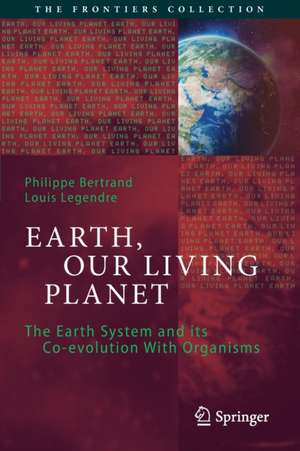
Earth, Our Living Planet
Autor Philippe Bertrand, Louis Legendreen Limba Engleză Paperback – 23 apr 2022
Recomandăm această lucrare ca referință profesională și suport de curs pentru nivelurile de master și doctorat în științele sistemului terestru și ecologie globală. Earth, Our Living Planet, publicată de Springer în seria The Frontiers Collection, propune o analiză riguroasă a modului în care viața a modelat și a fost modelată de condițiile geologice și astronomice ale planetei noastre. Comparabil cu An Introduction to the Earth-Life System în rigurozitate, dar actualizat pentru a integra rolul decisiv al organismelor ca agenți de reglare globală, textul explorează de ce Pământul a rămas locuibil în timp ce planete precum Marte sau Venus au urmat traiectorii diferite. Autorii, Philippe Bertrand și Louis Legendre, organizează materialul într-o structură narativă inedită, divizată în acte care urmăresc progresia complexității biologice prin intermediul unor conexiuni fundamentale. Actul 1 stabilește cadrul apariției vieții prin șapte conexiuni esențiale, în timp ce Actul 2 se concentrează pe cele patru conexiuni majore prin care sistemele vii au preluat controlul asupra evoluției globale. Lucrarea este comparabilă cu Climate Change and Life prin abordarea multidisciplinară, însă se distinge prin analiza detaliată a mecanismelor de feedback pe termen lung care au asigurat stabilitatea planetară timp de 3,6 miliarde de ani. Considerăm esențială secțiunea finală, care analizează modul în care cele două conexiuni perturbatoare introduse de om amenință acest echilibru, propunând o viziune în care societatea trebuie să devină administratorul conștient al sistemului terestru.
Preț: 265.93 lei
Carte disponibilă
Livrare economică 16-30 mai
Specificații
ISBN-10: 3030677753
Pagini: 584
Ilustrații: IX, 572 p. 121 illus., 98 illus. in color.
Dimensiuni: 155 x 235 x 32 mm
Greutate: 0.87 kg
Ediția:1st ed. 2021
Editura: Springer
Locul publicării:Cham, Switzerland
V-ar putea interesa
-
 The Universe WithinNeil ShubinPreț: 88.20 lei
 -
 -21%Preț: 53.41 lei67.74 lei
 -
 Gaia: A New Look at Life on EarthJames Lovelock-21%Preț: 58.49 lei74.36 lei
 -
 Earth and Life: A History of Four Billion YearsAnne Nédélec-13%Preț: 257.12 lei297.06 lei
 -
 Fundamental Processes in Ecology: An Earth Systems ApproachDavid M. Wilkinson-51%Preț: 265.27 lei543.63 lei
 -
 A Rough Ride to the FutureJames LovelockPreț: 74.55 lei
 -
 A Little History of the EarthJamie WoodwardPreț: 117.49 lei
 -
 How to Build a Habitable PlanetCharles H. LangmuirPreț: 380.20 lei
 -
 -8%Preț: 70.09 lei75.87 leiRecomandat
 -
 Our StoryColin Butfield-22%Preț: 124.69 lei160.16 lei
 -
 -36%Preț: 51.53 lei80.03 lei
 -
 The Earth Transformed: An Untold HistoryProfessor Peter Frankopan-41%Preț: 70.13 lei118.91 lei
 -
 Jabr, F: Becoming EarthFerris Jabr-35%Preț: 76.17 lei116.87 lei
 -
 Becoming EarthFerris Jabr-44%Preț: 49.32 lei88.78 lei
 -
 Life on Our PlanetTom Fletcher-15%Preț: 197.50 lei232.86 lei
 -
 -28%Preț: 64.08 lei88.81 lei
 -
 Epic EarthLindsay Nikole-18%Preț: 87.43 lei106.05 lei
 -
 From Cells to OurselvesGill Arbuthnott-18%Preț: 99.53 lei120.67 lei
 -
 Human NatureKate MarvelPreț: 130.60 lei
 -
 Life on a Little-Known PlanetElizabeth KolbertPreț: 180.39 lei
De ce să citești această carte
Recomandăm această carte studenților și specialiștilor care caută o înțelegere profundă a Pământului ca sistem viu integrat. Cititorul câștigă o perspectivă științifică asupra modului în care mecanismele biologice reglează clima pe termen lung. Este un argument solid pentru conservarea biodiversității, demonstrând că aceasta nu este doar o resursă, ci un motor esențial al stabilității planetare în fața schimbărilor climatice antropice.
Despre autor
Philippe Bertrand și Louis Legendre sunt cercetători de prestigiu în domeniul științelor naturii, contribuind prin această lucrare la seria The Frontiers Collection a editurii Springer. Expertiza lor reunește discipline precum geologia, biologia și oceanografia pentru a oferi o viziune unitară asupra sistemului terestru. Louis Legendre este recunoscut pentru contribuțiile sale în oceanografia biologică și analiza ecosistemelor, elemente care fundamentează rigoarea cu care este tratată co-evoluția dintre viață și mediul abiotic. Lucrarea lor reprezintă o sinteză modernă a proceselor care guvernează locuibilitatea planetară.
Descriere scurtă
The habitability of a planet is its capacity to allow the emergence of organisms. What astronomical and geological conditions concurred to make Earth habitable 4 billion years ago, and how has it remained habitable since? What have been the respective roles of non-biological and biological characteristics in maintaining the habitability of Earth?
This unique book answers the above questions by considering the roles of organisms and ecosystems in the Earth System, which is made of the non-living and living components of the planet. Organisms have progressively occupied all the habitats of the planet, diversifying into countless life forms and developing enormous biomassesover the past 3.6 billion years. In this way, organisms and ecosystems "took over" the Earth System, and thus became major agents in its regulation and global evolution. There was co-evolution of the different components of the Earth System, leading to a number of feedback mechanisms that regulated long-term Earth conditions.
For millennia, and especially since the Industrial Revolution nearly 300 years ago, humans have gradually transformed the Earth System. Technological developments combined with the large increase in human population have led, in recent decades, to major changes in the Earth's climate, soils, biodiversity and quality of air and water. After some successes in the 20th century at preventing internationally environmental disasters, human societies are now facing major challenges arising from climate change. Some of these challenges are short-term and others concern the thousand-year evolution of the Earth's climate. Humans should become the stewards of Earth.
Cuprins
Notă biografică
Louis Legendre conducted his career in Canada and in France. He is professor emeritus at Sorbonne University, France, and Laval University, Canada. His fields of research are: marine biogeochemistry, biological oceanography, numerical ecology, and philosophy of science. His work is a blend of theoretical studies, laboratory research, and fieldwork. He tested his theoretical contributions by conducting research in tropical, temperate and polar waters, including the Gulf of St. Lawrence, Arctic waters and polynyas, the Greenland Sea, the Mediterranean Sea, lagoons of coral reefs and atolls of French Polynesia, the Sea of Okhotsk, the Equatorial Atlantic, and lakes. He received several prestigious honours and awards, including membership in three academies of science in Canada, China and Europe. His textbook Numerical Ecology (with Pierre Legendre) is used for research and university teaching all over the world. He enjoys the cultures, includingfood and drink, of countries where he worked and/or travelled extensively, especially (alphabetical order) China, France, Greece, Italy, Japan, Québec and Spain.