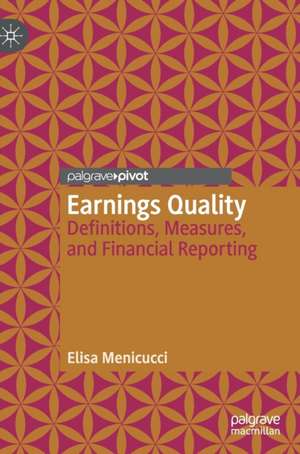
Earnings Quality
Autor Elisa Menicuccien Limba Engleză Hardback – 22 dec 2019
The book describes the relationship between EQ and earnings management (EM) since they can be considered related challenges, especially in the context of international financial reporting standards (IAS/IFRSs). EM occurs when managers make discretionary accounting choices that are regarded as either an efficient communication of private information to improve the informativeness of a firm’s current and future performance, or a distorting disclosure to mislead the firm’s true performance. The intentional manipulation of earnings by managers, within the limits allowed by the accounting standards, may alter the usefulness of financial reporting and lead to lower quality of earnings. The use of fair value in financial reporting has created a current debate about the impact it might have on EQ. At times, the high subjectivity in estimating fair value can allow opportunities for the exercise of management judgments and intentional bias, which can reduce the quality of financial reporting. Management discretion can result in high EM and hence in a reduction of EQ. Particularly during difficult financial periods, managers engage in EM to mask the negative effects of the turmoil, and in such circumstances accruals and earnings smoothing are attempts to reduce abnormal variations of earnings in such circumstances. This book is a valuable resource for those interested in wider perspectives on EQ and it adds to the research studies on this topic in the context of financial reporting.
Preț: 431.47 lei
Puncte Express: 647
Carte tipărită la comandă
Livrare economică 28 noiembrie-12 decembrie
Livrare prin curier în România Termenul estimat este afișat lângă disponibilitate.
Transport gratuit pentru acest produs Plată online sau ramburs, în funcție de opțiunile comenzii.
Retur gratuit în 14 zile Comandă securizată și suport în română.
Specificații
ISBN-13: 9783030367978
ISBN-10: 3030367975
Pagini: 160
Ilustrații: XI, 147 p. 2 illus., 1 illus. in color.
Dimensiuni: 153 x 216 x 14 mm
Greutate: 0.29 kg
Ediția:1st ed. 2020
Editura: Springer
Locul publicării:Cham, Switzerland
ISBN-10: 3030367975
Pagini: 160
Ilustrații: XI, 147 p. 2 illus., 1 illus. in color.
Dimensiuni: 153 x 216 x 14 mm
Greutate: 0.29 kg
Ediția:1st ed. 2020
Editura: Springer
Locul publicării:Cham, Switzerland
Cuprins
Chapter 1. Earnings quality: how to define.- Chapter 2. Measures of earnings quality.- Chapter 3. Earnings quality and earnings management.- Chapter 4. IAS/IFRSs, accounting quality and earnings quality.- Chapter 5. Fair Value Accounting and earnings quality.
Textul de pe ultima copertă
This book provides an overview of earnings quality (EQ) in the context of financial reporting and offers suggestions for defining and measuring it. Although EQ has received increasing attention from investors, creditors, regulators, and researchers in different areas, there are various definitions of it and different approaches for its measurement.
The book describes the relationship between EQ and earnings management (EM) since they can be considered related challenges, especially in the context of international financial reporting standards (IAS/IFRSs). EM occurs when managers make discretionary accounting choices that are regarded as either an efficient communication of private information to improve the informativeness of a firm’s current and future performance, or a distorting disclosure to mislead the firm’s true performance. The intentional manipulation of earnings by managers, within the limits allowed by the accounting standards, may alter the usefulness of financial reporting and lead to lower quality of earnings. The use of fair value in financial reporting has created a current debate about the impact it might have on EQ. At times, the high subjectivity in estimating fair value can allow opportunities for the exercise of management judgments and intentional bias, which can reduce the quality of financial reporting. Management discretion can result in high EM and hence in a reduction of EQ. Particularly during difficult financial periods, managers engage in EM to mask the negative effects of the turmoil, and in such circumstances accruals and earnings smoothing are attempts to reduce abnormal variations of earnings in such circumstances. This book is a valuable resource for those interested in wider perspectives on EQ and it adds to the research studies on this topic in the context of financial reporting.Elisa Menicucci is an Assistant Professor of Business Administration at the Department of Business Studies, University of Roma Tre, Rome, Italy. Her research focuses on accounting, business valuation, and integrated reporting, and she is also involved in editorial and review activities for various international journals. Elisa is a chartered accountant and auditor, and also provides consultancy services, mainly in the areas of accounting, auditing, and business valuation for financial institutions and companies.
The book describes the relationship between EQ and earnings management (EM) since they can be considered related challenges, especially in the context of international financial reporting standards (IAS/IFRSs). EM occurs when managers make discretionary accounting choices that are regarded as either an efficient communication of private information to improve the informativeness of a firm’s current and future performance, or a distorting disclosure to mislead the firm’s true performance. The intentional manipulation of earnings by managers, within the limits allowed by the accounting standards, may alter the usefulness of financial reporting and lead to lower quality of earnings. The use of fair value in financial reporting has created a current debate about the impact it might have on EQ. At times, the high subjectivity in estimating fair value can allow opportunities for the exercise of management judgments and intentional bias, which can reduce the quality of financial reporting. Management discretion can result in high EM and hence in a reduction of EQ. Particularly during difficult financial periods, managers engage in EM to mask the negative effects of the turmoil, and in such circumstances accruals and earnings smoothing are attempts to reduce abnormal variations of earnings in such circumstances. This book is a valuable resource for those interested in wider perspectives on EQ and it adds to the research studies on this topic in the context of financial reporting.Elisa Menicucci is an Assistant Professor of Business Administration at the Department of Business Studies, University of Roma Tre, Rome, Italy. Her research focuses on accounting, business valuation, and integrated reporting, and she is also involved in editorial and review activities for various international journals. Elisa is a chartered accountant and auditor, and also provides consultancy services, mainly in the areas of accounting, auditing, and business valuation for financial institutions and companies.