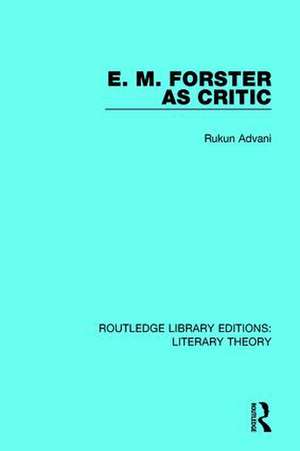
E. M. Forster as Critic: Routledge Library Editions: Literary Theory
Autor Rukun Advanien Limba Engleză Paperback – 9 ian 2018
Din seria Routledge Library Editions: Literary Theory
-
 Preț: 207.39 lei
 -
 Preț: 241.52 lei
 -
 Preț: 377.91 lei
 -
 Preț: 266.97 lei
 -
 Preț: 240.99 lei
 -
 Preț: 426.32 lei
 -
 Preț: 337.57 lei
 -
 Preț: 379.45 lei
 -
 Preț: 266.21 lei
 -
 Preț: 408.35 lei
 -
 Preț: 335.61 lei
 -
 Preț: 376.72 lei
 -
 Preț: 411.60 lei
 -
 Preț: 408.87 lei
 -
 Preț: 380.22 lei
 -
 Preț: 398.56 lei
 -
 Preț: 250.44 lei
 -
 Preț: 352.20 lei
 -
 Preț: 267.73 lei
 -
 Preț: 136.17 lei
 -
 Preț: 390.89 lei
 -
 Preț: 375.19 lei
 -
 Preț: 297.24 lei
 -
 Preț: 172.59 lei
 - 33%
 Preț: 21660.02 lei
Preț: 265.82 lei
Puncte Express: 399
Carte tipărită la comandă
Livrare economică 21 noiembrie-05 decembrie
Livrare prin curier în România Termenul estimat este afișat lângă disponibilitate.
Transport gratuit de la 400.00 lei Plată online sau ramburs, în funcție de opțiunile comenzii.
Retur gratuit în 14 zile Comandă securizată și suport în română.
Specificații
ISBN-13: 9781138683983
ISBN-10: 1138683981
Pagini: 272
Dimensiuni: 156 x 234 x 14 mm
Greutate: 0.15 kg
Ediția:1
Editura: Taylor & Francis
Colecția Routledge
Seria Routledge Library Editions: Literary Theory
Locul publicării:Oxford, United Kingdom
ISBN-10: 1138683981
Pagini: 272
Dimensiuni: 156 x 234 x 14 mm
Greutate: 0.15 kg
Ediția:1
Editura: Taylor & Francis
Colecția Routledge
Seria Routledge Library Editions: Literary Theory
Locul publicării:Oxford, United Kingdom
Public țintă
General, Postgraduate, and UndergraduateCuprins
Preface; List of Abbreviations; Introduction: Forster and the Liberal Dilemma; 1. Forster’s View of the Nature of Man and Human Experience 2. Forster’s View of Social Order 3. Forster’s View of Religion 4. Forster’s Aesthetics 5. Forster’s View of the Novel 6. Forster on Criticism and as a Critic 7. Forster’s Literary Criticism; Conclusion; Set Bibliography; Index
Descriere
This title, first published in 1984, is a study of E. M. Forster as a liberal-humanist thinker and socio-literary critic. Advani discusses Forster’s ideas on man, society, politics, religion, art, aesthetics, fiction and literary criticism. The author examines why Forster was impelled from fiction towards socio-literary criticism and propaganda for art within the political and cultural context of post-Great War Britain. The book argues for Forster’s continuing importance as much more than a skilful novelist. It will be of interest to students of English cultural history, literary theory and criticism, and the work of E. M. Forster.