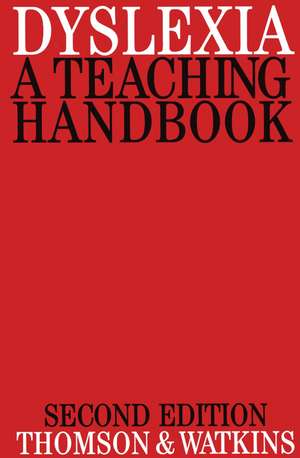
Dyslexia 2e
Autor Thomson, Watkinsen Limba Engleză Paperback – 26 oct 2007
Preț: 465.84 lei
Puncte Express: 699
Carte tipărită la comandă
Livrare economică 16-30 noiembrie
Livrare prin curier în România Termenul estimat este afișat lângă disponibilitate.
Transport gratuit pentru acest produs Plată online sau ramburs, în funcție de opțiunile comenzii.
Retur gratuit în 14 zile Comandă securizată și suport în română.
Specificații
ISBN-13: 9781861560391
ISBN-10: 1861560397
Pagini: 268
Dimensiuni: 152 x 229 x 15 mm
Greutate: 0.39 kg
Ediția:2. Auflage
Editura: Wiley
Locul publicării:Chichester, United Kingdom
ISBN-10: 1861560397
Pagini: 268
Dimensiuni: 152 x 229 x 15 mm
Greutate: 0.39 kg
Ediția:2. Auflage
Editura: Wiley
Locul publicării:Chichester, United Kingdom
V-ar putea interesa
-
 Visual Aspects of DyslexiaJohn Stein-29%Preț: 602.50 lei845.28 lei
 -
 -19%Preț: 87.30 lei107.86 lei
 -
 Dyslexia, Dyscalculia and Mathematics: A practical guideAnne HendersonPreț: 369.63 lei
 -
 Supporting Dyslexic Adults inBrunswickPreț: 342.44 lei
 -
 Dyslexia & LiteracyReid-23%Preț: 446.39 lei579.72 lei
 -
 Could It Be You?Carina NorrisPreț: 102.72 lei
 -
 Dyslexia - A Practitioner¿s Handbook 5eGavin ReidPreț: 343.90 lei
 -
 Mathematics for Dyslexics and Dyscalculics - A Teaching Handbook 4eRichard Edmund AshcroftPreț: 345.85 lei
 -
 The Little Book of DyslexiaJoe BeechPreț: 94.81 lei
 -
 -21%Preț: 107.43 lei135.45 lei
 -
 Preț: 392.00 lei
 -
 Dyslexia and MathsJulie KayPreț: 255.54 lei
 -
 Dyslexia, Speech and Language 2eSnowlingPreț: 383.68 lei
Notă biografică
Dr Michael Thomson is Principal of East Court, an internationally acclaimed specialist school for dyslexia, and Honorary Senior Lecturer in Applied Child Psychology at the University of Kent. He is also an executive editor of Dyslexia, the journal of the British Dyslexia Association, an Associate of the British Psychological Society, a Chartered Educational Psychologist and a Fellow of the International Academy for Research into Learning Difficulties.
Cuprins
Preface to the First Edition. Preface to th Second Edition.
Chapter 1 Introduction.
Historical context and definition.
Features of dyslexia.
Dyslexia as a syndrome.
Causes of dyslexia.
Reading and spelling development.
Assessment and teaching.
Addendum: Dyslexia and the 1981 Education Act.
Code of Practice.
Individual Educational Plans.
Dyslexia and the National Curriculum.
Chapter 2 Making a Start.
Setting up a dyslexia unit.
Priniples of teaching.
General classroom procedures.
Chapter 3 From Spoken to Written Language.
Introduction.
Linguistic knowledge required by child and teacher.
Written language structure.
Teaching techniques.
Chapter 4 Reading.
Introduction.
Use of word lists.
Syllable analysis.
Developing reading skills.
Listening to dyslexics read.
Written language structure and meaning.
Choosing a book.
Useful reading schemes.
Chapter 5 Spelling.
Introduction.
Teaching techniques for spelling.
Spelling rules.
Using dictionaries.
Chapter 6 Writing.
Handwriting.
Essay writing.
Grammar.
Chapter 7 The Older Student.
Choice of course.
Study skills.
Examinations.
Chapter 8 Computers and Dyslexia.
Using information technology in a specialist school.
Computers in the classroom.
Information technology curriculum.
Using computers with dyslexics.
Curriculum outline for word processing with dyslexics.
Interactive books.
Appendices.
1. Examples of Individual Educational Plans (IEP) - English.
II. Phonic work sheets.
III. Common words for a basic sight vocabulary.
IV Suggested key word list for irregular words.
V Key word list for school subjects.
VI Word lists.
VII Spelling rules.
VIII Vowel digraphs/diphthongs.
IX Ways of spelling.
X The impossible word list.
XI Statementing.
XII Using the Aston Portfolio for prescriptive teaching based on error analysis.
XIII Some examples of minimal pair words (southern British pronunciation).
XIV Word processing examples.
XV Reading game.
References.
Index.
Chapter 1 Introduction.
Historical context and definition.
Features of dyslexia.
Dyslexia as a syndrome.
Causes of dyslexia.
Reading and spelling development.
Assessment and teaching.
Addendum: Dyslexia and the 1981 Education Act.
Code of Practice.
Individual Educational Plans.
Dyslexia and the National Curriculum.
Chapter 2 Making a Start.
Setting up a dyslexia unit.
Priniples of teaching.
General classroom procedures.
Chapter 3 From Spoken to Written Language.
Introduction.
Linguistic knowledge required by child and teacher.
Written language structure.
Teaching techniques.
Chapter 4 Reading.
Introduction.
Use of word lists.
Syllable analysis.
Developing reading skills.
Listening to dyslexics read.
Written language structure and meaning.
Choosing a book.
Useful reading schemes.
Chapter 5 Spelling.
Introduction.
Teaching techniques for spelling.
Spelling rules.
Using dictionaries.
Chapter 6 Writing.
Handwriting.
Essay writing.
Grammar.
Chapter 7 The Older Student.
Choice of course.
Study skills.
Examinations.
Chapter 8 Computers and Dyslexia.
Using information technology in a specialist school.
Computers in the classroom.
Information technology curriculum.
Using computers with dyslexics.
Curriculum outline for word processing with dyslexics.
Interactive books.
Appendices.
1. Examples of Individual Educational Plans (IEP) - English.
II. Phonic work sheets.
III. Common words for a basic sight vocabulary.
IV Suggested key word list for irregular words.
V Key word list for school subjects.
VI Word lists.
VII Spelling rules.
VIII Vowel digraphs/diphthongs.
IX Ways of spelling.
X The impossible word list.
XI Statementing.
XII Using the Aston Portfolio for prescriptive teaching based on error analysis.
XIII Some examples of minimal pair words (southern British pronunciation).
XIV Word processing examples.
XV Reading game.
References.
Index.