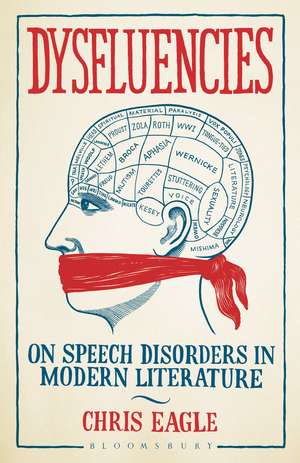
Dysfluencies: On Speech Disorders in Modern Literature
Autor Dr. Chris Eagleen Limba Engleză Hardback – 2 ian 2014
Preț: 835.03 lei
Preț vechi: 1242.33 lei
-33%
Puncte Express: 1253
Carte tipărită la comandă
Livrare economică 07-21 decembrie
Livrare prin curier în România Termenul estimat este afișat lângă disponibilitate.
Transport gratuit pentru acest produs Plată online sau ramburs, în funcție de opțiunile comenzii.
Retur gratuit în 14 zile Comandă securizată și suport în română.
Specificații
ISBN-13: 9781623563325
ISBN-10: 1623563321
Pagini: 240
Dimensiuni: 152 x 230 x 18 mm
Greutate: 0.48 kg
Editura: Bloomsbury Publishing
Colecția Bloomsbury Academic
Locul publicării:New York, United States
ISBN-10: 1623563321
Pagini: 240
Dimensiuni: 152 x 230 x 18 mm
Greutate: 0.48 kg
Editura: Bloomsbury Publishing
Colecția Bloomsbury Academic
Locul publicării:New York, United States
V-ar putea interesa
-
 Preț: 329.29 lei
 -
 Women and Writing in Modern ChinaWendy Larson-19%Preț: 493.24 lei608.93 lei
 -
 North American Romance WritersKay Mussell-33%Preț: 547.34 lei818.46 lei
 -
 Preț: 228.02 lei
 -
 Crossing Borders through Folklore: African American Women's Fiction and ArtAlma Jean Billingslea-BrownPreț: 404.26 lei
 -
 Modernism, Sex, and GenderProfessor Celia Marshik-25%Preț: 194.43 lei260.12 lei
 -
 Youth Culture and the Post-War British Novel: From Teddy Boys to TrainspottingProfessor Stephen Ross-18%Preț: 193.26 lei236.85 lei
 -
 Salman Rushdie and TranslationDr Jenni Ramone-24%Preț: 835.63 lei1105.92 lei
 -
 -15%Preț: 279.35 lei330.27 lei
 -
 Encountering Buddhism in Twentieth-Century British and American LiteratureDr Lawrence Normand-16%Preț: 283.09 lei335.11 lei
 -
 -16%Preț: 276.49 lei328.74 lei
 -
 Diane di Prima: Visionary Poetics and the Hidden ReligionsDr David Stephen Calonne-32%Preț: 862.45 lei1265.64 lei
 -
 The IDA Pro Book, 2nd EditionChris Eagle-20%Preț: 401.94 lei502.43 lei
 -
 -16%Preț: 278.27 lei329.68 lei
 -
 -25%Preț: 275.69 lei368.28 lei
 -
 -16%Preț: 277.20 lei329.09 lei
Cuprins
Acknowledgements
Introduction: The Neurolinguistic Turn
Chapter 1: Aphasia and Neurology in Zola and Proust
. "la vièille paralytique"
. "nervous being"
. "raucous sounds"
. "menacé d'aphasie"
. "whispered words"
Chapter 2: Speech Disorders and Shell Shock in World War I Writing
. "Kindred Disorders"
. "no stammer previous to shock"
. "You can't communicate noise"
. "the new voice from Craiglockhart"
Chapter 3: Stuttering and Sexuality in Woolf, Melville, Kesey, and Mishima
. "shy and stammering"
. "organic hesitancy"
. "m-m-m-m-mamma"
. "The Rusty Key"
Chapter 4: Stuttering, Violence, and the Politics of Voice in Graves, Roth, and Jones
. "vox populi"
. "though he do limp and stammer a bit"
. "angry because she stutters"
. "haltings and erasures"
Chapter 5: Tourettic Speech in Jonathan Lethem's Motherless Brooklyn
. "la maladie des tics"
. "the world (or my brain - same thing)"
. "to tic freely"
. "Those walls of language"
. "Tourette's muse was with me"
Conclusion: On Speech Disorders in Theory
Bibliography
Index
Introduction: The Neurolinguistic Turn
Chapter 1: Aphasia and Neurology in Zola and Proust
. "la vièille paralytique"
. "nervous being"
. "raucous sounds"
. "menacé d'aphasie"
. "whispered words"
Chapter 2: Speech Disorders and Shell Shock in World War I Writing
. "Kindred Disorders"
. "no stammer previous to shock"
. "You can't communicate noise"
. "the new voice from Craiglockhart"
Chapter 3: Stuttering and Sexuality in Woolf, Melville, Kesey, and Mishima
. "shy and stammering"
. "organic hesitancy"
. "m-m-m-m-mamma"
. "The Rusty Key"
Chapter 4: Stuttering, Violence, and the Politics of Voice in Graves, Roth, and Jones
. "vox populi"
. "though he do limp and stammer a bit"
. "angry because she stutters"
. "haltings and erasures"
Chapter 5: Tourettic Speech in Jonathan Lethem's Motherless Brooklyn
. "la maladie des tics"
. "the world (or my brain - same thing)"
. "to tic freely"
. "Those walls of language"
. "Tourette's muse was with me"
Conclusion: On Speech Disorders in Theory
Bibliography
Index
Recenzii
Dysfluencies: On Speech Disorders in Modern Literature is an authoritative and important book that creates a model for interdisciplinary studies that will enlarge the horizon of scholarly work for years to come. Its study of modern literatures - British, American, French, Japanese, Australian - creates a significant rethinking of literary history in relation to neurological and clinical understandings of representations of behavior, personality, and motivation in literary texts. It does so by bringing together the diverse disciplines of medicine, neurology, psychology, and poetics in creating a rich sense of the power of language and discourse as it is inflected by intellectual culture. Its understanding of speech disorder as not only a deficit but also as a "superabundance" of linguistic function has much to teach medicine and neurology, just as it demonstrates throughout how literary studies and simply the experience of reading can be enriched in the light of the systematic knowledge and practical work of neuroscience and medicine. For readers in all these disciplines, Dysfluencies offers a mode of comprehension that will make their understanding and work more inclusive, more humane, and more fulfilling.
Dysfluencies is a critical genealogy of modern literature's struggle to understand the faculty of language, not what we say or how, but the very fact that we can say it. Reading for the moments when that faculty deserts us, Eagle offers a wide-ranging but tightly focused literary history from a surprising angle, but also undertakes a thoroughly original reflection on literatures attempt to grapple with its most basic material.
Dysfluencies is a critical genealogy of modern literature's struggle to understand the faculty of language, not what we say or how, but the very fact that we can say it. Reading for the moments when that faculty deserts us, Eagle offers a wide-ranging but tightly focused literary history from a surprising angle, but also undertakes a thoroughly original reflection on literatures attempt to grapple with its most basic material.