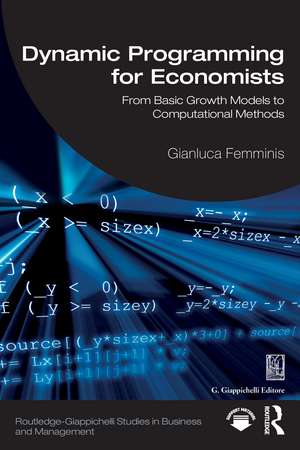
Dynamic Programming for Economists: From Basic Growth Models to Computational Methods: Routledge-Giappichelli Studies in Business and Management
Autor Gianluca Femminisen Limba Engleză Paperback – 21 iul 2026
This book is a primer on dynamic programming and related numerical techniques. To assist the reader, the discussion focuses on a specific example: a simple optimal growth model. Once the reader has mastered the most important concepts, these can be easily applied to business cycle models, New Keynesian frameworks, dynamic CAPM, and many other issues.
The deterministic growth model is used to introduce dynamic programming in an intuitive way. Technicalities are reduced to a minimum, though not avoided, to provide a solid foundation for the applications (and to stimulate the interested reader toward further readings). After a discussion of cases where a closed-form solution exists, the most commonly used numerical techniques are introduced. The book considers the value function iteration method, detailing the steps needed to build the pertinent numerical routines using Matlab. The policy function iteration method and the endogenous grid approach are also discussed since—while similar in spirit to value function iteration—they offer ways to save computing time for some applications. Then, collocation methods are used to obtain a ‘global’ solution. Again, the reader is guided step-by-step in building the numerical routines. Finally, the book introduces the perturbation method, emphasizing its nature as an approximation of the ‘true’ solution.
Moving in small steps, and with the aim of keeping the presentation as readable as possible, the book then focuses on stochastic versions of the growth model. The numerical techniques introduced for the deterministic version are used to deal with (persistent) productivity shocks. In addition, the book presents a method—the parameterized expectation approach—that only mildly suffers from the “curse of dimensionality”.
Din seria Routledge-Giappichelli Studies in Business and Management
- 18%
 Preț: 1057.86 lei
 -
 Preț: 423.82 lei
 -
 Preț: 387.01 lei
 -
 Preț: 213.93 lei
 -
 Preț: 411.24 lei
 -
 Preț: 421.21 lei
 -
 Preț: 403.49 lei
 -
 Preț: 424.32 lei
 -
 Preț: 439.64 lei
 -
 Preț: 424.32 lei
 -
 Preț: 424.32 lei
 -
 Preț: 433.53 lei
 -
 Preț: 458.33 lei
 -
 Preț: 390.89 lei
 -
 Preț: 412.91 lei
 -
 Preț: 427.39 lei
 -
 Preț: 403.95 lei
 -
 Preț: 397.82 lei
 -
 Preț: 378.93 lei
 -
 Preț: 424.32 lei
 -
 Preț: 410.99 lei
 - 15%
 Preț: 436.91 lei
 - 18%
 Preț: 1055.67 lei
 -
 Preț: 425.30 lei
 - 18%
 Preț: 1110.62 lei
 -
 Preț: 474.91 lei
 -
 Preț: 416.24 lei
 - 18%
 Preț: 1117.96 lei
 - 25%
 Preț: 1097.29 lei
Preț: 353.14 lei
Preț vechi: 448.17 lei
-21% Nou
Puncte Express: 530
Carte indisponibilă temporar
Doresc să fiu notificat când acest titlu va fi disponibil:
Se trimite...
Specificații
ISBN-13: 9781041303398
ISBN-10: 1041303394
Pagini: 272
Ilustrații: 62
Dimensiuni: 156 x 234 mm
Greutate: 0.42 kg
Ediția:1
Editura: Taylor & Francis
Colecția Routledge
Seria Routledge-Giappichelli Studies in Business and Management
Locul publicării:Oxford, United Kingdom
ISBN-10: 1041303394
Pagini: 272
Ilustrații: 62
Dimensiuni: 156 x 234 mm
Greutate: 0.42 kg
Ediția:1
Editura: Taylor & Francis
Colecția Routledge
Seria Routledge-Giappichelli Studies in Business and Management
Locul publicării:Oxford, United Kingdom
Public țintă
Postgraduate and Undergraduate AdvancedNotă biografică
Gianluca Femminis is a Full Professor of Economics in the Department of Economics and Finance at the Catholic University of Milan, Italy.
Cuprins
1. Utility maximization in a dynamic deterministic setting 2. The Dynamic Programming formulation 3. Guess and verify 4. A “paper and pencil” introduction to function iteration 5. Collocation and perturbation with paper and pencil 6. A Lagrangian approach to stochastic growth 7. Stochastic growth: Bellman formulation and closed-form solutions 8. Solving the stochastic growth model: a brief tour of the techniques. Conclusion
Descriere
This book is a primer in dynamic programming and related numerical techniques. The reader is introduced to formal concepts by an application to a simple deterministic growth model. The concepts can then be easily adapted to deal with Real Business Cycle, New Keynesian models, dynamic CAPM and many other topics in Macroeconomics and Finance.