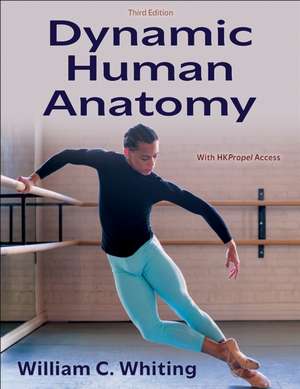
Dynamic Human Anatomy
Autor William C. Whitingen Limba Engleză Paperback – 16 feb 2026
Dynamic Human Anatomy, Third Edition With HKPropel Access, covers concepts not found in traditional anatomy texts. It sets itself apart by linking anatomy to biomechanics principles to explain fundamental movements and movement patterns. With a greater understanding of anatomy in conjunction with how the body moves, students planning for a career in any field of human movement—including those pursuing preclinical degrees—will be better prepared to assess muscle action and employ specific movement applications.
The third edition of Dynamic Human Anatomy provides students with an understanding of the body's structure as it explores the complexity of the body's functional movement anatomy. Unlike many titles that focus primarily on sport mechanics, this text also offers supporting information on everyday body motions.
New to This Edition
- Addition of bony landmarks plus images for understanding muscle attachment points
- Expanded information on osteoporosis beyond postmenopausal women, including gymnasts and ballet dancers
- Added exploration of musculotendinous sensory structures and their role in reflexes
- New information on sleeping surfaces and postures for lying down
- Discussion of muscle adaptations as a result of resistance and endurance training
- New section on cycling, including pedaling cycle, propulsion, cadence, body position, and aerodynamic drag
The third edition of Dynamic Human Anatomy is sensibly organized with a progressive approach. It opens with the general concepts of human anatomy and the structure and organization of the skeletal system. The second part discusses biomechanical properties essential to understanding and assessing human movement, including the muscle control formula.
The text then connects structural anatomy with biomechanics to focus on everyday movements and movement patterns. Students will examine posture and balance, gait, and other functional movements like jumping and lifting. The final section explores further applications for strength and conditioning, sport and dance, clinical scenarios, and ergonomics.
Dynamic Human Anatomy, Third Edition With HKPropel Access, explores the potential of the human body to express itself through movement, making it a highly valuable text for students who need a more detailed exposure to concepts in human movement anatomy.
Note: A code for accessing HKPropel is included with all print books.
Preț: 781.87 lei
Preț vechi: 823.02 lei
-5%
Carte disponibilă
Livrare economică 07-21 noiembrie
Livrare express 24-30 octombrie pentru 61.35 lei
Specificații
ISBN-10: 1718235755
Pagini: 408
Dimensiuni: 212 x 278 x 24 mm
Greutate: 1.11 kg
Ediția:Third Edition
Editura: HUMAN KINETICS
V-ar putea interesa
-
 Brain Damage, Brain RepairJames Fawcett-5%Preț: 618.95 lei651.53 lei
 -
 In Vivo Body Composition StudiesJoan E. Harrison-18%Preț: 992.20 lei1210.00 lei
 -
 The Naked NeuronRhawn Joseph-15%Preț: 669.81 lei788.01 lei
 -
 The Design of Synthetic Inhibitors of ThrombinGoran Claeson-5%Preț: 1138.01 lei1197.90 lei
 -
 Human Acid-Base PhysiologyOliver HolmesPreț: 371.03 lei
 -
 Unsaturated Fatty AcidsThe British Nutrition FoundationPreț: 382.07 lei
 -
 Vertebrate EcophysiologyDon Bradshaw-19%Preț: 623.12 lei769.29 lei
 -
 -11%Preț: 446.82 lei502.04 lei
 -
 Role of Calcium and Comparable Cations in Animal BehaviourPatricia Wilkins-5%Preț: 453.80 lei477.69 lei
 -
 The Igf SystemRon G Rosenfeld-18%Preț: 1307.69 lei1594.75 lei
 -
 Hypoxic Pulmonary VasoconstrictionJason X. -J. Yuan-18%Preț: 1448.23 lei1766.13 lei
 -
 Preț: 131.72 lei
 -
 War Powers Under The Constitution Of The United StatesWilliam WhitingPreț: 234.32 lei
 -
 -5%Preț: 543.49 lei572.09 lei
 -
 The Sensory Circumventricular Organs of the Mammalian BrainMichael J. McKinley-15%Preț: 635.39 lei747.52 lei
 -
 Tissue Restoration Through Regenerative Biology and MedicineDavid L. StocumPreț: 365.51 lei
 -
 -5%Preț: 436.02 lei458.96 lei
 -
 Das intrathorakale Blutvolumen als hämodynamischer LeitparameterUlrich J. Pfeiffer-5%Preț: 436.71 lei459.70 lei
 -
 Cardiorespiratory and Motor CoordinationHans-Peter Koepchen-5%Preț: 691.42 lei727.80 lei
 -
 -5%Preț: 434.98 lei457.86 lei
 -
 -5%Preț: 466.41 lei490.96 lei
 -
 Die Ernährungsbedürfnisse von SportlernFred Brouns-5%Preț: 440.04 lei463.19 lei
 -
 Hair FollicleK. Morioka-5%Preț: 1484.09 lei1562.20 lei
 -
 Preț: 155.62 lei
Notă biografică
Whiting currently serves on the editorial board of NSCA's Journal of Strength and Conditioning Research and serves as a reviewer for a number of scholarly journals. Whiting is a fellow of the American College of Sports Medicine (ACSM) and has served as president of the Southwest Regional Chapter of ACSM. He is also a member of the American Society of Biomechanics, the International Society of Biomechanics, and the National Strength and Conditioning Association.
Cuprins
Chapter 1. Introduction to Human Anatomy and Movement
Introduction to Human Anatomy
Introduction to Human Movement
Movement Across the Life Span
Anatomical Concepts
Levels of Structural Organization
Anatomical References and Terminology
Study of Human Movement
Concluding Comments
Suggested Readings
Chapter 2. Osteology and the Skeletal System
Functions of the Skeletal System
Bone Histology and Composition
Bone Modeling, Growth, and Development
Skeletal System Organization
Bone Adaptation
Bone Health
Concluding Comments
Suggested Readings
Chapter 3. Joint Anatomy and Function
Joint Structure and Classification
Joint Motion and Movement Description
Types of Joint Movement
Joint Structure and Movement
Joint-Related Conditions
Concluding Comments
Suggested Readings
Chapter 4. Skeletal Muscle
Properties of Skeletal Muscle
Structure and Function of Skeletal Muscle
Muscle Names
Functional Actions of Muscles
Muscles of Major Joints
Muscle Adaptations
Muscle Injury, Pain, and Soreness
Concluding Comments
Suggested Readings
Part II. Biomechanics and Movement Control
Chapter 5. Biomechanics
Biomechanical Concepts
Movement Mechanics
Fluid Mechanics
Joint Mechanics
Material Mechanics
Concluding Comments
Suggested Readings
Chapter 6. Muscular Control of Movement and Movement Assessment
Muscle Function
Muscle Action
Movement Coordination
Movement Efficiency and Economy
Muscle Redundancy and Abundancy
Movement Assessment
Concluding Comments
Suggested Readings
Part III. Fundamentals of Movements
Chapter 7. Posture and Balance
Fundamentals of Posture and Balance
Concluding Comments
Suggested Readings
Chapter 8. Gait
Walking
Running
Concluding Comments
Suggested Readings
Chapter 9. Basic Movement Patterns
Cycling
Lifting
Jumping
Throwing
Kicking
Striking
Concluding Comments
Suggested Readings
Part IV. Movement Applications
Chapter 10. Strength and Conditioning Applications
General Principles
Types of Strength and Conditioning Programs
Resistance Training
Endurance (Aerobic) Training
Concluding Comments
Suggested Readings
Chapter 11. Sport and Dance Applications
Baseball and Softball
Basketball
Competitive Cycling
American Football
Golf
Soccer
Swimming
Tennis
Volleyball
Dance Applications
Concluding Comments
Suggested Readings
Chapter 12. Clinical Applications
Concepts of Musculoskeletal Injury
Injury Prevention and Prehabilitation
Common Injuries
Rehabilitation
Prosthetics and Orthotics
Concluding Comments
Suggested Readings
Chapter 13. Ergonomics Applications
Ergonomic Concepts
Lifting
Overuse Conditions
Concluding Comments
Suggested Readings
Descriere
Dynamic Human Anatomy, Second Edition With Web Study Guide, is back--with a new title, significant new material and learning aids, and the same goals: to cover concepts not found in traditional anatomy texts and to help students apply those concepts.
Formerly titled Dynatomy, the new edition of this introductory to upper-level biomechanics and anatomy text sets itself apart from other texts in this field by connecting biomechanical principles with applications in sports and dance, strength training, work settings, and clinical settings. Dynamic Human Anatomy offers applied dance- and sport-specific information on how the body performs dynamic movement, providing students an understanding of the body's structure and function as it explores the elegance and complexity of the body's functional movement anatomy.
New Tools and Learning Aids
Dynamic Human Anatomy comes with many tools and learning aids, including a web study guide and new instructor resources, each featuring new material and tools.
The web study guide offers the following:
- Tables that indicate articulations for the spine and upper and lower extremities
- Tables that list the origin, insertion, action, and innervation for all major muscle groups
- Practice problems that allow students to apply the muscle control formula discussed in chapter 6
- Critical thinking questions
The instructor resources include:
- A presentation package with slides that present the key concepts from the text and can be used for class discussion and demonstration
- An image bank that includes the figures and tables from the book to develop a custom presentation
- An instructor guide that includes a sample syllabus, chapter summaries, lecture outlines, ideas for additional assignments, and answers to the critical thinking questions presented in the web study guide
- A test package that includes 330 questions
Dynamic Human Anatomy also offers a full-color design and learning aids that include an updated glossary, chapter objectives, summaries, and suggested readings. Each chapter has Applying the Concept sidebars, which provide practical examples of concepts, and Research in Mechanics sidebars, which highlight recent research in biomechanics and human movement.
Organized Into Four Parts
Dynamic Human Anatomy is organized into four parts. Part I provides a concise review of relevant anatomical information and neuromechanical concepts. It covers the dynamics of human movement, the essentials of anatomical structure and the organization of the skeletal system. Part II details the essentials of a dynamic approach to movement, including a review of mechanical concepts essential to understanding human movement, the muscle control formula, and topics relevant to movement assessment.
In part III, the focus is on fundamental movements as the chapters examine posture and balance, gait, and basic movement patterns. Part IV explores movement-related aspects for strength and conditioning applications, sport and dance applications, clinical applications, and ergonomic applications.
Brings Anatomy to Life
Dynamic Human Anatomy, Second Edition, explores the potential of the human body to express itself through movement, making it a highly valuable text for students who have taken, or are taking, introductory anatomy and who need a more detailed exposure to concepts in human movement anatomy.