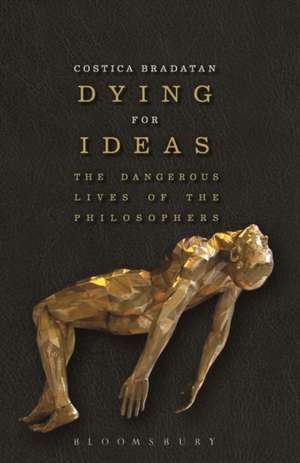
Dying for Ideas
Autor Costica Bradatanen Limba Engleză Paperback – 22 mar 2018
Preț: 78.65 lei
Preț vechi: 139.50 lei
-44%
Puncte Express: 118
Carte disponibilă
Livrare economică 09-23 noiembrie
Livrare express 23-29 octombrie pentru 86.48 lei
Livrare prin curier în România Termenul estimat este afișat lângă disponibilitate.
Transport gratuit de la 400.00 lei Plată online sau ramburs, în funcție de opțiunile comenzii.
Retur gratuit în 14 zile Comandă securizată și suport în română.
Specificații
ISBN-13: 9781472529718
ISBN-10: 1472529715
Pagini: 252
Ilustrații: 10 bw illus
Dimensiuni: 136 x 214 x 20 mm
Greutate: 0.34 kg
Editura: BLOOMSBURY ACADEMIC
Locul publicării:London, United Kingdom
ISBN-10: 1472529715
Pagini: 252
Ilustrații: 10 bw illus
Dimensiuni: 136 x 214 x 20 mm
Greutate: 0.34 kg
Editura: BLOOMSBURY ACADEMIC
Locul publicării:London, United Kingdom
V-ar putea interesa
-
 The Book of LifeJiddu KrishnamurtiPreț: 110.56 lei
 -
 The Pocket Oracle and Art of PrudenceBalthasar GracianPreț: 85.14 lei
 -
 The Boy with the Cuckoo-Clock HeartMathias MalzieuPreț: 82.98 lei
 -
 Love in the Western WorldDenis De RougemontPreț: 295.49 lei
 -
 The Birth of HedonismKurt LampePreț: 252.67 lei
 -
 The Devil at LargeErica JongPreț: 103.42 lei
 -
 The Quest for Hermes TrismegistusGary LachmanPreț: 143.77 lei
 -
 LesabéndioPaul ScheerbartPreț: 114.83 lei
 -
 The Limerick: An Anthology with Notes, Variants and IndexSergei Mikhail TolstoiPreț: 143.76 lei
 -
 Year of Wonder: Classical Music for Every DayClemency Burton-Hill-25%Preț: 93.35 lei124.12 lei
 -
 I am Not a Brain - Philosophy of Mind for the 21st CenturyMarkus GabrielPreț: 127.66 lei
 -
 A Day in the LifeSenji KuroiPreț: 85.94 lei
 -
 The Book of Primal Signs: The High Magic of SymbolsNigel Pennick-24%Preț: 70.16 lei91.85 lei
 -
 Preț: 88.92 lei
 -
 -22%Preț: 91.40 lei117.82 lei
 -
 MedusaDavid Leeming-13%Preț: 133.36 lei153.97 lei
 -
 Diary of a Vampire in PyjamasMathias MalzieuPreț: 63.36 lei
 -
 If Venice DiesSalvatore SettisPreț: 113.08 lei
 -
 A Companion to Federico García LorcaFederico BonaddioPreț: 232.15 lei
 -
 Sex and Horror: Volume FourPino Dangelico-17%Preț: 140.48 lei168.93 lei
 -
 Forbidden EroticaTaschenPreț: 185.74 lei
Caracteristici
Provides timely philosophical and political insights into the notion of dying for an idea
Notă biografică
Costica Bradatan is a Professor of Humanities in the Honors College at Texas Tech University, USA, and an Honorary Research Professor of Philosophy at University of Queensland, Australia. He is the author or editor of several books, and his work has been translated into many languages, including Dutch, German, Italian, Chinese, Vietnamese, and Farsi. Bradatan writes regularly for such publications as the New York Times, Times Literary Supplement, Aeon, Dissent,and The New Statesman,and serves as the Religion/Comparative Studies Editor for the Los Angeles Review of Books.
Cuprins
Acknowledgments Introduction1. Philosophy as Self-fashioning 2. The First Layer 3. Philosophy in the Flesh 4. The Second Layer 5. The Making of a Martyr-Philosopher Postscript: To Die LaughingBibliography Index
Recenzii
An intriguing 'dramatic narrative' of philosophers' clash with death . a book that is accessible to all philosophers, academic and non-academic alike. In this intelligent and artful account, [Bradatan] ranges from the ancient world to our own times, drawing on the stories of individual philosophers who defended and died for their beliefs ... Bradatan's rich examination of the philosopher's act of dying for ideas brings into focus the riskiness of living for them as well.
[Bradatan] argues persuasively that death is not simply the opposite of life, but that it enters life and lends it urgency - that it can even 'breathe new life into life'.
Dying for Ideas: The Dangerous Lives of the Philosophers [is] a stimulating spiritual journey through an essential topic of human existence, and a reading of the history of human vision about it... Bradatan's highly intelligent and challenging book is an exemplary scrutiny of the life of the human mind, the human soul and body.
[Bradatan's] style is nimble. A register of directness works throughout the book, moving from argument to quip, to narrative as appropriate. The book is well designed, with each chapter building on the previous ... Dying for Ideas is a lucid discussion of mortality and an unsparing portrait of philosophy's ends - in both senses of the word.
Accessible, penetrating and erudite, [Dying For Ideas is] a beautifully written book which reveals that philosophy is not about academics grinding out dry papers but about mortals confronting the truths of the human condition in order to develop an art of living ... Bradatan has achieved something special in writing this book. As a comprehensive philosophy of death, it amounts to a profound philosophy of the true nature of philosophy itself
Books of philosophy are rarely page-turners, but Bradatan takes us through a fascinating exploration of the existential limit-situations in which philosophers find themselves when their only means of communicating the truth is their own dying bodies.
The choice of philosophers to sacrifice their lives for their ideas is lofty and grim. In Costica Bradatan's book, it is also fun and funny. Dying for Ideas is full of joie de mourir, which as Plato's Socrates would have put it, is just the other side of joie de vivre. The book is at once heroic and ironic ... Too often when young people announce their intention to study philosophy, well-wishers ask them what they are going to do with it, assuming it is a commodity that is bought from professionals and should lead to monetary returns. The correct answer is: live right, be prepared to die. Dying for Ideas reminds us of this ancient truth.
[This is] a pithy book that is hard to put down as each section promises a new surprise.
One of the greatest merits of Costica Bradatan's book is that it explores a cluster of topics that represent the untold, the unuttered, almost the unutterable in contemporary philosophy: death, dying, sacrifice and self-sacrifice. Ours is a culture of 'happy endings' and, in this respect, most philosophers of today are the spokespersons of their time. Bradatan is a dissenter. His book approaches death head-on. Indeed, what makes this project fascinating is the fact that, while the book purports to be about 'dying for an idea,' it in fact sings praise to life. Death, in Bradatan's view, is something that brings new meaning to life, a renewed intensity to the act of living.
A thoroughly stimulating exploration of philosophers and their courageous deaths, pushing us to reflect on the fascinating question: what is philosophy for?
Written with verve and humor, at once deeply learned and wickedly ironic, this book explores how philosophy is not only an art of living but also an art of dying - and dying well! Original and irreverent!
What it all comes down to, unexpectedly enough, is laughter, even if it isn't clear at whose expense the joke has been played. The martyr laughs in the face of death, as More did... 'If you are the first to laugh at yourself,' Bradatan asks, 'what else can death possibly do to you?' ... a suggestive and finely delineated argument.
Poignant, provocative, astute, moving, thoughtful.
[Bradatan] argues persuasively that death is not simply the opposite of life, but that it enters life and lends it urgency - that it can even 'breathe new life into life'.
Dying for Ideas: The Dangerous Lives of the Philosophers [is] a stimulating spiritual journey through an essential topic of human existence, and a reading of the history of human vision about it... Bradatan's highly intelligent and challenging book is an exemplary scrutiny of the life of the human mind, the human soul and body.
[Bradatan's] style is nimble. A register of directness works throughout the book, moving from argument to quip, to narrative as appropriate. The book is well designed, with each chapter building on the previous ... Dying for Ideas is a lucid discussion of mortality and an unsparing portrait of philosophy's ends - in both senses of the word.
Accessible, penetrating and erudite, [Dying For Ideas is] a beautifully written book which reveals that philosophy is not about academics grinding out dry papers but about mortals confronting the truths of the human condition in order to develop an art of living ... Bradatan has achieved something special in writing this book. As a comprehensive philosophy of death, it amounts to a profound philosophy of the true nature of philosophy itself
Books of philosophy are rarely page-turners, but Bradatan takes us through a fascinating exploration of the existential limit-situations in which philosophers find themselves when their only means of communicating the truth is their own dying bodies.
The choice of philosophers to sacrifice their lives for their ideas is lofty and grim. In Costica Bradatan's book, it is also fun and funny. Dying for Ideas is full of joie de mourir, which as Plato's Socrates would have put it, is just the other side of joie de vivre. The book is at once heroic and ironic ... Too often when young people announce their intention to study philosophy, well-wishers ask them what they are going to do with it, assuming it is a commodity that is bought from professionals and should lead to monetary returns. The correct answer is: live right, be prepared to die. Dying for Ideas reminds us of this ancient truth.
[This is] a pithy book that is hard to put down as each section promises a new surprise.
One of the greatest merits of Costica Bradatan's book is that it explores a cluster of topics that represent the untold, the unuttered, almost the unutterable in contemporary philosophy: death, dying, sacrifice and self-sacrifice. Ours is a culture of 'happy endings' and, in this respect, most philosophers of today are the spokespersons of their time. Bradatan is a dissenter. His book approaches death head-on. Indeed, what makes this project fascinating is the fact that, while the book purports to be about 'dying for an idea,' it in fact sings praise to life. Death, in Bradatan's view, is something that brings new meaning to life, a renewed intensity to the act of living.
A thoroughly stimulating exploration of philosophers and their courageous deaths, pushing us to reflect on the fascinating question: what is philosophy for?
Written with verve and humor, at once deeply learned and wickedly ironic, this book explores how philosophy is not only an art of living but also an art of dying - and dying well! Original and irreverent!
What it all comes down to, unexpectedly enough, is laughter, even if it isn't clear at whose expense the joke has been played. The martyr laughs in the face of death, as More did... 'If you are the first to laugh at yourself,' Bradatan asks, 'what else can death possibly do to you?' ... a suggestive and finely delineated argument.
Poignant, provocative, astute, moving, thoughtful.