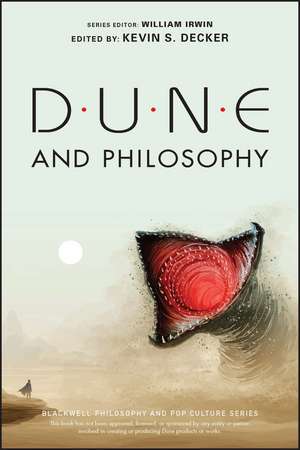
Dune and Philosophy
Editat de Kevin S Decker, William Irwinen Limba Engleză Paperback – 18 oct 2022
Problematica ecologiei deșertului și a responsabilității morale în crearea unui salvator reprezintă nucleul în jurul căruia este construit volumul Dune and Philosophy. Subliniem modul în care acest ansamblu de eseuri, coordonat de Kevin S Decker și William Irwin, reușește să transforme complexitatea narativă a lui Frank Herbert într-un teren de investigație filozofică riguroasă. Considerăm că forța acestei ediții rezidă în capacitatea celor 23 de colaboratori de a extrage înțelepciune din concepte precum „memoria rasei” sau controlul minții prin artele marțiale Bene Gesserit, oferind cititorului instrumente critice pentru a înțelege nu doar romanele originale, ci și viziunea cinematografică a lui Denis Villeneuve. Textul analizează strategiile pe termen lung ale Marilor Case și implicațiile etice ale utilizării mirodeniei, ridicând întrebări fundamentale despre natura umană și sacrificiile necesare pentru putere sau religie. Volumul completează perspectiva oferită de Theology, Religion, and the Universe of Dune, adăugând o dimensiune laică și etică discuțiilor despre providență și mesianism. În timp ce titluri precum A Dune Companion funcționează ca instrumente enciclopedice de referință pentru personaje și locații, Dune and Philosophy propune o angajare activă cu ideile subiacente, transformând lectura dintr-un act de divertisment într-un exercițiu intelectual. Observăm o atenție deosebită acordată culturii psihedelice a anilor '60 și '70, perioadă în care a apărut opera originală, explicând cum experimentele literare ale lui Herbert reflectă schimbările de paradigmă din filozofia contemporană. Este o resursă esențială pentru cei care doresc să exploreze dincolo de intriga politică, spre fundamentele ontologice ale Imperiului.
Preț: 101.34 lei
Carte disponibilă
Livrare economică 18 noiembrie-02 decembrie
Livrare express 03-07 noiembrie pentru 24.89 lei
Specificații
ISBN-10: 1119841399
Pagini: 272
Dimensiuni: 148 x 226 x 15 mm
Greutate: 0.32 kg
Ediția:1
Editura: Wiley
Locul publicării:Hoboken, United States
De ce să citești această carte
Recomandăm această carte cititorilor care doresc să aprofundeze straturile conceptuale din spatele luptei pentru Arrakis. Veți câștiga o înțelegere clară a dilemelor etice legate de determinism, ecologie și leadership politic. Este lectura ideală pentru fanii seriei care vor să exploreze legătura dintre science-fiction-ul clasic și marile întrebări ale filozofiei, oferind o perspectivă nouă asupra destinului lui Paul Atreides.
Despre autor
Kevin S. Decker este profesor de filozofie, cunoscut pentru capacitatea sa de a aplica teoria critică asupra fenomenelor din cultura populară. Alături de el, William Irwin este editorul seriei de succes „The Blackwell Philosophy and Pop Culture”, un proiect academic care a revoluționat modul în care publicul larg interacționează cu filozofia prin intermediul filmelor și literaturii de gen. Ambii editori au o vastă experiență în coordonarea volumelor care traduc concepte abstracte — de la etică la metafizică — în limbajul accesibil al marilor narațiuni contemporane, asigurând un echilibru între rigoarea academică și relevanța culturală.
Notă biografică
Descriere
Cuprins
Introduction: "He Who Controls the Spice Controls the Universe" xiv
Kevin S. Decker
A Brief Dune Series Timeline xviii
Songs of Muad'Dib: Culture and Religion in Dune 1
1 Liberating Women's Bodies: Feminist Philosophy and the Bene Gesserit of Dune 3
Kara Kennedy
2 What Do Zendaya's Blue Eyes Really Mean? 14
Edwardo Pérez
3 The Golden Path and Multicultural Meanings of Life 24
Ethan Mills
4 Messiahs, Jihads, and God Emperors: Should Humanity Just Give Up Religion? 35
Greg Littmann
5 (Re)defining Masculinity and Femininity in Villeneuve's Dune 46
Edwardo Pérez
Arrakis Awakening: Science and Ecology in Dune 55
6 Spiritual Realm Adaptation: Arrakeen Spice, Terrestrial Psychedelics, and Technique 57
A.M. Houot
7 Thinking Like a Desert: Environmental Philosophy and Dune 67
Zach Vereb
8 Humans, Machines, and an Ethics for Technology in Dune 76
Zachary Pirtle
The Wisdom of Muad'Dib: Mind, Memory, and Interpretation in Dune 87
9 "Thou Shalt Make a Human Mind in the Likeness of a Machine": Imitation, Thinking Machines, and Mentats 89
Tomi Kokkonen, Ilmari Hirvonen, and Matti Mäkikangas
10 Herbert's Gholas: Mystical Legends and Scientific Inspiration 99
Jennifer Mundale
11 Psychological Expanses of Dune: Indigenous Philosophy, Americana, and Existentialism 108
Matthew Crippen
12 Thatched Cottages at Cordeville: Hegel, Heidegger, and the Death of Art in Dune 119
Kevin S. Decker
The Lens of Time: Freedom, History, and Evil in Dune 131
13 Should the Bene Gesserit Be in Charge? 133
Greg Littmann
14 Prisoners of Prophecy: Freedom and Foreknowledge in the Dune Series 144
William Peden
15 Time versus History: A Conflict Central to Herbert's Dune 153
Aaron Irvin
The Humanity of Muad'Dib: Morality and Ethics in Dune 163
16 Secher Nbiw and the Child's Right to an Open Future 165
Kenneth R. Pike
17 The Spice of Life: Hedonism and Nozick in the Dune Universe 173
Luke Hillman
18 "Less Than a God, More Than a Man": Is It Morally Wrong to Make a Kwisatz Haderach? 179
Alexandru Dragomir
19 That Which Does Not Kill Me Makes Me Shai-Hulud: Self-overcoming in Nietzsche, Hinduism, and Dune 189
Steve Bein
Lessons of the Great Revolt: Politics and War in Dune 199
20 The God Emperor and the Tyrant: The Political Theology of Frank Herbert's Dune Saga 201
James R.M. Wakefield
21 Lessons from Islamic Philosophy on the Politics of Paul Atreides 211
Galipcan Altinkaya and Mehmet Kuyurtar
22 Why Settle for Hobbes's Sovereign When You Could Have a God Emperor? 221
R.S. Leiby
23 The Mind at War: Conflict and Cognition in Frank Herbert's Dune 229
Sam Forsythe
Index 239