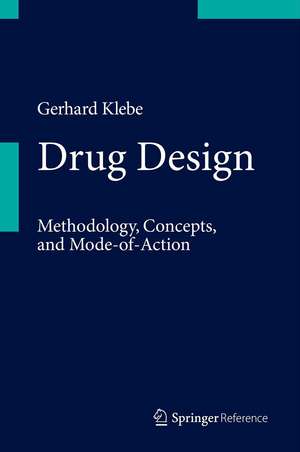
Drug Design: Drug Design
Autor Gerhard Klebeen Limba Engleză Hardback – 10 iul 2013
Preț: 4593.58 lei
Preț vechi: 6785.62 lei
-32%
Puncte Express: 6890
Carte indisponibilă temporar
Livrare prin curier în România Termenul estimat este afișat lângă disponibilitate.
Transport gratuit pentru acest produs Plată online sau ramburs, în funcție de opțiunile comenzii.
Retur gratuit în 14 zile Comandă securizată și suport în română.
Specificații
ISBN-13: 9783642179068
ISBN-10: 3642179061
Pagini: 920
Ilustrații: XV, 901 p. 496 illus., 333 illus. in color.
Dimensiuni: 160 x 241 x 54 mm
Greutate: 1.47 kg
Ediția:2013
Editura: Springer
Colecția Drug Design
Seria Drug Design
Locul publicării:Berlin, Heidelberg, Germany
ISBN-10: 3642179061
Pagini: 920
Ilustrații: XV, 901 p. 496 illus., 333 illus. in color.
Dimensiuni: 160 x 241 x 54 mm
Greutate: 1.47 kg
Ediția:2013
Editura: Springer
Colecția Drug Design
Seria Drug Design
Locul publicării:Berlin, Heidelberg, Germany
V-ar putea interesa
-
 -5%Preț: 1139.49 lei1199.47 lei
 -
 DrugsRick Ng-23%Preț: 607.87 lei789.44 lei
 -
 -5%Preț: 1021.28 lei1075.02 lei
 -
 -5%Preț: 294.23 lei309.71 lei
 -
 Ovulation Stimulation with GonadotropinsJean-Claude Emperaire-5%Preț: 739.26 lei778.17 lei
 -
 -15%Preț: 613.00 lei721.18 lei
 -
 -15%Preț: 613.00 lei721.18 lei
 -
 Lectures on PhotomorphogenesisHans MohrPreț: 376.11 lei
 -
 -5%Preț: 687.05 lei723.21 lei
 -
 -5%Preț: 692.60 lei729.05 lei
 -
 Molecular and Cellular Mechanisms in DiseaseJ. L. VanlanckerPreț: 438.46 lei
 -
 Membrane Transport in PlantsU. Zimmermann-15%Preț: 628.24 lei739.10 lei
 -
 -5%Preț: 688.29 lei724.52 lei
Public țintă
ResearchCuprins
Part I Fundamentalsin Drug Research.- 1. Drug Research Yesterday, Today and Tomorrow.- 2. The Role of Serendipityin Drug Research.- 3. Classical Drug Research.- 4. Protein–Ligand Interactionsas the Basis for Drug Action.- 5. Optical Activity and Biological Effects.- Part II Discovery and Optimizationof Lead Compounds.- 6. Screeningfor Lead Structures.- 7. Screening Technologies for LeadDiscovery.- 8. Optimizationof Lead Structures.- 9. Designingprodrugs.- 10. Peptidomimetics.- Part III Experimental and Theoretical Methods.- 11. Combinatorics: Chemistry With Big Numbers.- 12. Gene Technology in drug research.- 13. Experimental Methods of Structure Determination.- 14. The Spatial Structure of Biomolecules.- 15. Molecular Modelling.- 16. Conformational Analysis.- Part IV Structure–Activity Relationships and Design Approaches.- 17.Pharmacophore Hypothesis and Molecular Comparisons.- 18. Quantitative Structure–ActivityRelationships.- 19. From in vitro to in vivo:Optimization of ADME-Tox Properties.- 20. ProteinModeling and Structure-BasedDrug Design.- 21. ACase Study: Structure-Based Inhibtor Design for tRNA-Guanine Transglycosylase.- Part V. Drugs and drug action: Successes of stucture-based design.- 22. Howdrugs act: Concepts for therapy.- 23. Inhibitors of hydrolases With an acyl-enzymeintermediate.- 24. Asparticprotease inhibitors.- 25. Inhibitorsof hydrolysing metalloenzymes.- 26. Inhibitorsof transferases.- 27. Inhibitors ofoxidoreductases.- 28. Agonists and antagonistsof nuclear receptors.- 29. Agonists and antagonists of membrane-bound.- 30. Ligands forchannels, pores and transporters.- 31. Ligands for surfacereceptors.- 32. Biologicals: Peptides, proteins, nucleotidesand macrolides as drugs.
Notă biografică
Well-known author has won a prize for the German edition of this work.
Caracteristici
Unique reference work on the subject of drug design Full colours throughout Intelligibly written and illustrated containing over 100 computer graphics Including an index of about 5,000 items
Textul de pe ultima copertă
This English-language textbook, based on the successful German edition 'Wirkstoffdesign', brings the subject of drug design back to the cutting edge of research. The reader learns about new methods in genetic engineering and the expanded range of structural biological methods. Especially in the last 10 years, many complex target structures such as G-protein coupled receptors or ion channels have been elucidated by using these methods. The reader learns how these long-sought complex structures with classical drugs look like and how the therapeutic effect is achieved.
This textbook is aimed at students of pharmacy, chemistry and the life sciences, but also at career changers and medicinal chemists in research and development departments of the pharmaceutical industry. Conceptually, it is very different from classical textbooks on pharmaceutical chemistry. It focuses on the path to a new drug substance. The selection of case studies is based on didactic aspects and attempts to give a broad overview of methods and strategies without forgetting to look back at the beginnings of this field of work. Thus, the arc spans from the history of drug research, the mechanisms of action of drugs and the methods for lead structure search and optimisation to structure determination methods, modelling, molecular dynamics and QSAR methods to structure- and computer-aided design.
Videos via app: simply download the SN More Media app free of charge, scan a link with the play button or use the printed QR code and immediately play the video on your smartphone or tablet.
This textbook is aimed at students of pharmacy, chemistry and the life sciences, but also at career changers and medicinal chemists in research and development departments of the pharmaceutical industry. Conceptually, it is very different from classical textbooks on pharmaceutical chemistry. It focuses on the path to a new drug substance. The selection of case studies is based on didactic aspects and attempts to give a broad overview of methods and strategies without forgetting to look back at the beginnings of this field of work. Thus, the arc spans from the history of drug research, the mechanisms of action of drugs and the methods for lead structure search and optimisation to structure determination methods, modelling, molecular dynamics and QSAR methods to structure- and computer-aided design.
Videos via app: simply download the SN More Media app free of charge, scan a link with the play button or use the printed QR code and immediately play the video on your smartphone or tablet.