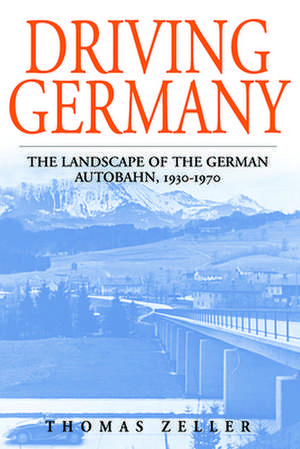
Driving Germany: Studies in German History, cartea 5
Autor Thomas Zelleren Limba Engleză Hardback – feb 2007
Din seria Studies in German History
- 33%
 Preț: 627.56 lei
- 33%
 Preț: 696.00 lei
- 32%
 Preț: 713.89 lei
- 32%
 Preț: 691.04 lei
- 32%
 Preț: 657.39 lei
- 32%
 Preț: 572.26 lei
- 19%
 Preț: 679.46 lei
- 32%
 Preț: 554.82 lei
- 12%
 Preț: 284.13 lei
- 30%
 Preț: 713.30 lei
- 30%
 Preț: 586.22 lei
- 30%
 Preț: 747.85 lei
- 23%
 Preț: 759.35 lei
- 30%
 Preț: 779.91 lei
- 32%
 Preț: 636.05 lei
- 31%
 Preț: 558.21 lei
- 19%
 Preț: 652.30 lei
- 31%
 Preț: 664.47 lei
- 19%
 Preț: 588.20 lei
- 23%
 Preț: 755.83 lei
-
 Preț: 170.41 lei
- 23%
 Preț: 764.88 lei
-
 Preț: 265.32 lei
- 23%
 Preț: 760.82 lei
-
 Preț: 546.30 lei
- 23%
 Preț: 761.67 lei
- 23%
 Preț: 780.07 lei
-
 Preț: 307.63 lei
- 23%
 Preț: 761.29 lei
- 23%
 Preț: 757.19 lei
-
 Preț: 269.13 lei
-
 Preț: 355.69 lei
-
 Preț: 267.73 lei
-
 Preț: 252.88 lei
- 23%
 Preț: 764.15 lei
-
 Preț: 252.55 lei
-
 Preț: 550.38 lei
- 23%
 Preț: 1020.18 lei
Preț: 759.66 lei
Preț vechi: 986.57 lei
-23%
Puncte Express: 1139
Carte tipărită la comandă
Livrare economică 03-17 decembrie
Livrare prin curier în România Termenul estimat este afișat lângă disponibilitate.
Transport gratuit pentru acest produs Plată online sau ramburs, în funcție de opțiunile comenzii.
Retur gratuit în 14 zile Comandă securizată și suport în română.
Specificații
ISBN-13: 9781845453091
ISBN-10: 1845453093
Pagini: 298
Dimensiuni: 157 x 235 x 21 mm
Greutate: 0.59 kg
Editura: BERGHAHN BOOKS
Colecția Studies in German History
Seria Studies in German History
Locul publicării:United Kingdom
ISBN-10: 1845453093
Pagini: 298
Dimensiuni: 157 x 235 x 21 mm
Greutate: 0.59 kg
Editura: BERGHAHN BOOKS
Colecția Studies in German History
Seria Studies in German History
Locul publicării:United Kingdom
V-ar putea interesa
-
 The Wages of DestructionAdam Tooze-17%Preț: 121.61 lei146.63 lei
-
 The Third ReichMichael Burleigh-32%Preț: 98.58 lei144.67 lei
-
 Germany's Aims in the First World WarFritz FischerPreț: 280.15 lei
-
 Inside the Third ReichAlbert SpeerPreț: 140.55 lei
-
 Showcasing the Third ReichAndrew RawsonPreț: 131.32 lei
-
 Nazi Germany and the Arab WorldFrancis R. NicosiaPreț: 157.05 lei
-
 -17%Preț: 167.33 lei201.44 lei
-
 Holidays with HitlerNathan MorleyPreț: 78.07 lei
-
 -25%Preț: 91.14 lei121.96 lei
-
 Unknown Enemy: The Hidden Nazi Force That Built the Third ReichDr Charles Dick-31%Preț: 131.78 lei190.29 lei
-
 The Race for Hitler's X-PlanesJohn ChristopherPreț: 100.28 lei
-
 Twelve Years with HitlerAlbert ZollerPreț: 187.38 lei
-
 The Age of Hitler and How We Will Survive ItAlec RyriePreț: 133.68 lei
-
 The Conquest Of NatureDavid BlackbournPreț: 142.83 lei
-
 Architecture for CarsChristopher BeanlandPreț: 237.68 lei
-
 The Third ReichCaroline SharplesPreț: 72.93 lei
-
 The Germans - Beautiful MachinesGestalten-8%Preț: 444.18 lei482.81 lei
-
 Drive DifferentGestalten-8%Preț: 441.20 lei479.56 lei
Notă biografică
Thomas Zeller is an associate professor at the University of Maryland, College Park, where he teaches the history of technology, environmental history, and science and technology studies. He is the author of Strasse, Bahn, Panorama (2002) and has co-edited the volumes How Green Were the Nazis? Nature, Environment, and Nation in the Third Reich (2005), Germany's Nature: Cultural Landscapes and Environmental History (2005), The World Beyond the Windshield: Roads and Landscapes in the United States and Europe (2008) and Rivers in History: Perspectives on Waterways in Europe and North America (2008). His current research project, consuming Landscapes, has been supported by the National Science Foundation, the John W. Kluge Center at the Library of Congress, and the Program in Garden and Landscape Studies at Dumbarton Oaks.
Cuprins
Illustrations
Acknowledgments
Chapter 1. Introduction: Germany and its Autobahn
A growing overlap: history of technology and environmental history
Transportation history: the system of mobility
Chapter 2. Landscape: the Dual Construction
Physically altered landscapes
Culturally altered landscapes
Chapter 3. The Historical Habitat of Landscape-Friendly Roads
The autobahnen in environmental history
Building technological landscapes on the Rhine and Neckar
Reconciling nature and technology in the interwar period
Alwin Seifert and Fritz Todt: a biographic constellation
Chapter 4. Planning the Autobahn before and after 1933
The failed autobahn project of the interwar period
Building the Nazi autobahn
The place of the autobahn in the Nazi dictatorship
Propagandizing the Reichsautobahn
German Technology (Deutsche Technik) and the Reichsautobahn
Chapter 5. Conflicts over the Harmonious Road
Finding a niche for landscape architects
Searching for a job description
Pitting landscape architects against civil engineers
Marginalizing conservation and spatial planning on the autobahn
Legalizing the exclusion of conservation
Chapter 6. The Myth of the Green Autobahn
Road alignment as a subject of controversy
"One drives faster than I can write": visual consumption on the Reichsautobahnen
The flora of the Nazi autobahn: contesting native plants
An ideology disintegrates: technology in the crisis of 1937
The value and cost of landscaping
The landscape advocates seek power beyond the autobahn
Chapter 7. Reinterpretations: the West German Autobahn, 1949 to 1970
Autobahnen and the politics of the Bonn Republic
Building a federal highway system
The postwar trust in numbers
"An autobahn is not a hiking path": roadside plantings as safety devices
Roadside greenery as a bone of public contention
Chapter 8. Conclusion
Bibliography and Sources
Index