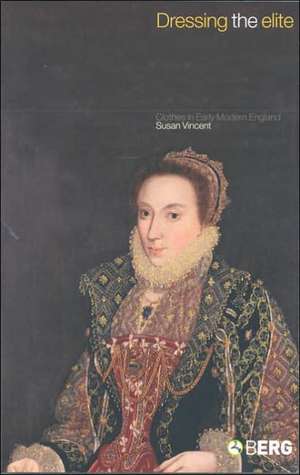
Dressing the Elite: Clothes in Early Modern England
Autor Susan J. Vincenten Limba Engleză Hardback – noi 2003
Preț: 833.90 lei
Preț vechi: 1108.96 lei
-25%
Puncte Express: 1251
Carte tipărită la comandă
Livrare economică 20 noiembrie-04 decembrie
Livrare prin curier în România Termenul estimat este afișat lângă disponibilitate.
Transport gratuit pentru acest produs Plată online sau ramburs, în funcție de opțiunile comenzii.
Retur gratuit în 14 zile Comandă securizată și suport în română.
Specificații
ISBN-13: 9781859737460
ISBN-10: 1859737463
Pagini: 240
Ilustrații: 26 b&w illustrations, bibliography, index
Dimensiuni: 138 x 216 x 21 mm
Greutate: 0.42 kg
Editura: Bloomsbury Publishing
Colecția Berg Publishers
Locul publicării:London, United Kingdom
ISBN-10: 1859737463
Pagini: 240
Ilustrații: 26 b&w illustrations, bibliography, index
Dimensiuni: 138 x 216 x 21 mm
Greutate: 0.42 kg
Editura: Bloomsbury Publishing
Colecția Berg Publishers
Locul publicării:London, United Kingdom
V-ar putea interesa
-
 The Fashion HandbookTim JacksonPreț: 437.51 lei
 -
 Treasury of Smocking DesignsA. S. Holland-19%Preț: 37.63 lei46.38 lei
 -
 Victorian FashionsCarol Grafton-19%Preț: 99.25 lei122.44 lei
 -
 Fashion in the 1920sJayne Shrimpton-32%Preț: 46.24 lei67.90 lei
 -
 Fashion and Jazz: Dress, Identity and Subcultural ImprovisationAlphonso McClendon-23%Preț: 235.79 lei308.18 lei
 -
 Classic Tailoring TechniquesRoberto Cabrera-21%Preț: 444.16 lei561.16 lei
 -
 Dimensions of DevelopmentSusan VincentPreț: 216.07 lei
 -
 The Language of FashionRoland Barthes-21%Preț: 141.67 lei179.92 lei
 -
 Practical Guide to Patternmaking for Fashion Designers: MenswearLori A. Knowles-26%Preț: 355.87 lei481.14 lei
 -
 The Spec Manual 2nd editionMichele Wesen BryantPreț: 279.50 lei
 -
 Your Personal StyleNancy Plummer-21%Preț: 376.50 lei475.65 lei
 -
 Patternmaking for Menswear: Classic to ContemporaryMyoung Ok Kim-30%Preț: 532.94 lei757.25 lei
 -
 -20%Preț: 105.94 lei131.87 lei
 -
 Techno FashionBradley Quinn-17%Preț: 207.60 lei249.17 lei
 -
 20th-Century FashionAlison A. NiederPreț: 167.61 lei
Cuprins
Contents
Abbreviations
Introduction
'When I am in Good Habitt'
History and Dress
The Meaning of Clothing and the Clothing of Meaning in Early Modern England
Chapter 1 Fashioning Appearances
The Wardrobe - Men
The Wardrobe - Women
Reviewing the Wardrobe
Chapter 2 Addressing the Body
Outwardly for Defence - Inwardly for Cleanliness
Bodily Transitions
Clothing Grief
Chapter 3 Clothes Make the Man
His Garments Helpe Him to bee Counted Such a One
Godly Apparel
The Way of Wearing - Hat Honour
To See and be Seen
Increasing Visibility - Portraits and Livery
Punishment and Shame
A Very Good Fancy in Making Good Clothes
Chapter 4 None Shall Wear Dress and the Law
Economic Regulation
Moral Regulation
Social Regulation
Deformity and Change - Discipline and Display
Doomed to Failure?
Chapter 5 Them and Us, He or She?
The Rogue
Being and Seeming
Actors and Courtiers
Wo to Men
Cross-Dressing
Conclusion From Riches to Rags
Bibliography
Abbreviations
Introduction
'When I am in Good Habitt'
History and Dress
The Meaning of Clothing and the Clothing of Meaning in Early Modern England
Chapter 1 Fashioning Appearances
The Wardrobe - Men
The Wardrobe - Women
Reviewing the Wardrobe
Chapter 2 Addressing the Body
Outwardly for Defence - Inwardly for Cleanliness
Bodily Transitions
Clothing Grief
Chapter 3 Clothes Make the Man
His Garments Helpe Him to bee Counted Such a One
Godly Apparel
The Way of Wearing - Hat Honour
To See and be Seen
Increasing Visibility - Portraits and Livery
Punishment and Shame
A Very Good Fancy in Making Good Clothes
Chapter 4 None Shall Wear Dress and the Law
Economic Regulation
Moral Regulation
Social Regulation
Deformity and Change - Discipline and Display
Doomed to Failure?
Chapter 5 Them and Us, He or She?
The Rogue
Being and Seeming
Actors and Courtiers
Wo to Men
Cross-Dressing
Conclusion From Riches to Rags
Bibliography
Recenzii
This will be a very important publication. Susan Vincent uses techniques of historical and literary analysis to move beyond the conventional narratives of clothing history. It is a significant contribution and should be read by more than those with an existing interest in Early Modern England.