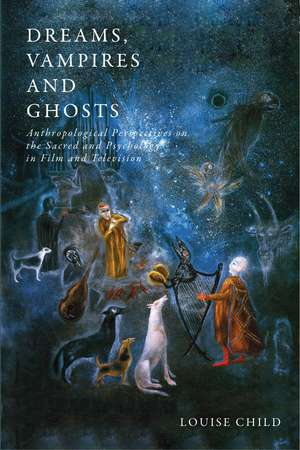
Dreams, Vampires and Ghosts: Anthropological Perspectives on the Sacred and Psychology in Film and Television
Autor Louise Childen Limba Engleză Paperback – 20 feb 2025
Films and television programs explored include Buffy the Vampire Slayer, Twin Peaks, Bram Stoker's Dracula, Truly Madly Deeply and the films of Hitchcock. Louise Child draws attention to how they both depict and challenge ideas and practices rooted in psychology, while quality television has also facilitated a wave of programming that can explore the interaction of characters in complex social worlds over time. In addition to drawing on theories of film from Freudian psychology and feminist theory, Dreams, Vampires and Ghosts uses approaches derived from a combination of Jungian film studies and anthropology that offer fresh insights for exploring film and television.
This book draws attention to explicit and subtle ways in which cinematic narratives engage with myth and religion while at the same time exploring collective dimensions to social and personal life. It advances new developments in genre studies and gender as well as contributing to the growing field of implicit religion using in-depth analyses of communicative dreaming, the shadow, and mystical lovers in film and television.
Preț: 211.08 lei
Preț vechi: 283.15 lei
-25%
Puncte Express: 317
Carte disponibilă
Livrare economică 10-24 noiembrie
Livrare prin curier în România Termenul estimat este afișat lângă disponibilitate.
Transport gratuit de la 400.00 lei Plată online sau ramburs, în funcție de opțiunile comenzii.
Retur gratuit în 14 zile Comandă securizată și suport în română.
Specificații
ISBN-13: 9781350402485
ISBN-10: 1350402486
Pagini: 194
Ilustrații: 5 bw illus
Dimensiuni: 150 x 229 x 13 mm
Greutate: 0.28 kg
Editura: Bloomsbury Publishing
Colecția Bloomsbury Academic
Locul publicării:London, United Kingdom
ISBN-10: 1350402486
Pagini: 194
Ilustrații: 5 bw illus
Dimensiuni: 150 x 229 x 13 mm
Greutate: 0.28 kg
Editura: Bloomsbury Publishing
Colecția Bloomsbury Academic
Locul publicării:London, United Kingdom
Cuprins
1. Dreaming: Anthropology, Psychology, and the Study of Film and Television
2. Dreams as Detection: Trauma and Psychology in the Films of Alfred Hitchcock
3. Animism, Anima, and the Shadow in Twin Peaks
4. A Fairy Tale Heroine: Buffy the Vampire Slayer
5. Ghosts and Spirits: Ghost, Poltergeist, and Afterlife.
6. Dreams Reprise: Mad Love, Mesmerism, and Mystical Participation in Heavenly Creatures and Bram Stoker's Dracula
Conclusion
Bibliography
Index
2. Dreams as Detection: Trauma and Psychology in the Films of Alfred Hitchcock
3. Animism, Anima, and the Shadow in Twin Peaks
4. A Fairy Tale Heroine: Buffy the Vampire Slayer
5. Ghosts and Spirits: Ghost, Poltergeist, and Afterlife.
6. Dreams Reprise: Mad Love, Mesmerism, and Mystical Participation in Heavenly Creatures and Bram Stoker's Dracula
Conclusion
Bibliography
Index
Recenzii
Louise Child's book, Dreams, Vampires and Ghosts: Anthropological Perspectives on the Sacred and Psychology in Film and Television, offers a thoughtful and skillfully crafted examination of the presence of symbols, themes, and motifs commonly linked to psychoanalysis and animistic belief systems in modern film and television. The seriousness with which Child, lecturer in religious studies at Cardiff University (UK), engages her subject, and its presentation in a straightforward, jargon-free manner, results in a text appropriate for both academic and popular audiences.
A fascinating application of new, more relational approaches to film and
television, challenging the more typically individualist and psychologizing
approaches. The films and TV series are evocatively discussed and will be
relatively familiar so readers will be well-placed to reflect on Louise Child's
important arguments about religion, modernity, personhood and more.
This book is a fine contribution and an interdisciplinary achievement in the academic study of apocalypticism and millennialism, particularly in the way it pushes us to move beyond Christian, Jewish, and Islamic theological models by giving equal analytical weight to other traditions, whether religious or secular.
A fascinating application of new, more relational approaches to film and
television, challenging the more typically individualist and psychologizing
approaches. The films and TV series are evocatively discussed and will be
relatively familiar so readers will be well-placed to reflect on Louise Child's
important arguments about religion, modernity, personhood and more.
This book is a fine contribution and an interdisciplinary achievement in the academic study of apocalypticism and millennialism, particularly in the way it pushes us to move beyond Christian, Jewish, and Islamic theological models by giving equal analytical weight to other traditions, whether religious or secular.