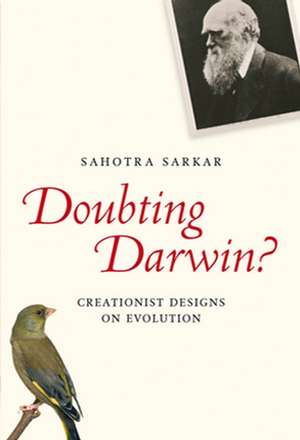
DOUBTING DARWIN
Autor Sarkaren Limba Engleză Hardback – 4 apr 2007
- A scientific and philosophical exploration of the debate between evolutionary theory and Intelligent Design in the classroom
- Puts the debate into its scientific and historical context
- Looks at a variety of topics, including the relation between Darwinism and modern evolutionary theory, the use of computer science and information theory by the creationists, and the idea of metaphysical naturalism
- Rejects Intelligent Design's claim to legitimacy, showing clearly how and why it is an unsuitable alternative to evolutionary biology in the classroom
- A thought-provoking book for those seeking to understand an intellectual debate that is shaping our education policies
- Forms part of the provocative and timely Blackwell Public Philosophy series
Preț: 555.92 lei
Preț vechi: 721.98 lei
-23%
Puncte Express: 834
Carte tipărită la comandă
Livrare economică 11-25 noiembrie
Livrare prin curier în România Termenul estimat este afișat lângă disponibilitate.
Transport gratuit pentru acest produs Plată online sau ramburs, în funcție de opțiunile comenzii.
Retur gratuit în 14 zile Comandă securizată și suport în română.
Specificații
ISBN-13: 9781405154901
ISBN-10: 140515490X
Pagini: 236
Dimensiuni: 157 x 235 x 17 mm
Greutate: 0.5 kg
Ediția:New.
Editura: Wiley
Locul publicării:Chichester, United Kingdom
ISBN-10: 140515490X
Pagini: 236
Dimensiuni: 157 x 235 x 17 mm
Greutate: 0.5 kg
Ediția:New.
Editura: Wiley
Locul publicării:Chichester, United Kingdom
Public țintă
students and scholars in philosophy and religion; general readersNotă biografică
Sahotra Sarkar is Professor of Integrative Biology and of Philosophy at the University of Texas at Austin. He is author of Genetics and Reductionism: A Primer (1998), Molecular Models of Life (2004), and Biodiversity and Environmental Philosophy (2005); editor of several books, including The Philosophy and History of Molecular Biology (1996), the six-volume Science and the Philosophy in the Twentieth Century: Basic Works of Logical Empiricism (1996), and co-editor of the two-volume The Philosophy of Science: An Encyclopedia (2005).
Cuprins
List of Figures. Preface.
Acknowledgements.
1. Introduction.
a. The Central Argument.
b. The Evidence for Evolution.
c. Rejecting Theories.
d. Plan of the Book.
2. The Legacy of Darwin and Wallace.
a. The Theory of Natural Selection.
b. "Absurd in the Highest Possible Degree".
c. Darwin's Unfortunate Retreat.
d. Wallace and Weisman.
e. The Decline of Darwinism.
f. Mind and Culture.
g. Contemporary Implications.
3. The Argument from Design.
a. Adaptation and Design.
b. Function, Design, and Selection.
c. Blind Variation.
d. Dembski's Resurrection.
4. Mere Evolution.
a. Mendel's Legacy.
b. The Modern Framework for Evolutionary Theory.
c. Selectionism and Neutralism.
d. Reconstructing the Past.
e. Contemporary Debates.
f. Terminological Choices.
5. The Cost of Lunch.
a. Evolutionary Algorithms.
b. The "No Free Lunch" Theorems.
c. Dembski's Excitement.
d. Utter Irrelevance.
e. Adaptationism.
f. Final Assessment.
6. Complexity is Complicated.
a. Irreducible Complexity?.
b. Pathways to ICSs.
c. The Citric Acid Cycle.
d. The Blood Clotting System.
e. The Bacterial Flagellum.
f. Protein Evolution.
g. Irreducibility and Design.
7. Questions of Information.
a. What is Biological Information?.
b. Information and Evolution.
c. Specified Complexity.
d. The Law of Conservation of Information.
e. The Cambrian "Explosion".
f. Taking Leave of Creation Biology.
8. Cosmic Coincidences.
a. Physics and Biology.
b. Anthropic Principles?.
c. The Force of Improbability.
d. A Cosmological Design Argument.
e. Is Fine-Tuning Surprising?.
f. A Concluding Note.
9. Naturalism and Its Discontents.
a. What Naturalism Is.
b. Nagel's Legacy.
c. The Problem of Normativity.
d. Creationist Critiques.
e. Metaphysical Naturalism.
10 Conclusions.
a. Critiques of Evolutionary Theory.
b. Is ID Science?.
c. Back to the Classroom.
Notes.
References.
Index
Acknowledgements.
1. Introduction.
a. The Central Argument.
b. The Evidence for Evolution.
c. Rejecting Theories.
d. Plan of the Book.
2. The Legacy of Darwin and Wallace.
a. The Theory of Natural Selection.
b. "Absurd in the Highest Possible Degree".
c. Darwin's Unfortunate Retreat.
d. Wallace and Weisman.
e. The Decline of Darwinism.
f. Mind and Culture.
g. Contemporary Implications.
3. The Argument from Design.
a. Adaptation and Design.
b. Function, Design, and Selection.
c. Blind Variation.
d. Dembski's Resurrection.
4. Mere Evolution.
a. Mendel's Legacy.
b. The Modern Framework for Evolutionary Theory.
c. Selectionism and Neutralism.
d. Reconstructing the Past.
e. Contemporary Debates.
f. Terminological Choices.
5. The Cost of Lunch.
a. Evolutionary Algorithms.
b. The "No Free Lunch" Theorems.
c. Dembski's Excitement.
d. Utter Irrelevance.
e. Adaptationism.
f. Final Assessment.
6. Complexity is Complicated.
a. Irreducible Complexity?.
b. Pathways to ICSs.
c. The Citric Acid Cycle.
d. The Blood Clotting System.
e. The Bacterial Flagellum.
f. Protein Evolution.
g. Irreducibility and Design.
7. Questions of Information.
a. What is Biological Information?.
b. Information and Evolution.
c. Specified Complexity.
d. The Law of Conservation of Information.
e. The Cambrian "Explosion".
f. Taking Leave of Creation Biology.
8. Cosmic Coincidences.
a. Physics and Biology.
b. Anthropic Principles?.
c. The Force of Improbability.
d. A Cosmological Design Argument.
e. Is Fine-Tuning Surprising?.
f. A Concluding Note.
9. Naturalism and Its Discontents.
a. What Naturalism Is.
b. Nagel's Legacy.
c. The Problem of Normativity.
d. Creationist Critiques.
e. Metaphysical Naturalism.
10 Conclusions.
a. Critiques of Evolutionary Theory.
b. Is ID Science?.
c. Back to the Classroom.
Notes.
References.
Index
Descriere
The debate about what to teach as science in our schools has reached boiling point, both inside and outside the classroom. From Young Earth to Intelligent Design creationism, the intrusion of political and religious ideals is damaging the integrity of our public education system.