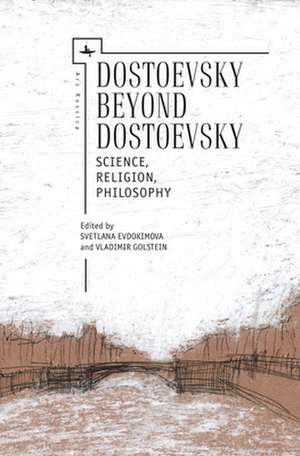
Dostoevsky Beyond Dostoevsky: Ars Rossica
Editat de Vladimir Golstein, Svetlana Evdokimovaen Limba Engleză Paperback – 8 feb 2019


Preț: 334.73 lei
Puncte Express: 502
Carte tipărită la comandă
Livrare economică 29 octombrie-12 noiembrie
Livrare prin curier în România Termenul estimat este afișat lângă disponibilitate.
Transport gratuit de la 400.00 lei Plată online sau ramburs, în funcție de opțiunile comenzii.
Retur gratuit în 14 zile Comandă securizată și suport în română.
Specificații
ISBN-13: 9781644690284
ISBN-10: 1644690284
Pagini: 424
Dimensiuni: 156 x 234 x 23 mm
Greutate: 0.64 kg
Editura: Academic Studies Press
Seria Ars Rossica
ISBN-10: 1644690284
Pagini: 424
Dimensiuni: 156 x 234 x 23 mm
Greutate: 0.64 kg
Editura: Academic Studies Press
Seria Ars Rossica
V-ar putea interesa
-
 Penelope FitzgeraldHermione Lee-19%Preț: 84.96 lei104.72 lei
 -
 -31%Preț: 818.06 lei1191.17 lei
 -
 Ezra Pound: Poet: Volume II: The Epic YearsA. David MoodyPreț: 201.70 lei
 -
 Voltaire: A Very Short IntroductionNicholas Cronk-20%Preț: 55.78 lei69.86 lei
 -
 Double Diaspora in Sephardic LiteratureDavid A WacksPreț: 286.65 lei
 -
 G K Chesterton: a ReappraisalConlon DenisPreț: 247.25 lei
 -
 The Complete Poems of Philip LarkinPhilip LarkinPreț: 194.12 lei
 -
 Writing HomeAlan BennettPreț: 123.02 lei
 -
 MacbethAnna Claybourne-5%Preț: 80.36 lei84.74 lei
 -
 Preț: 101.25 lei
 -
 The Shakespeare BookDK PublishingPreț: 169.40 lei
 -
 Ley LinesH L HixPreț: 193.02 lei
 -
 Anthologizing Canadian LiteratureRobert LeckerPreț: 418.44 lei
 -
 The Antinomies of RealismFredric JamesonPreț: 213.35 lei
 -
 Romeo and JulietWilliam Shakespeare-20%Preț: 39.01 lei48.96 lei
Descriere
Provides a collection of essays with a broad interdisciplinary focus. This book includes contributions by leading Dostoevsky scholars, social scientists, scholars of religion and philosophy. It considers aesthetics, philosophy, theology, and science of the 19th century Russia and the West that might have informed Dostoevsky's thought and art.
Cuprins
Introduction: Fiction beyond Fiction: Dostoevsky’s Quest for Realism
Vladimir Golstein and Svetlana Evdokimova
I. Encounters with Science
1. Darwin, Dostoevsky, and Russia’s Radical Youth
David Bethea and Victoria Thorstensson
2. Darwin’s Plots, Malthus’s Mighty Feast, Lamennais’s Motherless Fledglings, and Dostoevsky’s Lost Sheep
Liza Knapp
3. “Viper will eat viper”: Dostoevsky, Darwin, and the Possibility of Brotherhood
Anna A. Berman
4. Encounters with the Prophet: Ivan Pavlov, Serafima Karchevskaia, and “Our Dostoevsky”
Daniel P. Todes
II. Engagements with Philosophy
5. Dostoevsky and the Meaning of “the Meaning of Life”
Steven Cassedy
6. Dostoevsky and Nietzsche: The Hazards of Writing Oneself into (or out of) Belief
David S. Cunningham
7. Dostoevsky as Moral Philosopher
Charles Larmore
8. “If there’s no immortality of the soul . . . everything is lawful”: On the Philosophical Basis of Ivan Karamazov’s Idea
Sergei A. Kibalnik
III. Questions of Aesthetics
9. Once Again about Dostoevsky’s Response to Hans Holbein the Younger’s Dead Body of Christ in the Tomb
Robert L. Jackson
10. Prelude to a Collaboration: Dostoevsky’s Aesthetic Polemic with Mikhail Katkov
Susanne Fusso
11. Dostoevsky’s Postmodernists and the Poetics of Incarnation
Svetlana Evdokimova
IV. The Self and the Other
12. What Is It Like to Be Bats? Paradoxes of The Double
Gary Saul Morson
13. Interiority and Intersubjectivity in Dostoevsky: The Vasya Shumkov Paradigm
Yuri Corrigan
14. Dostoevsky’s Angel—Still an Idiot, Still beyond the Story: The Case of Kalganov
Michal Oklot
15. The Detective as Midwife in Dostoevsky’s Crime and Punishment
Vladimir Golstein
16. Metaphors for Solitary Confinement in Notes from Underground and Notes from the House of the Dead
Carol Apollonio
17. Moral Emotions in Dostoevsky’s “The Dream of a Ridiculous Man”
Deborah A. Martinsen
18. Like a Shepherd to His Flock: The Messianic Pedagogy of Fyodor Dostoevsky—Its Sources and Conceptual Echoes
Inessa Medzhibovskaya
V. Intercultural Connections
19. Achilles in Crime and Punishment
Donna Orwin
20. Raskolnikov and the Aqedah (Isaac’s Binding)
Olga Meerson
21. Prince Myshkin’s Night Journey: Chronotope as a Symptom
Marina Kostalevsky
I. Encounters with Science
1. Darwin, Dostoevsky, and Russia’s Radical Youth
David Bethea and Victoria Thorstensson
2. Darwin’s Plots, Malthus’s Mighty Feast, Lamennais’s Motherless Fledglings, and Dostoevsky’s Lost Sheep
Liza Knapp
3. “Viper will eat viper”: Dostoevsky, Darwin, and the Possibility of Brotherhood
Anna A. Berman
4. Encounters with the Prophet: Ivan Pavlov, Serafima Karchevskaia, and “Our Dostoevsky”
Daniel P. Todes
II. Engagements with Philosophy
5. Dostoevsky and the Meaning of “the Meaning of Life”
Steven Cassedy
6. Dostoevsky and Nietzsche: The Hazards of Writing Oneself into (or out of) Belief
David S. Cunningham
7. Dostoevsky as Moral Philosopher
Charles Larmore
8. “If there’s no immortality of the soul . . . everything is lawful”: On the Philosophical Basis of Ivan Karamazov’s Idea
Sergei A. Kibalnik
III. Questions of Aesthetics
9. Once Again about Dostoevsky’s Response to Hans Holbein the Younger’s Dead Body of Christ in the Tomb
Robert L. Jackson
10. Prelude to a Collaboration: Dostoevsky’s Aesthetic Polemic with Mikhail Katkov
Susanne Fusso
11. Dostoevsky’s Postmodernists and the Poetics of Incarnation
Svetlana Evdokimova
IV. The Self and the Other
12. What Is It Like to Be Bats? Paradoxes of The Double
Gary Saul Morson
13. Interiority and Intersubjectivity in Dostoevsky: The Vasya Shumkov Paradigm
Yuri Corrigan
14. Dostoevsky’s Angel—Still an Idiot, Still beyond the Story: The Case of Kalganov
Michal Oklot
15. The Detective as Midwife in Dostoevsky’s Crime and Punishment
Vladimir Golstein
16. Metaphors for Solitary Confinement in Notes from Underground and Notes from the House of the Dead
Carol Apollonio
17. Moral Emotions in Dostoevsky’s “The Dream of a Ridiculous Man”
Deborah A. Martinsen
18. Like a Shepherd to His Flock: The Messianic Pedagogy of Fyodor Dostoevsky—Its Sources and Conceptual Echoes
Inessa Medzhibovskaya
V. Intercultural Connections
19. Achilles in Crime and Punishment
Donna Orwin
20. Raskolnikov and the Aqedah (Isaac’s Binding)
Olga Meerson
21. Prince Myshkin’s Night Journey: Chronotope as a Symptom
Marina Kostalevsky
Recenzii
"I found the volume to be an informative and fascinating read. Students and scholars of Dostoevsky gain new appreciations and understandings by reconciling the established links between Russian literature, science, faith, and humanistic traditions...It would be productive not only for Slavists, but also for specialists from a range of different areas of expertise to publish additional series of this volume to enrich scholarly understanding of the author and his creative, interdisciplinary imagination."
“This valuable book includes verywell-researched articles written by the scholars of the field which examine the dialoguesof Dostoevky’s personas from aesthetic,philosophical and religious viewpoints. It is a major contribution to the Russian literature associated with Dostoevky’s name and works.” —Ayse Dietrich,International Journal of Russian Studies, Vol. 8 No. 1
“This valuable book includes verywell-researched articles written by the scholars of the field which examine the dialoguesof Dostoevky’s personas from aesthetic,philosophical and religious viewpoints. It is a major contribution to the Russian literature associated with Dostoevky’s name and works.” —Ayse Dietrich,International Journal of Russian Studies, Vol. 8 No. 1