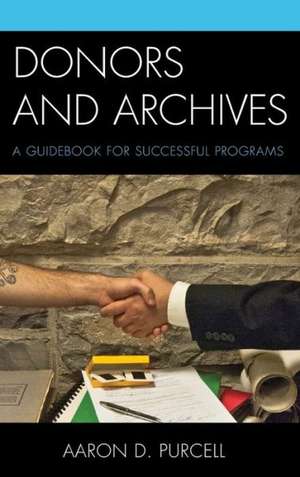
Donors and Archives: A Guidebook for Successful Programs
Autor Aaron D. Purcellen Limba Engleză Hardback – 17 feb 2015
Donors and Archives: A Guidebook for Successful Programs reviews the complex landscape of donor work, archival donations, and institutional fundraising for today's archivists. It provides practical approaches to enhance donor relations for all types of archival programs, such as academic, government, private, and corporate archives. The book covers the planning, the process, and the partners needed for successful donations and donor programs.
Arranged into four sections, the book offers practical advice and best practices in a number of areas including: how donations work, who donates to archives, how to prepare for donors, how to evaluate and manage the stuff from potential donors, how to work with an institution's development office, what are the obligations and expectations of archivists and donors, how to develop donor strategies, how to work with friends and supporters of the archives program, what happens after the donation is complete, and what is the overall value of donors to archival programs.
Donors and Archives: A Guidebook for Successful Programs highlights the importance of development and fundraising for archives, while focusing on the donor and potential donor. Their interest, their support, their enthusiasm, and their stuff are vital to the success of archival programs. Archivists involved in donor work and fundraising will find the practical advice and best practices in this book applicable, replicable, timely, and valuable.
Preț: 639.64 lei
Preț vechi: 914.18 lei
-30%
Puncte Express: 959
Carte tipărită la comandă
Livrare economică 08-22 decembrie
Livrare prin curier în România Termenul estimat este afișat lângă disponibilitate.
Transport gratuit pentru acest produs Plată online sau ramburs, în funcție de opțiunile comenzii.
Retur gratuit în 14 zile Comandă securizată și suport în română.
Specificații
ISBN-13: 9780810893238
ISBN-10: 0810893231
Pagini: 238
Ilustrații: 2 b/w illustrations
Dimensiuni: 163 x 240 x 25 mm
Greutate: 0.5 kg
Editura: Bloomsbury Publishing
Colecția Rowman & Littlefield
Locul publicării:New York, United States
ISBN-10: 0810893231
Pagini: 238
Ilustrații: 2 b/w illustrations
Dimensiuni: 163 x 240 x 25 mm
Greutate: 0.5 kg
Editura: Bloomsbury Publishing
Colecția Rowman & Littlefield
Locul publicării:New York, United States
V-ar putea interesa
-
 The Intellectual Foundation of Information OrganizationElaine Svenonius-20%Preț: 213.68 lei267.10 lei
 -
 Preț: 467.81 lei
 -
 RDA and Cartographic ResourcesPaige G. AndrewPreț: 442.19 lei
 -
 Diversity in Youth Literature: Opening Doors Through ReadingJamie Campbell NaidooPreț: 373.86 lei
 -
 Library Management 101: A Practical GuideDiane L. VelasquezPreț: 487.99 lei
 -
 Cut Flower GardenErin Benzakein-25%Preț: 155.97 lei207.16 lei
 -
 Beyond the Browser: Web 2.0 and LibrarianshipKarl Bridges-36%Preț: 210.28 lei328.29 lei
 -
 -21%Preț: 283.48 lei357.64 lei
 -
 -26%Preț: 265.87 lei358.27 lei
 -
 101 Great, Ready-to-Use Book Lists for ChildrenNancy J. Keane-19%Preț: 293.12 lei362.83 lei
 -
 Lost in TransitionAaron D PurcellPreț: 362.14 lei
 -
 Greening LibrariesMonika AntonelliPreț: 277.59 lei
 -
 No Ordinary MomentAaron D PurcellPreț: 155.90 lei
 -
 Preț: 105.44 lei
 -
 Preț: 123.58 lei
 -
 Preț: 97.92 lei
 -
 Preț: 295.32 lei
 -
 Le Livre Du Bibliophile (Éd.1874)Anatole FrancePreț: 96.90 lei
 -
 Preț: 112.19 lei
Cuprins
List of Figures
Acknowledgments
Introduction
Part I: The Planning
Chapter 1: Donor Preparedness and the Archival Program
Chapter 2: Archival Obligations and Shared Expectations
Chapter 3: Developing Donor Strategies
Part II: The Process
Chapter 4: Negotiating and Reviewing a Potential Donation
Chapter 5: The Details of a Donation
Chapter 6: The Days Following a Donation
Part III: The Partners
Chapter 7: Donor Types
Chapter 8: The Development Office and the Archives
Chapter 9: Friends, Lovers, and Supporters of Archives
Part IV: The Payoff
Chapter 10: The Value of Donors and a Donor Program
Index
About the Author
Acknowledgments
Introduction
Part I: The Planning
Chapter 1: Donor Preparedness and the Archival Program
Chapter 2: Archival Obligations and Shared Expectations
Chapter 3: Developing Donor Strategies
Part II: The Process
Chapter 4: Negotiating and Reviewing a Potential Donation
Chapter 5: The Details of a Donation
Chapter 6: The Days Following a Donation
Part III: The Partners
Chapter 7: Donor Types
Chapter 8: The Development Office and the Archives
Chapter 9: Friends, Lovers, and Supporters of Archives
Part IV: The Payoff
Chapter 10: The Value of Donors and a Donor Program
Index
About the Author
Recenzii
[This book] is a well-crafted blend of the hard and soft skills necessary to navigate the many steps involved with archival donations. Purcell takes it one step beyond the archives and includes the development officers of organizations in the conversation. If properly educated and prepared, allies will pay off in the form of both great collections and monetary compensation to care for those collections.
Aaron D. Purcell has prepared a useful and engagingly written book about donors and archives, offering a comprehensive view of the various elements that make for a successful donor program. . . .[F]or professional archivists, those working in collecting archives or with manuscript collections in libraries, this is an informative and unique contribution to the professional literature.
[T]he body of literature devoted specifically to donors and archives is quite limited, and the instructive guidance provided in Donors and Archives fills an existing gap. In terms of audiences, it offers highly instructive examples for those starting a career in archives, whilst simultaneously providing considered reflection for seasoned archivists who have wrestled with many of the issues discussed.
This book opens a new world for archivists, one that was always there but which few of us could ever see through the fog of our focus on the more technical issues in the field. This book is a call to action, a roadmap, and an avuncular advisor all at once. Donors and Archives codifies something core to the archival enterprise yet one treated with something worse than disdain-with neglect borne out of our certainty there was just too little there to consider. Now, our consideration can begin, and we can thank Aaron Purcell for getting us started.
In Donors and Archives: A Guidebook for Successful Programs, author Aaron D. Purcell, professor and director of special collections at Virginia Tech, has written a comprehensive and practical overview of what it takes to successfully navigate the many issues and decisions that an archives program may have to make when working with potential donors. Purcell also gives a step-by-step overview of the planning, cultivation, and long term sustainability of a donor program. With little to no specific literature on the topic of donors and donor relations, Purcell's work is an incredibly useful and invaluable introduction for the beginning archivist, as well as a handy refresher for a mid-career or established archivist. This book would be extremely beneficial for someone working in a smaller archive where they are required to handle multiple duties, inclusive of everything from acquisition to processing, outreach, and fundraising.
Purcell's comprehensive new book offers a seasoned professional's perspective on a critical, but often overlooked area of practice. Establishing good relationships with donors is a cornerstone of building collections. This book provides a roadmap for doing just that, with helpful guidance for those new to the field and useful tips for those with more experience as well.
With a keen eye on the practical, this book will be very helpful to anyone who works with donors of historical materials. Well-written and thorough, Purcell thoughtfully expands the concept of who are our donors and how to work with them. As a teacher and practitioner, I believe this book fills an important gap in the archival literature.
In a profession where so many times the answer is 'it depends,' Aaron Purcell has managed to write a broad and applicable guide to donor work, well-founded in the canon of archival theory and tradition of archival practice. What he has produced fills a long-standing gap in the professional literature: a comprehensive, practical, and entertaining guide to negotiating the many complexities of archival donor work. Examples abound, but so does more generalized advice, good for those new to archival donor work and more experienced archivists thinking about how they might improve their skills or expand their reach.
Donor relations are essential for a successful archives program but it's rarely taught in graduate programs. Whether you are a new professional or are looking to enhance your skill set, Donors and Archives will give your strategies for success, boost your confidence, and serve as your donor relations guide!
Purcell's latest represents an overdue comprehensive examination on building relationships with donors, and establishing a coherent program to support this crucial facet of archival work. Purcell considers the sphere of the archival profession and the role of donor relations in each context - collection management, strategic planning, facility support, staffing considerations, processing, description, and digitization. The illustrative anecdotes will feel familiar to archivists working in academia, private institutions, corporate archives, or at government repositories. It is certainly required reading for any archivist new to stewarding such relationships - the bibliography alone is essential. I wish someone handed me a copy of this book on my first day on the job.
Aaron D. Purcell has prepared a useful and engagingly written book about donors and archives, offering a comprehensive view of the various elements that make for a successful donor program. . . .[F]or professional archivists, those working in collecting archives or with manuscript collections in libraries, this is an informative and unique contribution to the professional literature.
[T]he body of literature devoted specifically to donors and archives is quite limited, and the instructive guidance provided in Donors and Archives fills an existing gap. In terms of audiences, it offers highly instructive examples for those starting a career in archives, whilst simultaneously providing considered reflection for seasoned archivists who have wrestled with many of the issues discussed.
This book opens a new world for archivists, one that was always there but which few of us could ever see through the fog of our focus on the more technical issues in the field. This book is a call to action, a roadmap, and an avuncular advisor all at once. Donors and Archives codifies something core to the archival enterprise yet one treated with something worse than disdain-with neglect borne out of our certainty there was just too little there to consider. Now, our consideration can begin, and we can thank Aaron Purcell for getting us started.
In Donors and Archives: A Guidebook for Successful Programs, author Aaron D. Purcell, professor and director of special collections at Virginia Tech, has written a comprehensive and practical overview of what it takes to successfully navigate the many issues and decisions that an archives program may have to make when working with potential donors. Purcell also gives a step-by-step overview of the planning, cultivation, and long term sustainability of a donor program. With little to no specific literature on the topic of donors and donor relations, Purcell's work is an incredibly useful and invaluable introduction for the beginning archivist, as well as a handy refresher for a mid-career or established archivist. This book would be extremely beneficial for someone working in a smaller archive where they are required to handle multiple duties, inclusive of everything from acquisition to processing, outreach, and fundraising.
Purcell's comprehensive new book offers a seasoned professional's perspective on a critical, but often overlooked area of practice. Establishing good relationships with donors is a cornerstone of building collections. This book provides a roadmap for doing just that, with helpful guidance for those new to the field and useful tips for those with more experience as well.
With a keen eye on the practical, this book will be very helpful to anyone who works with donors of historical materials. Well-written and thorough, Purcell thoughtfully expands the concept of who are our donors and how to work with them. As a teacher and practitioner, I believe this book fills an important gap in the archival literature.
In a profession where so many times the answer is 'it depends,' Aaron Purcell has managed to write a broad and applicable guide to donor work, well-founded in the canon of archival theory and tradition of archival practice. What he has produced fills a long-standing gap in the professional literature: a comprehensive, practical, and entertaining guide to negotiating the many complexities of archival donor work. Examples abound, but so does more generalized advice, good for those new to archival donor work and more experienced archivists thinking about how they might improve their skills or expand their reach.
Donor relations are essential for a successful archives program but it's rarely taught in graduate programs. Whether you are a new professional or are looking to enhance your skill set, Donors and Archives will give your strategies for success, boost your confidence, and serve as your donor relations guide!
Purcell's latest represents an overdue comprehensive examination on building relationships with donors, and establishing a coherent program to support this crucial facet of archival work. Purcell considers the sphere of the archival profession and the role of donor relations in each context - collection management, strategic planning, facility support, staffing considerations, processing, description, and digitization. The illustrative anecdotes will feel familiar to archivists working in academia, private institutions, corporate archives, or at government repositories. It is certainly required reading for any archivist new to stewarding such relationships - the bibliography alone is essential. I wish someone handed me a copy of this book on my first day on the job.