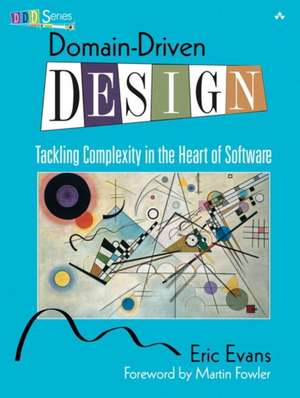
Domain-Driven Design
Autor Eric J. Evansen Limba Engleză Hardback – aug 2003
În industria dezvoltării de sisteme software complexe, alinierea codului cu logica de business reprezintă una dintre cele mai mari provocări tehnice. Putem afirma că Domain-Driven Design de Eric J. Evans a revoluționat acest domeniu, oferind un cadru sistematic pentru a transpune modelele mentale în implementări software durabile. Reținem că această lucrare nu este un manual despre o tehnologie specifică, ci un ghid despre cum să gândim arhitectura prin prisma domeniului de activitate. Pe linia practică a volumului Learning Domain-Driven Design de Vladik Khononov, dar cu un focus fundamental pe conceptele de bază care au definit această disciplină, Eric J. Evans propune o metodologie riguroasă. Cartea este organizată în patru părți esențiale: prima secțiune se concentrează pe „Knowledge Crunching” și crearea unui limbaj comun (Ubiquitous Language), în timp ce partea a doua detaliază blocurile de construcție tehnice, precum Entities, Value Objects și Service-uri. Ulterior, autorul ghidează cititorul spre refactorizarea profundă și menținerea integrității modelului în sisteme de mari dimensiuni. Spre deosebire de alte abordări pur tehnice, Evans subliniază că designul software-ului trebuie să evolueze odată cu înțelegerea domeniului. Deși autorul are un portofoliu vast în cercetarea istorică (precum William Pitt the Younger), în acest volum el își demonstrează expertiza de practician software, oferind soluții pentru izolarea stratului de domeniu (Layered Architecture) și evitarea anti-pattern-urilor precum „Smart UI”. Este o resursă indispensabilă pentru cei care doresc să gestioneze complexitatea fără a sacrifica flexibilitatea sistemului.
Preț: 423.02 lei
Preț vechi: 528.78 lei
-20%
Carte disponibilă
Livrare economică 06-20 noiembrie
Livrare express 22-28 octombrie pentru 67.23 lei
Specificații
ISBN-10: 0321125215
Pagini: 529
Dimensiuni: 187 x 241 x 43 mm
Greutate: 1.24 kg
Ediția:1. A.
Editura: ADDISON-WESLEY
Colecția Pearson Professional
Locul publicării:Boston, MA, United States
V-ar putea interesa
-
 -20%Preț: 641.11 lei801.39 lei
 -
 -20%Preț: 370.60 lei463.25 lei
 -
 Patterns of Enterprise Application ArchitectureMartin Fowler-20%Preț: 396.95 lei496.18 lei
 -
 Enterprise Integration PatternsGregor Hohpe-20%Preț: 398.67 lei498.33 lei
 -
 Java Concurrency in PracticeBrian Goetz-20%Preț: 303.96 lei379.95 lei
 -
 -20%Preț: 339.53 lei424.41 lei
 -
 Implementing Domain-Driven DesignVaughn Vernon-20%Preț: 367.42 lei459.27 lei
 -
 Managing the Testing ProcessRex Black-20%Preț: 239.17 lei298.97 lei
 -
 Lessons Learned in Software Testing - A Context- Driven ApproachBret Pettichord-20%Preț: 258.03 lei322.54 lei
 -
 Head First EJBKathy Sierra-20%Preț: 263.18 lei328.97 lei
 -
 Java SOA CookbookEben Hewitt-20%Preț: 277.91 lei347.39 lei
 -
 Java Message ServiceMark Richards-20%Preț: 203.21 lei254.01 lei
 -
 Code Complete: A practical handbook of software constructionSteve McConnell-20%Preț: 285.38 lei356.73 lei
 -
 Pro JPA 2Mike Keith-20%Preț: 399.39 lei499.23 lei
De ce să citești această carte
Pentru arhitecți și dezvoltatori seniori, această carte oferă vocabularul și instrumentele necesare pentru a comunica eficient cu experții de business. Veți câștiga o metodă clară de a descompune problemele complexe în modele software sustenabile, evitând acumularea datoriei tehnice prin utilizarea tiparelor de design și a arhitecturilor stratificate corect implementate.
Despre autor
Eric J. Evans este un autor polivalent, cunoscut atât pentru contribuțiile sale fundamentale în domeniul ingineriei software, cât și pentru activitatea sa academică de prestigiu. Deși în comunitatea IT este recunoscut drept părintele conceptului de Domain-Driven Design, Evans deține și titlul de Profesor de Istorie la Universitatea Lancaster. Lucrările sale istorice, precum Britain before the Reform Act sau Sir Robert Peel, demonstrează o capacitate analitică excepțională și o rigoare în cercetare pe care le-a transpus cu succes în sistematizarea principiilor de design software în lucrarea de față.
Textul de pe ultima copertă
"Eric Evans has written a fantastic book on how you can make the design of your software match your mental model of the problem domain you are addressing.
"His book is very compatible with XP. It is not about drawing pictures of a domain; it is about how you think of it, the language you use to talk about it, and how you organize your software to reflect your improving understanding of it. Eric thinks that learning about your problem domain is as likely to happen at the end of your project as at the beginning, and so refactoring is a big part of his technique.
"The book is a fun read. Eric has lots of interesting stories, and he has a way with words. I see this book as essential reading for software developers--it is a future classic." --Ralph Johnson, author of "Design Patterns "
"If you don't think you are getting value from your investment in object-oriented programming, this book will tell you what you've forgotten to do.
"Eric Evans convincingly argues for the importance of domain modeling as the central focus of development and provides a solid framework and set of techniques for accomplishing it. This is timeless wisdom, and will hold up long after the methodologies du jour have gone out of fashion." --Dave Collins, author of "Designing Object-Oriented User Interfaces "
"Eric weaves real-world experience modeling--and building--business applications into a practical, useful book. Written from the perspective of a trusted practitioner, Eric's descriptions of ubiquitous language, the benefits of sharing models with users, object life-cycle management, logical and physical application structuring, and the process and results of deep refactoring are major contributions to our field." --Luke Hohmann, author of "Beyond Software Architecture "
""This book belongs on the shelf of every thoughtful software developer.""
--Kent Beck
""What Eric has managed to capture is a part of the design process that experienced object designers have always used, but that we have been singularly unsuccessful as a group in conveying to the rest of the industry. We've given away bits and pieces of this knowledge...but we've never organized and systematized the principles of building domain logic. This book is important.""--Kyle Brown, author of "Enterprise Java(TM) Programming with IBM(R) WebSphere(R)"
The software development community widely acknowledges that domain modeling is central to software design. Through domain models, software developers are able to express rich functionality and translate it into a software implementation that truly serves the needs of its users. But despite its obvious importance, there are few practical resources that explain how to incorporate effective domain modeling into the software development process.
"Domain-Driven Design" fills that need. This is not a book about specific technologies. It offers readers a systematic approach to domain-driven design, presenting an extensive set of design best practices, experience-based techniques, and fundamental principles that facilitate the development of software projects facing complex domains. Intertwining design and development practice, this book incorporates numerous examples based on actual projects to illustrate the application of domain-driven design to real-world software development.
Readers learn how to use a domain model to make a complex development effort more focused and dynamic. A core of best practices and standard patterns provides a common language for the development team. A shift in emphasis--refactoring not just the code but the model underlying the code--in combination with the frequent iterations of Agile development leads to deeper insight into domains and enhanced communication between domain expert and programmer. "Domain-Driven Design" then builds on this foundation, and addresses modeling and design for complex systems and larger organizations.Specific topics covered include: Getting all team members to speak the same languageConnecting model and implementation more deeplySharpening key distinctions in a modelManaging the lifecycle of a domain object Writing domain code that is safe to combine in elaborate waysMaking complex code obvious and predictableFormulating a domain vision statement Distilling the core of a complex domainDigging out implicit concepts needed in the model Applying analysis patterns Relating design patterns to the model Maintaining model integrity in a large systemDealing with coexisting models on the same projectOrganizing systems with large-scale structuresRecognizing and responding to modeling breakthroughs
With this book in hand, object-oriented developers, system analysts, and designers will have the guidance they need to organize and focus their work, create rich and useful domain models, and leverage those models into quality, long-lasting software implementations.
Notă biografică
Eric Evans is the founder of Domain Language, a consulting group dedicated to helping companies build evolving software deeply connected to their businesses. Since the 1980s, Eric has worked as a designer and programmer on large object-oriented systems in several complex business and technical domains. He has also trained and coached development teams in Extreme Programming.