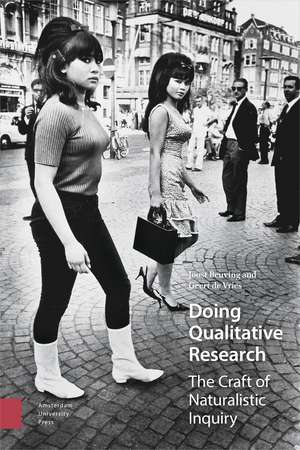
Doing Qualitative Research: The Craft of Naturalistic Inquiry
Autor Joost Beuving, Geert de Vriesen Limba Engleză Paperback – 25 noi 2014
Naturalistic inquiry is about studying people in everyday circumstances using ordinary means. It strives to blend in—respecting people in their daily lives, taking their actions and experiences seriously while not interfering—in order to come to theoretical understanding. This textbook offers guidance, combining thoughtful reflection with practical tips. It is written for undergraduate and graduate students in social science; for practitioners in social work, healthcare, policy advice, and organizational consultancy; and for all who have a genuine interest in society and its members.
Preț: 200.71 lei
Nou
Puncte Express: 301
Preț estimativ în valută:
35.52€ • 41.65$ • 31.19£
35.52€ • 41.65$ • 31.19£
Carte tipărită la comandă
Livrare economică 11-25 februarie 26
Preluare comenzi: 021 569.72.76
Specificații
ISBN-13: 9789089647658
ISBN-10: 9089647651
Pagini: 224
Ilustrații: 8 halftones
Dimensiuni: 152 x 229 x 15 mm
Greutate: 0.39 kg
Editura: Amsterdam University Press
Colecția Amsterdam University Press
ISBN-10: 9089647651
Pagini: 224
Ilustrații: 8 halftones
Dimensiuni: 152 x 229 x 15 mm
Greutate: 0.39 kg
Editura: Amsterdam University Press
Colecția Amsterdam University Press
V-ar putea interesa
-
 Structural Equation ModelingNatasha K. Bowen-13%Preț: 383.77 lei440.99 lei
 -
 Ideas and Politics in Social Science ResearchDaniel Béland-18%Preț: 519.48 lei631.25 lei
 -
 Analyzing Quantitative Data – An Introduction for Social ResearchersD Wetcher–Hendric-27%Preț: 833.37 lei1141.59 lei
 -
 Essentials of Utilization-Focused EvaluationMichael Quinn Patton-14%Preț: 862.15 lei1002.50 lei
 -
 Longitudinal Data Analysis for the Behavioral Sciences Using RJeffrey D. Long-27%Preț: 982.55 lei1345.95 lei
 -
 Applications of Case Study ResearchRobert K. Yin-15%Preț: 649.54 lei764.17 lei
 -
 Visualizing Social Science Research: Maps, Methods, & MeaningJohannes P. Wheeldon-15%Preț: 468.04 lei550.64 lei
 -
 Conducting Online SurveysValerie M. Sue-15%Preț: 646.39 lei760.45 lei
 -
 -15%Preț: 465.20 lei547.30 lei
 -
 Qualitative Research in EducationLiz AtkinsPreț: 353.28 lei
 -
 A Student's Guide to MethodologyPeter CloughPreț: 386.42 lei
 -
 The 2010 CensusKatherine M. De Luca-31%Preț: 1262.53 lei1821.99 lei
Notă biografică
Joost Beuving teaches anthropology at Radboud University, Nijmegen. Geert de Vries teaches sociology at VU University Amsterdam and Amsterdam University College.
Cuprins
List of boxes
List of figures
Acknowledgements
Introduction: The arc of naturalistic inquiry
Naturalistic inquiry and qualitative research
Genesis and audience of the book
Outline
1. On naturalistic inquiry: Key issues and practices
1.1. Positivism and interpretivism: Auguste Comte versus Max Weber
1.2. Describing, understanding, and explaining
1.3. Definitions of situations and social facts
1.4. Positivist and naturalistic designs
1.5. Qualitative versus quantitative methods?
1.6. Validity and reliability in naturalistic inquiry
2. Theorizing society: Grounded theory in naturalistic inquiry
2.1. Dissatisfaction with structural functionalism and grand theory
2.2. The intellectual pedigree of symbolic interactionism
2.3. Grounded theory in naturalistic inquiry: The problem of generalization and inference
2.4. Conclusion
3. Looking at society: Observing, participating, interpreting
3.1. Enlightenment roots
3.2. Observations in social research: Positivism and naturalistic inquiry
3.3. Naturalistic observations: Looking at everyday life
3.4. The observer as participant
3.5. Practical methodology in looking at society
3.6. Conclusion
4. Talking about society: Interviewing and casual conversation
4.1. From workers’ inquiry to social survey
4.2. The open interview
4.3. The life history interview
4.4. The creative or active interview
4.5. Practical methodology in interviewing
4.6. Conclusion: Casual conversation
5. Reading society: Texts, images, things
5.1. Texts
5.2. Images: Drawings, paintings, maps, photographs, film
5.3. Things
5.4. Practical methodology in reading society
5.5. Conclusion
6. Disentangling society: The analysis of social networks
6.1. The analysis and theory of social networks
6.2. A note on key thinkers: Roles, sociogenesis, and transactions
6.3. Applications of social network analysis in naturalistic inquiry
6.4. Practical methodology in disentangling society
6.5. Conclusion
7. Not getting lost in society: On qualitative analysis
7.1. Text and interpretation
7.2. Practical methodology: Qualitative analysis in six steps
7.3. Conclusion
8. Telling about society: On writing
8.1. Thick description and social theory
8.2. Writing as Verstehen
8.3. Contested issues: The ‘I’, literary technique, composite cases
8.4. Practical methodology in telling about society
8.5. Conclusion
Epilogue: Present and future of naturalistic inquiry
Naturalistic inquiry in social research
Accountability in naturalistic inquiry
The future
List of figures
Acknowledgements
Introduction: The arc of naturalistic inquiry
Naturalistic inquiry and qualitative research
Genesis and audience of the book
Outline
1. On naturalistic inquiry: Key issues and practices
1.1. Positivism and interpretivism: Auguste Comte versus Max Weber
1.2. Describing, understanding, and explaining
1.3. Definitions of situations and social facts
1.4. Positivist and naturalistic designs
1.5. Qualitative versus quantitative methods?
1.6. Validity and reliability in naturalistic inquiry
2. Theorizing society: Grounded theory in naturalistic inquiry
2.1. Dissatisfaction with structural functionalism and grand theory
2.2. The intellectual pedigree of symbolic interactionism
2.3. Grounded theory in naturalistic inquiry: The problem of generalization and inference
2.4. Conclusion
3. Looking at society: Observing, participating, interpreting
3.1. Enlightenment roots
3.2. Observations in social research: Positivism and naturalistic inquiry
3.3. Naturalistic observations: Looking at everyday life
3.4. The observer as participant
3.5. Practical methodology in looking at society
3.6. Conclusion
4. Talking about society: Interviewing and casual conversation
4.1. From workers’ inquiry to social survey
4.2. The open interview
4.3. The life history interview
4.4. The creative or active interview
4.5. Practical methodology in interviewing
4.6. Conclusion: Casual conversation
5. Reading society: Texts, images, things
5.1. Texts
5.2. Images: Drawings, paintings, maps, photographs, film
5.3. Things
5.4. Practical methodology in reading society
5.5. Conclusion
6. Disentangling society: The analysis of social networks
6.1. The analysis and theory of social networks
6.2. A note on key thinkers: Roles, sociogenesis, and transactions
6.3. Applications of social network analysis in naturalistic inquiry
6.4. Practical methodology in disentangling society
6.5. Conclusion
7. Not getting lost in society: On qualitative analysis
7.1. Text and interpretation
7.2. Practical methodology: Qualitative analysis in six steps
7.3. Conclusion
8. Telling about society: On writing
8.1. Thick description and social theory
8.2. Writing as Verstehen
8.3. Contested issues: The ‘I’, literary technique, composite cases
8.4. Practical methodology in telling about society
8.5. Conclusion
Epilogue: Present and future of naturalistic inquiry
Naturalistic inquiry in social research
Accountability in naturalistic inquiry
The future
Recenzii
“One of the best methodological treatments in contemporary social science literature. It is the type of book that students will remember as the text that moved them to serious study.”