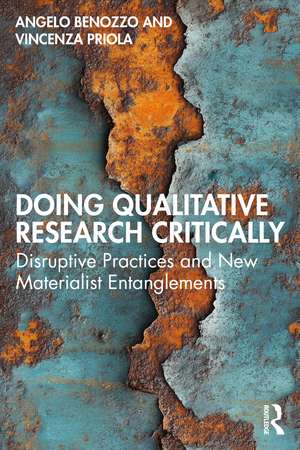
Doing Qualitative Research Critically: Disruptive Practices and New Materialist Entanglements
Autor Angelo Benozzo, Vincenza Priolaen Limba Engleză Paperback – 17 aug 2026
In advancing the critical agenda of qualitative methodologies, the authors introduce theoretical perspectives, such as poststructuralism, posthumanism, and feminist new materialism, to disrupt mainstream methodologies and develop more affirmative engagements with human/non-human relationalities. The problematisation of qualitative research is achieved through introducing art pieces (painting, sculpture, architecture, poetry, and film) to engage the reader at different levels: to generate emotions, and to provoke thoughts and reflections on the ethical and political character of qualitative research.
This engaging book is an essential read for research students and researchers across the social sciences and humanities, interested in exploring the landscape of critical qualitative methodologies and experimenting with doing research differently.
Preț: 338.05 lei
Preț vechi: 382.23 lei
-12% Nou
Puncte Express: 507
Carte indisponibilă temporar
Doresc să fiu notificat când acest titlu va fi disponibil:
Se trimite...
Specificații
ISBN-13: 9781032619668
ISBN-10: 103261966X
Pagini: 228
Ilustrații: 44
Dimensiuni: 156 x 234 mm
Greutate: 0.42 kg
Ediția:1
Editura: Taylor & Francis
Colecția Routledge
Locul publicării:Oxford, United Kingdom
ISBN-10: 103261966X
Pagini: 228
Ilustrații: 44
Dimensiuni: 156 x 234 mm
Greutate: 0.42 kg
Ediția:1
Editura: Taylor & Francis
Colecția Routledge
Locul publicării:Oxford, United Kingdom
Public țintă
Postgraduate and Undergraduate AdvancedCuprins
1. Introducing critical qualitative research in the Anthropocene
2. Understanding and Emancipating
3. Deconstructing
4. Diffracting and Becoming
5. Forming and Connecting Data
6. Exploring practices of data analysis
7. Interrogating practices of analysis
8. Assembling the text
9. Research as/in Experimentation - co-authored with Mirka Koro
Notă biografică
Angelo Benozzo is an undisciplined researcher in Work and Organisational Psychology at the University of Aosta Valley (Italy), where he also lectures on qualitative research methods. His research can be described as lying at the crossroads between organisational psychology, critical management studies, qualitative research, and cultural studies.
Vincenza (known as Cinzia) Priola is a Professor of Work and Organisation Studies at The Open University in the UK. She researches Equity/Equality, Diversity, and Inclusion in/at work, primarily studying gender and sexualities in the workplace. She has also published on disabilities, migration, intersectionality, Islamic feminism, and methodologies.
Vincenza (known as Cinzia) Priola is a Professor of Work and Organisation Studies at The Open University in the UK. She researches Equity/Equality, Diversity, and Inclusion in/at work, primarily studying gender and sexualities in the workplace. She has also published on disabilities, migration, intersectionality, Islamic feminism, and methodologies.
Recenzii
'This is a tour de force of philosophically-informed qualitative work. With clarity and erudition, the authors take the reader through all the major philosophical and ethical paradigms informing contemporary qualitative inquiry, paying particular attention to where these ideas overlap and blur. With examples drawn from art, psychology, etymology, and even film, the authors weave an engaging tapestry that both maps where qualitative practice has been and gives us direction for decades to come. As we find ourselves thrown into a world that poses a constellation of practical, intellectual, and ethical challenges to our very being and being with other species, this book gives us hope through inviting us to observe, reflect, and interact with compassion. This is a must read for researchers just beginning their epistemic journeys and for seasoned intellectual wanderers alike.'
Dr James M. Salvo, Clinical Assistant Professor, University of Florida.
'In many living contexts of academic discussion, and especially from young academics, I recently hear the plea for a social science that would be more aimed at understanding experience than counting things, or systematically observing them from the outside. This fascinating and exceedingly well written book takes the Reader for an explorative journey into the world of experiential social science. It presents in an engaging way some key qualitative methods of social research fit for the era of what Edgar Morin calls the polycrisis: ravaged by persistent systemic disruptive pathologies. Angelo Benozzo and Vincenza Priola offer an instrumental guide for researchers who wish to approach these phenomena in a scientifically rigorous way, yet not lose the ability to understand reality holistically. The authors show a way to go beyond the disciplinary boundaries and use arts, music, sounds, and colours to expand and organize our inquiry. Researchers and PhD candidates across the social sciences will benefit from reading this book slowly, giving it full attention.'
Professor Monika Kostera, University of Warsaw, Södertörn University, Sweden and L'Université Paris Nanterre.
'In Doing Qualitative Research Critically: Disruptive Practices and New Materialist Entanglements Angelo Benozzo and Vincenza Priola invite readers to accompany them on a ‘wandering journey’ of and for re-imagining research through creative, experimental and new materialist and posthuman theories and practices. Theoretically attuned to uncertainties and complexities of research, this lively, accessible and thoughtful book entangles with the social, political, re-imaginative and embodied dimensions of what it means to be ‘critical’ as a situated praxis. This book's theory-practice discussions will enable the reader to devise novel ways to craft disruptive and ethically-engaged research to meet the challenges of knowledge-making differently and resist anthropocentric, capitalist and colonialist knowledge legacies.'
Professor Carol A. Taylor, University of Bath.
Dr James M. Salvo, Clinical Assistant Professor, University of Florida.
'In many living contexts of academic discussion, and especially from young academics, I recently hear the plea for a social science that would be more aimed at understanding experience than counting things, or systematically observing them from the outside. This fascinating and exceedingly well written book takes the Reader for an explorative journey into the world of experiential social science. It presents in an engaging way some key qualitative methods of social research fit for the era of what Edgar Morin calls the polycrisis: ravaged by persistent systemic disruptive pathologies. Angelo Benozzo and Vincenza Priola offer an instrumental guide for researchers who wish to approach these phenomena in a scientifically rigorous way, yet not lose the ability to understand reality holistically. The authors show a way to go beyond the disciplinary boundaries and use arts, music, sounds, and colours to expand and organize our inquiry. Researchers and PhD candidates across the social sciences will benefit from reading this book slowly, giving it full attention.'
Professor Monika Kostera, University of Warsaw, Södertörn University, Sweden and L'Université Paris Nanterre.
'In Doing Qualitative Research Critically: Disruptive Practices and New Materialist Entanglements Angelo Benozzo and Vincenza Priola invite readers to accompany them on a ‘wandering journey’ of and for re-imagining research through creative, experimental and new materialist and posthuman theories and practices. Theoretically attuned to uncertainties and complexities of research, this lively, accessible and thoughtful book entangles with the social, political, re-imaginative and embodied dimensions of what it means to be ‘critical’ as a situated praxis. This book's theory-practice discussions will enable the reader to devise novel ways to craft disruptive and ethically-engaged research to meet the challenges of knowledge-making differently and resist anthropocentric, capitalist and colonialist knowledge legacies.'
Professor Carol A. Taylor, University of Bath.
Descriere
Doing Qualitative Research Critically: Disruptive Practices and New Materialist Entanglements interrogates practices of doing qualitative research in the social sciences.