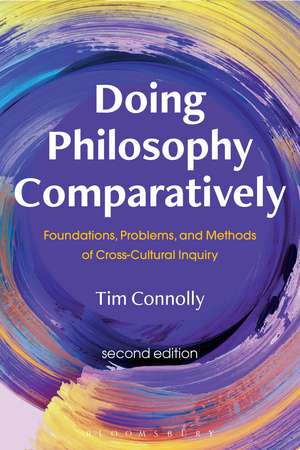
Doing Philosophy Comparatively: Foundations, Problems, and Methods of Cross-Cultural Inquiry
Autor Tim Connollyen Limba Engleză Paperback – 26 ian 2023
Doing Philosophy Comparatively answers these questions by providing a thorough overview of the methodology involved in extending philosophy across linguistic and cultural boundaries.
Now revised and updated to showcase the most recent developments in the field, this second edition engages with philosophies beyond the Anglo-European tradition and features:
· Examples of cross-cultural philosophy from a wider range of non-Western traditions
· Methodological innovations from works of comparative philosophy published in the last decade
· Focused exercises for each chapter demonstrating how to interact meaningfully with primary texts and engage with recent debates in comparative philosophy
· Updated discussion questions and readings
Introducing the main problems, methods, and approaches of comparative philosophy, this new edition shows you how to make informed cross-cultural judgments through reflection and practice. It remains an essential toolkit for the practice of doing comparative philosophy.
Preț: 147.70 lei
Preț vechi: 183.51 lei
-20%
Puncte Express: 222
Carte disponibilă
Livrare economică 09-23 noiembrie
Livrare express 24-30 octombrie pentru 67.70 lei
Livrare prin curier în România Termenul estimat este afișat lângă disponibilitate.
Transport gratuit de la 400.00 lei Plată online sau ramburs, în funcție de opțiunile comenzii.
Retur gratuit în 14 zile Comandă securizată și suport în română.
Specificații
ISBN-13: 9781350177543
ISBN-10: 1350177547
Pagini: 312
Dimensiuni: 156 x 232 x 24 mm
Greutate: 0.48 kg
Ediția:2
Editura: Bloomsbury Publishing
Colecția Bloomsbury Academic
Locul publicării:London, United Kingdom
ISBN-10: 1350177547
Pagini: 312
Dimensiuni: 156 x 232 x 24 mm
Greutate: 0.48 kg
Ediția:2
Editura: Bloomsbury Publishing
Colecția Bloomsbury Academic
Locul publicării:London, United Kingdom
V-ar putea interesa
-
 Preț: 89.33 lei
 -
 -16%Preț: 99.98 lei118.88 lei
 -
 -19%Preț: 355.18 lei437.64 lei
 -
 -31%Preț: 667.43 lei964.06 lei
 -
 Wittgenstein, Finitism, and the Foundations of MathematicsMathieu Marion-21%Preț: 397.75 lei506.43 lei
 -
 -31%Preț: 660.24 lei959.69 lei
 -
 Preț: 61.37 lei
 -
 The Subject's Point of ViewKatalin Farkas-13%Preț: 300.04 lei345.53 lei
 -
 A Short History of Western Political ThoughtW. M. SpellmanPreț: 241.13 lei
 -
 Logicomix: An epic search for truthApostolos Doxiadis-21%Preț: 102.01 lei129.25 lei
 -
 EntreEmmanuel Levinas-42%Preț: 133.62 lei230.00 lei
 -
 Logics of Worlds: Being and Event IIAlain Badiou-36%Preț: 280.05 lei437.04 lei
 -
 Theory of the SubjectAlain Badiou-37%Preț: 278.06 lei440.19 lei
 -
 Gottfried Wilhelm LeibnizMarcelo Dascal-18%Preț: 1385.40 lei1689.52 lei
 -
 On Resistance: A Philosophy of DefianceHoward Caygill-40%Preț: 99.51 lei166.54 lei
 -
 Starting with KantDr Andrew Ward-22%Preț: 161.01 lei206.65 lei
 -
 The Hellenistic Stoa: Political Thought and ActionAndrew Erskine-11%Preț: 324.63 lei364.65 lei
Cuprins
List of Tables
Acknowledgements
Introduction
How this Book Works
Part I. The Nature of Comparative Philosophy
1. Is There Such a Thing as Comparative Philosophy?
The Legitimacy of "non-Western philosophy"
What is "philosophy" in comparative philosophy?
The "Comparative" Aspect
Conclusion
2. The Goals of Comparison
A First Look at the Two Dimensions
The Interpretive Dimension: Comparing to Understand
The Constructive Dimension: Comparing to Make
Philosophical Progress
Conclusion
3. The Role of Tradition and Culture
Tradition and Philosophy
Culture
Which Traditions?
Conclusion
Part II. The Problems of Comparative Philosophy
4. Linguistic Incommensurability
Background on the Term
The Linguistic Relativity Thesis
Understanding Other Languages
Issues for Comparative Philosophers
Conclusion
5. Foundational and Evaluative Incommensurability
Foundational Incommensurability
Evaluative Incommensurability
Conclusion
6. One-Sidedness
The Meaning of One-sidedness
Avoiding One-sidedness
Conclusion
7. Generalization
Cultural Essentialism
The Generalizations Debate
Generalizations and Evidence
Conclusion
Part III. Approaches to Comparison
8. Universalism
Varieties of Universalism
Challenges and Criticisms
Conclusion
9. Pluralism
The Case for Pluralism
Criticism and Evaluation
Conclusion
10. Consensus
Consensus in Theory and Practice
Evaluating the Consensus Approach
Conclusion
11. Global Philosophy
The Challenge of Global Philosophy
External Criticism
Global Problem-Solving
Conclusion
Part IV: The Practice of Comparative Philosophy
12. Study and Teaching Resources for Doing Philosophy Comparatively
Exercises
Suggested Readings
Further Questions for Discussion
Conclusion
Notes
Bibliography
Index
Acknowledgements
Introduction
How this Book Works
Part I. The Nature of Comparative Philosophy
1. Is There Such a Thing as Comparative Philosophy?
The Legitimacy of "non-Western philosophy"
What is "philosophy" in comparative philosophy?
The "Comparative" Aspect
Conclusion
2. The Goals of Comparison
A First Look at the Two Dimensions
The Interpretive Dimension: Comparing to Understand
The Constructive Dimension: Comparing to Make
Philosophical Progress
Conclusion
3. The Role of Tradition and Culture
Tradition and Philosophy
Culture
Which Traditions?
Conclusion
Part II. The Problems of Comparative Philosophy
4. Linguistic Incommensurability
Background on the Term
The Linguistic Relativity Thesis
Understanding Other Languages
Issues for Comparative Philosophers
Conclusion
5. Foundational and Evaluative Incommensurability
Foundational Incommensurability
Evaluative Incommensurability
Conclusion
6. One-Sidedness
The Meaning of One-sidedness
Avoiding One-sidedness
Conclusion
7. Generalization
Cultural Essentialism
The Generalizations Debate
Generalizations and Evidence
Conclusion
Part III. Approaches to Comparison
8. Universalism
Varieties of Universalism
Challenges and Criticisms
Conclusion
9. Pluralism
The Case for Pluralism
Criticism and Evaluation
Conclusion
10. Consensus
Consensus in Theory and Practice
Evaluating the Consensus Approach
Conclusion
11. Global Philosophy
The Challenge of Global Philosophy
External Criticism
Global Problem-Solving
Conclusion
Part IV: The Practice of Comparative Philosophy
12. Study and Teaching Resources for Doing Philosophy Comparatively
Exercises
Suggested Readings
Further Questions for Discussion
Conclusion
Notes
Bibliography
Index
Recenzii
An excellent starting point for anyone interested in the field of comparative philosophy [...] Tim Connolly has established a benchmark for the study of comparative philosophy [...] by offering a clear summary of the key issues and by providing a platform for nurturing future philosophers to think beyond their localized perspectives.
The author faces the topics [in this book] in a concise but thought-provoking manner ... [and] outlines the discipline in an exciting way ... [A] vibrant introduction to comparative philosophy.
In this well-written, jargon-free textbook, Connolly sensitively addresses the worthiness and significance of comparative philosophy while also acknowledging the difficulties that arise from a comparative approach [.] Each of the 11 chapters concludes with rich suggested readings and discussion questions that will serve well in classroom settings. This volume marks an extraordinary step forward in comparative philosophy, and this reviewer knows of no better guidebook. An invaluable resource for those pursuing a career in comparative philosophy. Summing Up: Highly recommended.
This book's well-argued defense of comparative philosophy and illuminating discussions of its challenges and problems, as well as different comparative approaches, will provide invaluable resources for teaching and learning how to philosophize across cultural boundaries. Students will find the chapter-by-chapter exercises added to this new edition particularly helpful.
This book's lucid organization, engaging and accessible prose, and balanced presentation of competing views makes it the ideal introduction to comparative philosophy.
An excellent introduction to comparative philosophy, but it also serves as a wonderful pedagogical tool for a research and methods course. The text is clear, well-organized, and most importantly philosophically interesting.
The author faces the topics [in this book] in a concise but thought-provoking manner ... [and] outlines the discipline in an exciting way ... [A] vibrant introduction to comparative philosophy.
In this well-written, jargon-free textbook, Connolly sensitively addresses the worthiness and significance of comparative philosophy while also acknowledging the difficulties that arise from a comparative approach [.] Each of the 11 chapters concludes with rich suggested readings and discussion questions that will serve well in classroom settings. This volume marks an extraordinary step forward in comparative philosophy, and this reviewer knows of no better guidebook. An invaluable resource for those pursuing a career in comparative philosophy. Summing Up: Highly recommended.
This book's well-argued defense of comparative philosophy and illuminating discussions of its challenges and problems, as well as different comparative approaches, will provide invaluable resources for teaching and learning how to philosophize across cultural boundaries. Students will find the chapter-by-chapter exercises added to this new edition particularly helpful.
This book's lucid organization, engaging and accessible prose, and balanced presentation of competing views makes it the ideal introduction to comparative philosophy.
An excellent introduction to comparative philosophy, but it also serves as a wonderful pedagogical tool for a research and methods course. The text is clear, well-organized, and most importantly philosophically interesting.