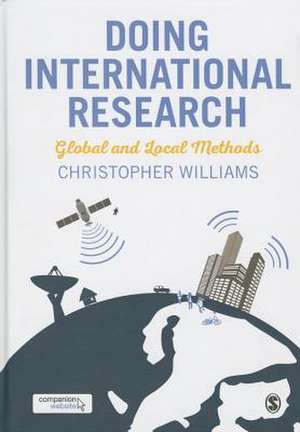
Doing International Research
Autor Christopher Williamsen Limba Engleză Hardback – 15 mai 2015
Williams introduces a range of frameworks, from desk-based studies and traditional ethnography to the use of internet, satellites, robots, drones and ‘big data’, and provides exciting, interdisciplinary examples. This book is presented in a clear international style and uses creative approaches to researching peoples, places and world systems.
It explains:
- desk-based research using international data including documentaries, museum objects, archives, data-sets and working with groups such as refugees, tourists and migrants
- distance research using online videos, surveys and remote methods such as video conferencing and crowdsourcing
- fieldwork abroad, including ethnography, street observation and mapping.
For Students
- Weblinks for each chapter
- Examples/summaries/templates related to text marked with
- Additional thinking zones
- An overview of data capture technologies
- Copies of all the figures and thinking zones for use in teaching material
- PowerPoint slides for each chapter
Preț: 1188.59 lei
Preț vechi: 1628.20 lei
-27%
Carte tipărită la comandă
Livrare economică 21 noiembrie-05 decembrie
Specificații
ISBN-10: 1446273482
Pagini: 344
Dimensiuni: 175 x 250 x 23 mm
Greutate: 0.75 kg
Ediția:1
Editura: SAGE Publications Ltd
Locul publicării:London, United Kingdom
V-ar putea interesa
-
 A Cultivated ReasonChristopher WilliamsPreț: 269.73 lei
 -
 Longitudinal Data AnalysisCatrien C. J. H. Bijleveld-18%Preț: 834.86 lei1018.13 lei
 -
 Expert SystemsRobert Alfred BenferPreț: 318.88 lei
 -
 Evaluating Medical TestsHelena Chmura Kraemer-5%Preț: 948.53 lei998.45 lei
 -
 Theory Driven EvaluationsHuey-Tsyh Chen-15%Preț: 633.81 lei745.65 lei
 -
 -15%Preț: 529.74 lei623.22 lei
 -
 Qualitative InterviewingHerbert J. Rubin-15%Preț: 635.85 lei748.06 lei
 -
 Longitudinal Data Analysis for the Behavioral Sciences Using RJeffrey D. Long-27%Preț: 942.96 lei1291.72 lei
 -
 Visualizing Social Science ResearchJohannes Wheeldon-15%Preț: 446.34 lei525.11 lei
 -
 Conducting Online SurveysValerie M. Sue-15%Preț: 615.32 lei723.91 lei
 -
 Introduction to Educational ResearchW. Newton Suter-27%Preț: 1106.93 lei1516.34 lei
 -
 Projects in Linguistics and Language StudiesAlison WrayPreț: 416.74 lei
 -
 Focus Group MethodologyPranee Liamputtong-8%Preț: 419.69 lei456.19 lei
 -
 Using Narrative in ResearchChristine BoldPreț: 438.82 lei
 -
 Assessing the Quality of Survey DataJörg Blasius-18%Preț: 682.62 lei832.46 lei
 -
 Preț: 494.87 lei
 -
 Qualitative Data Analysis Using a Dialogical ApproachPaul SullivanPreț: 494.36 lei
Recenzii
Cuprins
Chapter 1: Understanding world knowledge
Chapter 2: Theories and concepts in world research
Chapter 3: Searching and reviewing world literature
PART TWO: PLANNING THE STUDY
Chapter 4: Research design and logistics
Chapter 5: Research ethics and integrity
Chapter 6: Choosing research frameworks
PART THREE: DOING THE RESEARCH
Chapter 7: Data management
Chapter 8: Researching people
Chapter 9: Researching populations
Chapter 10: Researching places
Chapter 11: Mapping places
Chapter 12: Analysing world systems
Chapter 13: Analysing official documents
PART FOUR: USING THE FINDINGS
Chapter 14: Further analysis
Chapter 15: Reporting the research
Notă biografică
Christopher Williams (AGSM, PhD, FRSA) is an independent academic, and visiting Fellow at the University of London (Institute of Education). He has also held posts at the universities of Bristol (Medical School), Birmingham (College of Social Science), Cairo (Conservatoire of Music), Cambridge (Global Security Programme), London (Education and Development), and the United Nations (Leadership Academy).
Originally a professional trumpeter, his international interests started with a student visit to USSR in 1972 (without his parents' knowledge), across the Berlin Wall to Warsaw Pact countries in 1973, and then to Communist China. From 1980, he worked at Cairo University, to replace Soviet staff thrown-out in response to the Russian occupation of Afghanistan, and experienced the assassination of Sadat and dictatorship of Mubarak. He then broke boycotts to work in apartheid South African, setting up projects for street children. Later he joined the United Nations Leadership Academy in Jordan, but had to leave during the build-up to the US/UK occupation of Iraq.
His other books include Researching Power, Elites and Leadership (Sage); Leadership Accountability in a Globalizing World; Environmental Victims - New Risks, New Injustice; Invisible Victims - Crime and Abuse against People with Learning Disabilities; Terminus Brain - The Environmental Threat to Human Intelligence. He has written for the Times Higher, Korea Herald and China Daily, and has discussed his research on BBC TV and radio, government TV in Kazakhstan and Korea, and at the British House of Commons and UN Palais des Nations.