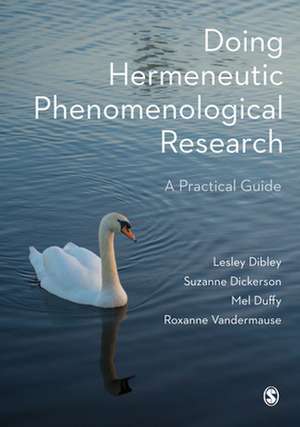
Doing Hermeneutic Phenomenological Research
Autor Lesley Dibley, Suzanne Dickerson, Mel Duffyen Limba Engleză Paperback – 21 oct 2020
The book maps the complete research process and shows how to apply key philosophical tenets to your project, demonstrating the close relationship between philosophy and research practice. It:
- Shows step-by-step how to translate philosophy into research methodology and turn methodology into robust research design
- Focuses on applied practice, illustrating theoretical discussions with examples and case studies
- Promotes advanced thinking about hermeneutic phenomenology in an easy to understand way
- Highlights the need for researchers to engage reflexively with the whole research process.
| Toate formatele și edițiile | Preț | Express |
|---|---|---|
| Paperback (1) | 385.90 lei 6-8 săpt. | +34.15 lei 6-10 zile |
| SAGE Publications – 21 oct 2020 | 385.90 lei 6-8 săpt. | +34.15 lei 6-10 zile |
| Hardback (1) | 864.87 lei 6-8 săpt. | +110.95 lei 6-10 zile |
| SAGE Publications – 21 oct 2020 | 864.87 lei 6-8 săpt. | +110.95 lei 6-10 zile |
Preț: 385.90 lei
Puncte Express: 579
Preț estimativ în valută:
68.18€ • 78.35$ • 59.06£
68.18€ • 78.35$ • 59.06£
Carte tipărită la comandă
Livrare economică 06-20 mai
Livrare express 31 martie-04 aprilie pentru 44.14 lei
Specificații
ISBN-13: 9781526485724
ISBN-10: 1526485729
Pagini: 232
Dimensiuni: 170 x 244 x 13 mm
Greutate: 0.41 kg
Ediția:1
Editura: SAGE Publications
Locul publicării:London, United Kingdom
ISBN-10: 1526485729
Pagini: 232
Dimensiuni: 170 x 244 x 13 mm
Greutate: 0.41 kg
Ediția:1
Editura: SAGE Publications
Locul publicării:London, United Kingdom
Recenzii
A book qualitative researchers have long waited for! This text concisely explains how to do hermeneutic phenomenological research. Drawing on Heidegger, Gadamer and the phenomenological movement, and rooted in a distinctively interpretive paradigm, the authors' methodology is interested in understanding people’s perception of meanings, their views and lived experience. The book leads readers through the research process, from the refinement of the research question, literature review, data collection, interviewing and data analysis to reflexivity, research ethics and dissemination. It is a practical guide, immensely useful both for novice and experienced researchers in healthcare and beyond.
Phenomenological philosophy is often perceived as a lofty and verbally verbose form of learning, without practical value or merit. However, reading this book certainly puts paid to that illusion. The practical topics of research that these active researchers explore are so humanly psychological, dealing with socially pressing themes that require better understanding. These pragmatic writers give meaning to the idea that ‘faith without works is dead.’ They translate their philosophical vision for health and social science to deeds; there is a recognition of the unevenness of the world environs and the book is driven by a desire to improve things.
By sharing the how and the what of their collective research, they offer a very transparent kaleidoscope into how hermeneutic phenomenological methodology and method are realised as one. If you are a researcher with a passion for your subject matter, the authors of the book have done a magnificent job in demonstrating how we can translate research passion into realisable intentions for making it happen.
Phenomenological philosophy is often perceived as a lofty and verbally verbose form of learning, without practical value or merit. However, reading this book certainly puts paid to that illusion. The practical topics of research that these active researchers explore are so humanly psychological, dealing with socially pressing themes that require better understanding. These pragmatic writers give meaning to the idea that ‘faith without works is dead.’ They translate their philosophical vision for health and social science to deeds; there is a recognition of the unevenness of the world environs and the book is driven by a desire to improve things.
By sharing the how and the what of their collective research, they offer a very transparent kaleidoscope into how hermeneutic phenomenological methodology and method are realised as one. If you are a researcher with a passion for your subject matter, the authors of the book have done a magnificent job in demonstrating how we can translate research passion into realisable intentions for making it happen.
Cuprins
Part I: Philosophy and thinking
Chapter 1: Philosophical perspectives
Chapter 2: Coming to thinking
Part II: Designing the hermeneutic phenomenology study
Chapter 3: Literature review and refining the hermeneutic research question
Chapter 4: Population and sampling
Chapter 5: Being ethical
Part III: Delivering the hermeneutic phenomenology study
Chapter 6: Data collection and management
Chapter 7: Data analysis and interpretation
Chapter 8: Reflexivity and rigour
Chapter 9: Writing and dissemination
Part IV: Personal entrees into hermeneutic phenomenology
Chapter 1: Philosophical perspectives
Chapter 2: Coming to thinking
Part II: Designing the hermeneutic phenomenology study
Chapter 3: Literature review and refining the hermeneutic research question
Chapter 4: Population and sampling
Chapter 5: Being ethical
Part III: Delivering the hermeneutic phenomenology study
Chapter 6: Data collection and management
Chapter 7: Data analysis and interpretation
Chapter 8: Reflexivity and rigour
Chapter 9: Writing and dissemination
Part IV: Personal entrees into hermeneutic phenomenology
Notă biografică
Lesley Dibley is Reader in Nursing Research and Education, who also leads the Centre for Chronic Illness and Ageing in the Institute for Lifecourse Development at the University of Greenwich, London, United Kingdom. She was awarded her PhD in 2014 for an interpretive phenomenology study of the experience of stigma in people with inflammatory bowel disease (IBD), has recently completed another funded project on the experience of kinship (family) stigma in IBD and has other active projects including an exploration of the experiences of young adults living with long fusion for idiopathic scoliosis, the experience of adjustment to intestinal stoma in people with IBD, and complex care needs of older people with IBD. Lesley teaches qualitative methods to undergraduates, phenomenology theory to postgraduates, and supervises Masters and PhD students. She publishes regularly in high impact international journals and presents at national and international conferences.
Descriere
This practical guide offers an approachable introduction to doing hermeneutic phenomenological research across the health and social sciences.