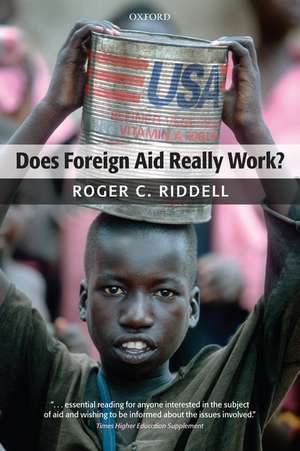
Does Foreign Aid Really Work?
Autor Roger C. Riddellen Limba Engleză Paperback – 7 aug 2008
Preț: 290.11 lei
Puncte Express: 435
Carte disponibilă
Livrare economică 19-24 noiembrie
Livrare prin curier în România Termenul estimat este afișat lângă disponibilitate.
Transport gratuit de la 400.00 lei Plată online sau ramburs, în funcție de opțiunile comenzii.
Retur gratuit în 14 zile Comandă securizată și suport în română.
Specificații
ISBN-13: 9780199544462
ISBN-10: 0199544468
Pagini: 536
Ilustrații: black & white illustrations, black & white tables, figures
Dimensiuni: 156 x 234 x 27 mm
Greutate: 0.82 kg
Ediția:New edition.
Editura: Oxford University Press
Colecția OUP Oxford
Locul publicării:Oxford, United Kingdom
ISBN-10: 0199544468
Pagini: 536
Ilustrații: black & white illustrations, black & white tables, figures
Dimensiuni: 156 x 234 x 27 mm
Greutate: 0.82 kg
Ediția:New edition.
Editura: Oxford University Press
Colecția OUP Oxford
Locul publicării:Oxford, United Kingdom
V-ar putea interesa
-
 -18%Preț: 82.36 lei100.49 lei
 -
 Toxic Aid: Economic Collapse and Recovery in TanzaniaSebastian Edwards-30%Preț: 589.40 lei840.89 lei
 -
 -16%Preț: 100.14 lei118.83 lei
 -
 -31%Preț: 854.23 lei1240.23 lei
 -
 Humanitarian InterventionThomas G WeissPreț: 133.97 lei
 -
 Hope in HellDan BortolottiPreț: 130.72 lei
 -
 -23%Preț: 926.72 lei1209.80 lei
 -
 -25%Preț: 196.16 lei261.23 lei
 -
 An Imperfect OfferingJames Orbinski-19%Preț: 98.55 lei121.72 lei
 -
 Engineering in EmergenciesJan DavisPreț: 416.92 lei
 -
 Aid, NGOs and the Realities of Women's LivesTina WallacePreț: 232.41 lei
Recenzii
'...[an] excellent and significant book...'
'...essential reading for anyone interested in the subject of aid and wishing to be informed about the issues involved.'
'Roger Riddell's text provides the single best introduction to the history and range of contemporary debates associated with foreign aid, including the rise of international NGOs as major actors and the centrality of domestic politics to shaping aid practice.'
'Riddell provides a compelling and thorough account of the intricacies of foreign aid. The strength of this book is that it establishes the positive attributes of aid without avoiding the need to critically assess its failures. Through a combination of personal experience, conceptual insight and empirical substance, Riddell demonstrates that investigating whether foreign aid works could ensure its future, rather than undermining it.'
'For anyone who wants to know more about development assistance, this is a 'must- read'. Roger Riddell provides us with a nuanced and honest outline of past and current aid-flows, their complexities, trends and possible impact. Does aid really work? His answer is a conditional, cautious - yes. And he presents some bold proposals to address some of the systemic weaknesses. It was strong international leadership that delivered the aid-reforms of the 90's. The question is whether the current leaders in development are ready for this debate?'
'This book is a heroic achievement. Not only has Roger Riddell mapped out with great clarity the arcane world of international aid, in a way that will help the practitioner as much as the general reader, he has also produced visionary and challenging recommendations for reform of the system.'
'In this impressive new study, Riddell has surpassed even his distinguished Foreign Aid Reconsidered. It includes a rare and much-needed analysis of emergency and voluntary assistance. Complete and authoritative, the book will have a long life as the definitive account of its important subject.'
'...essential reading for anyone interested in the subject of aid and wishing to be informed about the issues involved.'
'Roger Riddell's text provides the single best introduction to the history and range of contemporary debates associated with foreign aid, including the rise of international NGOs as major actors and the centrality of domestic politics to shaping aid practice.'
'Riddell provides a compelling and thorough account of the intricacies of foreign aid. The strength of this book is that it establishes the positive attributes of aid without avoiding the need to critically assess its failures. Through a combination of personal experience, conceptual insight and empirical substance, Riddell demonstrates that investigating whether foreign aid works could ensure its future, rather than undermining it.'
'For anyone who wants to know more about development assistance, this is a 'must- read'. Roger Riddell provides us with a nuanced and honest outline of past and current aid-flows, their complexities, trends and possible impact. Does aid really work? His answer is a conditional, cautious - yes. And he presents some bold proposals to address some of the systemic weaknesses. It was strong international leadership that delivered the aid-reforms of the 90's. The question is whether the current leaders in development are ready for this debate?'
'This book is a heroic achievement. Not only has Roger Riddell mapped out with great clarity the arcane world of international aid, in a way that will help the practitioner as much as the general reader, he has also produced visionary and challenging recommendations for reform of the system.'
'In this impressive new study, Riddell has surpassed even his distinguished Foreign Aid Reconsidered. It includes a rare and much-needed analysis of emergency and voluntary assistance. Complete and authoritative, the book will have a long life as the definitive account of its important subject.'
Notă biografică
Roger Riddell is a Non-Executive Director of Oxford Policy Management and a Principle of The Policy Practice. He was Chair of the first Presidential Economic Commission of Independent Zimbabwe in 1980, and Chief Economist of the Confederation of Zimbabwe Industries from 1981-83. From 1984 to 1998, he was a senior Research Fellow at the Overseas Development Institute, London and for five years to 2004 was International Director of Christian Aid.
Cuprins
- 1: 'A Good Thing?'
- Part I: The Complex Worlds of Foreign Aid
- 2: The origins and early decades of aid-giving
- 3: Aid-giving from the 1970s to the present
- 4: The growing web of bilateral aid donors
- 5: The complexities of multilateral aid
- Part II: Why is Aid Given?
- 6: The political and commercial dimensions of aid
- 7: Public support for aid
- 8: Charity or duty? The moral case for aid
- 9: The moral case for governments and individuals to provide aid
- Part III: Does Aid Really Work?
- 10: Assessing and measuring the impact of aid
- 11: The impact of official development aid projects
- 12: The impact of programme aid, technical assistance and aid for capacity development
- 13: The impact of aid at the country and cross-country level
- 14: Assesing the impact of aid conditionality
- 15: Does official development aid really work? A summing up
- 16: NGOs in development and the impact of discrete NGO development interventions
- 17: The wider impact of non-governmental and civil society organizations
- 18: The growth of emergencies and the humanitarian response
- 19: The impact of emergency and humanitarian aid
- Part IV: Towards a Different Future for Aid
- 20: Why aid isn't working
- 21: Making aid work better by implementing agreed reforms
- 22: Making aid work better by recasting aid relationships