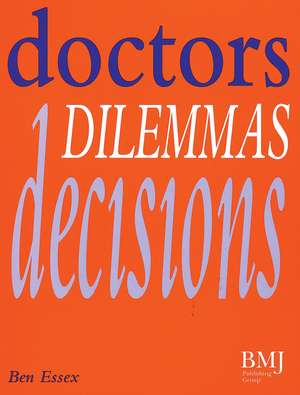
Doctors, Dilemmas, Decisions
Autor Ben Essexen Limba Engleză Paperback – dec 1994
This first book on decision making in general practice is an invaluable reference for all concerned with providing quality care. Using over 200 real life cases, it analyses the difficulties arising in:
Diagnosis, investigation, management, follow up, outcome, prevention, practice organization.
A body of rules that can be applied to these wide ranging issues provides a framework to improve decision making skills in ways that are ethical, cost-effective, safe, and acceptable for GPs, trainees, trainers and medical students. Here is an essential guide to understanding this critical element of general practice.
Preț: 577.40 lei
Preț vechi: 607.79 lei
-5%
Puncte Express: 866
Carte tipărită la comandă
Livrare economică 07-21 decembrie
Livrare prin curier în România Termenul estimat este afișat lângă disponibilitate.
Transport gratuit pentru acest produs Plată online sau ramburs, în funcție de opțiunile comenzii.
Retur gratuit în 14 zile Comandă securizată și suport în română.
Specificații
ISBN-13: 9780727908599
ISBN-10: 0727908596
Pagini: 316
Dimensiuni: 189 x 246 x 17 mm
Greutate: 0.61 kg
Editura: Wiley
Locul publicării:Chichester, United Kingdom
ISBN-10: 0727908596
Pagini: 316
Dimensiuni: 189 x 246 x 17 mm
Greutate: 0.61 kg
Editura: Wiley
Locul publicării:Chichester, United Kingdom
V-ar putea interesa
-
 -24%Preț: 453.30 lei600.30 lei
-
 The Ethics of Transplants: Why Careless Thought Costs LivesJanet Radcliffe Richards-19%Preț: 126.78 lei156.17 lei
-
 Careless Thought Costs Lives: The Ethics of TransplantsJanet Radcliffe Richards-16%Preț: 124.82 lei148.26 lei
-
 The Future of Bioethics: International DialoguesAkira Akabayashi-24%Preț: 851.65 lei1114.10 lei
-
 -24%Preț: 602.74 lei795.94 lei
-
 -32%Preț: 765.12 lei1119.63 lei
-
 -25%Preț: 767.01 lei1017.30 lei
-
 -16%Preț: 934.82 lei1112.43 lei
-
 Ethics Field Guide: Applications to Rehabilitation PsychologyThomas R. Kerkhoff-31%Preț: 480.57 lei692.94 lei
-
 -5%Preț: 201.17 lei211.75 lei
-
 Ethics in Speech and Language TherapyRichard Body-8%Preț: 445.05 lei483.76 lei
-
 Quality of LifeAlison Carr-5%Preț: 408.40 lei429.89 lei
-
 Everyday Medical Ethics and LawBma Medical Ethics Department-5%Preț: 348.33 lei366.67 lei
-
 PsychosurgeryMarc Lévêque-21%Preț: 620.00 lei785.86 lei
-
 Handbook of Global BioethicsHenk A. M. J. Ten Have-18%Preț: 3223.45 lei3931.03 lei
Public țintă
GPs, trainees, trainers, medical students, lecturersNotă biografică
Ben Essex is the author of Doctors, Dilemmas, Decisions, published by Wiley.
Cuprins
Foreword.
Preface.
Acknowledgements..
I. Decision analysis.
1. Introduction.
2. Classification of decisions.
3. Evaluation of rules.
4. Study decisions in general practice.
5. Factors and pathways.
6. Training.
7. Sharing decisions..
II. Specific decisions.
8. Diagnosis.
9. Investigations.
10. Objectives.
11. Management options.
12. Indications.
13. Follow up and outcomes.
14. Prevention..
III. Special problems.
15. Decisions about children.
16. HIV/AIDS.
17. Mental illness.
18. Violence.
19. Communicating decisions.
20. Requests.
21. Mistakes..
IV. Organisation.
22. Practice staff.
23. Referral decisions.
24. Responsibilities.
25. Protocols and policies.
26. Decisions and the district nurse.
27. Waiting lists..
V. Specific factors.
28. Acceptability.
29. Compliance.
30. Confidentiality.
31. Consent.
32. Culture.
33. Risk.
34. Urgency.
35. Social problems.
36. Conclusion.